

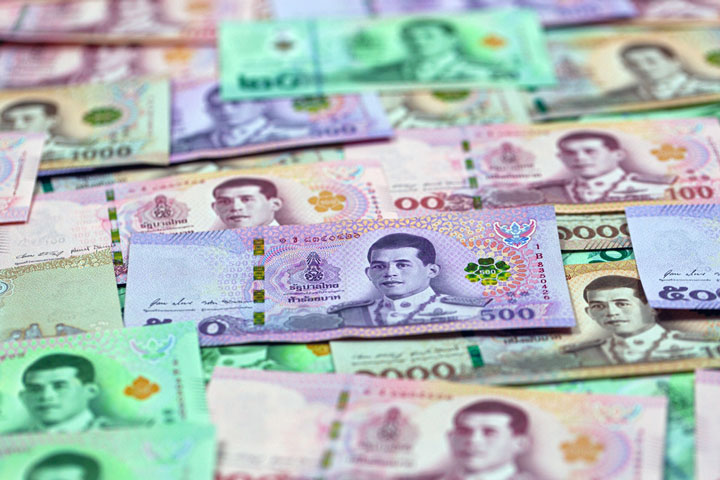
The Thai government is opting for a drastic financial measure as pressure on public finances mounts rapidly. Deputy Prime Minister Pakorn Nilprapunt announced that Bangkok is preparing an emergency decree to borrow up to 500 billion baht. That money is to be used to address economic problems.
According to the government, the step is necessary due to a tight cash position and an accumulation of external risks. These include international economic uncertainty, rising pressure on energy supplies, and environmental factors that make Thailand's economy particularly vulnerable.
Emergency decree must create financial room
The government wants to be able to act quickly with a special emergency decree. According to Deputy Prime Minister Pakorn, this does not automatically mean that Thailand will actually borrow the full amount of 500 billion baht. The main point is that the law provides sufficient scope to borrow up to that amount, should it prove necessary.
This immediately raises a second sensitive point. The rules regarding national debt require the government to align the debt ceiling with the maximum amount legally permitted. If the emergency decree allows 500 billion baht, the government must therefore also ensure that the debt ceiling is high enough to cover that amount.
National debt approaches current limit
Thailand's national debt is already close to the current limit. That debt currently amounts to approximately 66 percent of gross domestic product. This brings the country close to the existing ceiling of 70 percent. If Bangkok wants to borrow extra, raising that limit is therefore the obvious course of action.
Finance Minister Ekniti Nitithanprapas previously stated that the debt ceiling can be raised if circumstances warrant. The Ministry of Finance will ultimately determine exactly where that new limit will be set. This underscores just how limited Thailand's budgetary room for maneuver has become.
Government refers to previous crisis approach
For Thailand, this is not an entirely new instrument. During the coronavirus pandemic, the government also made use of a similar lending decision to support the economy. The reference to that period shows that Bangkok considers the current situation serious enough to resort to exceptional financial resources again.
The background is broader than just domestic growth. Thailand is sensitive to external shocks, including those triggered by energy prices, trade, and tourism. If that pressure coincides with climate-related issues or other disruptions, an open economy like Thailand's can quickly find itself in serious trouble. The government therefore wants to keep financial reserves in reserve.
The 2027 budget must be tighter and more frugal.
At the same time, the government is working on the budget for the 2027 fiscal year, which begins on October 1. Prime Minister Anutin Charnvirakul outlined the broad strokes for this preparation on Monday. The emphasis is on cutting non-essential spending and limiting budget increases in order to better manage financial risks.
The Cabinet already approved a budget plan of 3,788 trillion baht in November. This provides for an increase in spending of 0,2 percent and a decrease in the budget deficit of 8,37 percent compared to the current fiscal year. The proposal will go to the Cabinet on June 23 and will subsequently be discussed in the House of Representatives from July 1 to 3.
Thailand is trying to solve two problems simultaneously: absorbing immediate economic pressure and keeping government finances under control. The proposed loan of 500 billion baht shows how seriously Bangkok assesses the situation. In the coming months, it will become clear how much additional debt the government is truly willing to take on.
Sources: Bangkok Post, Reuters
About this blogger

-
This article has been written and reviewed by the editorial team. The content is based on the author's personal experiences, opinions, and independent research. Where relevant, ChatGPT was used as a tool for writing and structuring text. We also sometimes generate photos using AI. Although the content is handled with care, it cannot be guaranteed that all information is complete, up-to-date, or error-free.
The reader is responsible for the use of the information on this website. The author accepts no liability for any damage or consequences resulting from the use of the information provided.
Read the latest articles here
 Expats and retireesApril 21, 2026Divorce in Thailand: much revolves around evidence and registration
 BackgroundApril 21, 2026Dutch and Belgian citizens can also become monks in Thailand, but strict conditions apply.
 Expats and retireesApril 21, 2026Why it is important to verify a Chanote title in Thailand for the purchase of a condominium or land
 Expats and retireesApril 21, 2026Home care in Thailand for Western seniors: growing market without quality certification
Funny to read this. It is not only the Thai people who are loan-sick but also their government.
If you don't have money, get it somewhere else instead of looking for structural solutions.
If those gigantic debts can no longer be repaid soon, a different team will already be in power, and the mistakes will be blamed on the previous government. Apparently, it is the same scenario everywhere.
As in many countries, paper is patient.
No one will lose sleep over a higher debt ceiling.
That is for later generations, who will then have something to say about it.