

Bangkok still looks down on people from Isaan
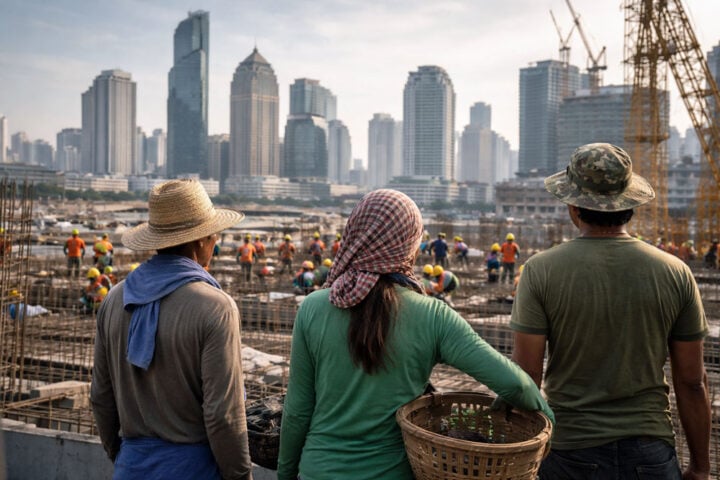
When speaking about the Isaan in Thailand, one rarely discusses only a region. Often, the conversation also touches upon status, origin, language, education, and money. Precisely for this reason, this subject touches upon something larger: the question of who is perceived as modern, developed, and fully-fledged in Thailand, and who is at a disadvantage.
The tension between Bangkok and the Northeast has developed historically and continues to impact daily life in 2026. Not every resident of Bangkok thinks this way, but prejudices regarding accent, skin color, class, profession, and political preference remain visible. At the same time, appreciation for Isaan culture and pride is growing.
An old power dynamic between center and region
The relationship between Bangkok and the Isaan has historically developed unequally. As Siam began to organize itself more centrally, the northeast was increasingly brought under the norm of the center in administrative, cultural, and linguistic terms. In the process, the Lao-related background of many inhabitants faded into the background, while Bangkok determined what constituted the correct national identity. Consequently, the Isaan was viewed not only as a distant region but also as an area that still needed to be developed and corrected.
That past is important because it explains why the subject today goes beyond mere insults or crude jokes. The lower status of the Isaan in Thailand has long been linked to state formation, language politics, and a hierarchy in which Bangkok was the standard. Anything that deviated from that norm was more readily perceived as provincial, less refined, or less modern.
Class, origin, language, and appearance intertwine.
The social distance between Bangkok and the Isaan is also economically visible. Bangkok is much wealthier than the Northeast, and this difference is reflected in income, education, opportunities, and standard of living. In the Isaan, poverty is higher, average income is lower, and access to higher education is less self-evident. As a result, in practice, Isaan is often perceived not only as a geographical origin but also as a social label associated with low status.
Other characteristics are added on top of that. In Thailand, prestige and credibility are often linked to the way you speak, how you dress, where you come from, the work you do, and your level of education. Skin color also plays a role, as dark skin is still often associated with outdoor work, poverty, and a lower social position. For people from Isaan, these perceptions reinforce each other. The region is then seen not only as poor, but also as less chic, less urban, and less important.

Language and accent often say more than words in Thailand.
Language is one of the most sensitive points in this matter. Isaan is often officially treated as a regional Thai language, but is culturally and linguistically close to Lao. In practice, Standard Thai has much more prestige. Those with a strong Isaan accent are more likely to be perceived as less educated, less refined, or less suitable for positions where representation and status matter. This is particularly the case in schools, government offices, hospitals, businesses, and other formal environments.
As a result, many people from Isaan realize at a young age that language is not neutral. Parents sometimes consciously choose to speak more Standard Thai at home so that children do not suffer a disadvantage from their accent later in life. In daily life, this leads to adaptation, embarrassment, or the feeling that one must correct oneself to be taken seriously. Officially, everyone is equal, but in social practice, the language of Bangkok still carries more weight than the language of the region.
Migration to Bangkok has reinforced the stereotype
Internal migration has further sharpened the perception. For years, many people moved from Isaan to Bangkok and the central region to earn money. They often ended up in low-paid and physically demanding jobs, such as construction, transport, domestic work, hospitality, factory work, and informal labor. This provided many families in Isaan with income and new opportunities, but it also made the region particularly visible in Bangkok as a supplier of labor at the bottom of the labor market.
This created a persistent link between Isaan and low-status work. Those from the Northeast were more readily viewed as laborers, service providers, or powerless migrants. That stereotype permeated how people were addressed, the expectations held about them, and how they were portrayed in media and popular culture. The reality is, of course, much broader. Isaan has also produced teachers, entrepreneurs, civil servants, artists, academics, and political leaders. Yet, it was precisely the image of the poor migrant that remained dominant for a long time.
Where do you see discrimination and stereotyping concretely reflected?
Negative perception is not merely a feeling, but becomes visible in multiple domains. It is by no means always about overt exclusion. Often, it operates more subtly, through tone, assumptions, selection, and social interaction. You see it in these areas, among others:
- on the labor market, where accent, background, and presentation can influence how seriously someone is taken;
- in education, where Standard Thai is the norm and regional languages have less status;
- in the media, where Isaan characters were often portrayed as comical, simple, or subordinate;
- in politics, where voters from Isaan have regularly been portrayed as easily manipulated;
- in daily life, through jokes, condescending remarks, and low expectations regarding intelligence or sophistication.
| Part | How it is visible | Why it counts |
|---|---|---|
| Work | More appreciation for Bangkok speaking style and presentation | Influences opportunities and status |
| Education | Regional languages have less prestige | Children learn early what counts as “neat” |
| Media | Stereotypical roles of stupid, poor or submissive | Confirms existing prejudices |
| Politics | Isaan voters are more quickly dismissed as bizable. | Undervalues political autonomy |
| Daily life | Jokes about accent, origin, and behavior | Makes disadvantage socially normal |
For many people from Isaan, the pain lies precisely in that last point. Not just in policy or figures, but in small humiliations that accumulate. An accent is mimicked. Someone is automatically judged lower. A job applicant feels that he has to present himself twice as politely to receive the same respect.
Official equality is not the same as social equality
On paper, discrimination is prohibited in Thailand and there is formal equality. In practice, however, this does not mean that old hierarchies have disappeared. There is a major gap between law and reality. The social logic of Bangkok as a center of power, money, language, and cultural norms still persists. As a result, people can be legally equal yet still be treated unequally socially.
That also holds true in 2026. There is no strong, recent national poll that shows exactly how many residents of Bangkok think negatively about the Isaan. One must therefore be cautious with that. What is clear, however, is that the underlying factors still exist: regional inequality, language hierarchy, status thinking, color bias, and a long media history of stereotyping. At the same time, there are changes. Isaan culture is more visible, receives more appreciation, and is celebrated more emphatically in music, food, and regional pride. That helps, but cultural appreciation is not yet full social equality.
Less self-evident, but not yet disappeared
The image of the Isaan in Thailand has changed, but not resolved. Speaking openly disparagingly about people from the northeast is less commonplace than it used to be, especially in younger, urban, and more creative environments. Yet the old patterns have not disappeared. Anyone who looks closely will see that class, language, income, and origin still weigh heavily in how someone is judged.
Therefore, the core of the answer is quite clear. Discrimination against people from Isaan still exists today, primarily as social inferiority, stereotyping, and unequal opportunities. The most severe causes are the historical power dynamic with Bangkok, the economic divide, and the persistent link between language, class, and status.
Sources: World Bank, The Asia Foundation, The Isaan Record, World Justice Project, OHCHR, Bangkok Post, Thailand PRD
About this blogger

-
This article has been written and reviewed by the editorial team. The content is based on the author's personal experiences, opinions, and independent research. Where relevant, ChatGPT was used as a tool for writing and structuring text. We also sometimes generate photos using AI. Although the content is handled with care, it cannot be guaranteed that all information is complete, up-to-date, or error-free.
The reader is responsible for the use of the information on this website. The author accepts no liability for any damage or consequences resulting from the use of the information provided.
Read the latest articles here
 LanguageApril 20, 2026Why the English of many Thais lags behind in practice
 BackgroundApril 20, 2026Bangkok still looks down on people from Isaan
 BackgroundApril 20, 2026Thailand is increasingly opting for IPTV, but illegal providers remain a risk.
 EconomyApril 20, 2026Stagflation threatens in Thailand due to expensive energy and weak growth