

High household debt puts Thai banks under further pressure
Thai households are once again under pressure. High debt, expensive groceries, energy costs, and a slow income recovery are making it harder for many families to repay loans on time. This affects not only consumers but also banks, which must take rising risks in their credit portfolios into greater account.
According to Bloomberg Intelligence and recent figures from SCB EIC, tensions are rising further now that household debt has risen to 86,7 percent of GDP. Major banks remain profitable for the time being, but margins are under pressure. Particularly with persistently high oil prices, the quality of loans could deteriorate further and become noticeable in the coming quarters.
Households are feeling the economic pressure increasingly strongly.
The warning comes at a time when the economic recovery in Thailand remains uneven. For many households, this means a difficult combination of high debt, rising costs of living, and incomes recovering less quickly than hoped. As a result, pressure on families is increasing, and it is becoming more difficult to repay existing loans properly.
According to senior credit analyst Rena Kwok of Bloomberg Intelligence, it is precisely that combination that undermines the repayment capacity of many borrowers. New inflationary pressure could further exacerbate that problem. Household debt in Thailand has now risen to 86,7 percent of GDP. This confirms how vulnerable a large part of the domestic economy still is.
The banking sector is also being presented with the bill.
The consequences are not limited to consumers. Household tension is now impacting the balance sheets of Thai banks. While the major banks collectively posted a profit of more than 50 billion baht in the first quarter, those profits were lower year-on-year. This points to increasing headwinds due to deteriorating credit quality and higher costs.
If the oil price remains above 100 dollars per barrel for an extended period, banks may have to raise their borrowing costs by 20 to 30 basis points this year to absorb additional risks. This puts direct pressure on profitability. In addition, inflation impacts not only energy prices but also higher raw material costs and weaker consumer spending, potentially affecting loan portfolios more broadly.
Not every bank is equally vulnerable.
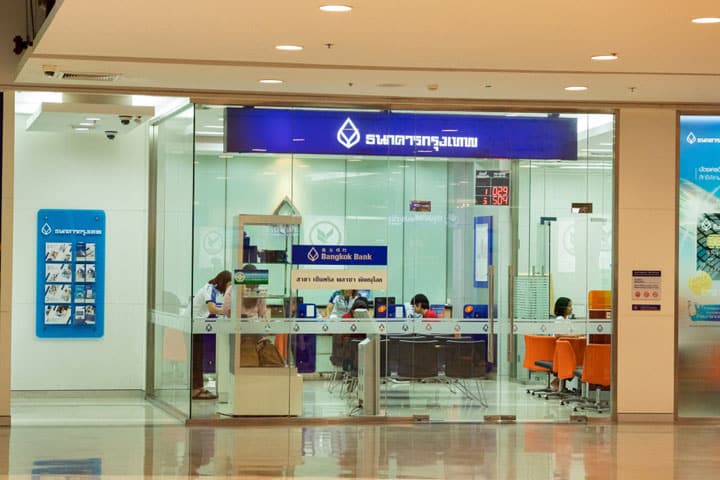
The risks are not evenly distributed across the sector. Banks with a cautious credit mix and strong buffers appear better equipped to withstand a prolonged period of economic uncertainty. Bangkok Bank is viewed as relatively strong in this regard, partly due to its large corporate loan portfolio, which accounts for approximately 49 percent of total lending, and strong provisioning coverage.
As a result, the bank has more room to absorb a deterioration in asset quality. The ratio of non-performing loans could stabilize around 3 percent. According to the analysis, Krung Thai Bank is also in a reasonably good position. That bank benefits from a large number of loans to the government and from lower exposure to SMEs, which typically run into trouble more quickly in a weaker economy.
Riskier credit portfolios call for more caution
Vulnerability is higher at other banks. Siam Commercial Bank and Kasikornbank may face higher borrowing costs precisely because they have relatively greater exposure to vulnerable groups such as SME customers and consumers with unsecured personal loans. In such segments, payment problems escalate more rapidly as economic pressure increases.
Banks have therefore already started tightening their lending conditions, particularly in the riskier segments of the market. At the same time, financial institutions are expected to continue supporting the government in assisting vulnerable borrowers. This dual role makes the coming quarters tense: banks must lend more cautiously, while simultaneously maintaining the capacity to provide targeted support to struggling customers.
Thailand therefore faces a difficult balancing act. Households feel the pressure of debt and higher costs, while banks must remain alert to rising risks. As long as external shocks persist and the recovery remains slow, debt, inflation, and credit quality will continue to determine Thailand's economic outlook.
Sources: The Nation Thailand, Bloomberg Intelligence
About this blogger

-
This article has been written and reviewed by the editorial team. The content is based on the author's personal experiences, opinions, and independent research. Where relevant, ChatGPT was used as a tool for writing and structuring text. We also sometimes generate photos using AI. Although the content is handled with care, it cannot be guaranteed that all information is complete, up-to-date, or error-free.
The reader is responsible for the use of the information on this website. The author accepts no liability for any damage or consequences resulting from the use of the information provided.
Read the latest articles here
 Expats and retireesApril 21, 2026Divorce in Thailand: much revolves around evidence and registration
 BackgroundApril 21, 2026Dutch and Belgian citizens can also become monks in Thailand, but strict conditions apply.
 Expats and retireesApril 21, 2026Why it is important to verify a Chanote title in Thailand for the purchase of a condominium or land
 Expats and retireesApril 21, 2026Home care in Thailand for Western seniors: growing market without quality certification
And meanwhile, Janneman sees nothing but commercials almost daily: buy this and buy that with 0% interest and with many free accessories.
And not only for vehicles, but also mopeds and household items, air conditioning, mobile phones, and so on.
As long as no limits are set here, we will sink ever deeper into the financial debt quagmire.
Just look at all those many TV commercials with those smooth boys and beautiful ladies.
After all, we have to have everything, otherwise you no longer belong.
Just imagine showing up at your friends' with an outdated but perfectly functioning mobile phone model.
Janneman.
Good point, Jan. I am happy with my 4-year-old Oppo, and as long as it works, I won't buy another device.
Thai acquaintances really want an iPhone, and a new one every year too. When I try to explain to them that the Oppo is more than half the price with almost the same features, they don't believe me..