

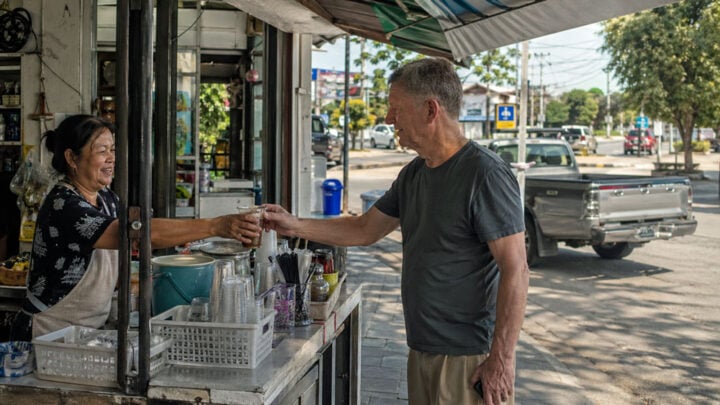
Walking through Korat, the question arises for Ryan once again: why do some foreigners make it here effortlessly, while others get stuck? Over the past two years, Ryan has spoken to expats who had just arrived and people who have lived here for more than twenty years. Their stories vary widely, but certain themes keep recurring.
Many people move to Thailand without thoroughly researching where they are ending up beforehand. For some, it simply turns out to be the wrong place. The country doesn't suit everyone, and that is perfectly fine. Nevertheless, there are pitfalls that people stumble over time and again, both in my work and in the responses I receive through this channel.
Realistic expectations make the difference
Those who succeed here do not harbor exaggerated expectations. No country can make you satisfied or happy in the long run. A place can give you temporary pleasure, provide new insights, and bring beautiful moments, but happiness ultimately comes from within yourself. The Buddhist way of life and the pleasant aspects of Thai culture can support that process. Compared to more turbulent or dangerous parts of the world, it is possibly easier to find inner peace here.
The expats who stick it out do not expect Thailand to save them from their old life. Nor do they count on the country magically making their existence better than anywhere else. They accept that visa matters can sometimes be a hassle and that working as a foreigner has limitations. Before they came here, they already had a realistic view. They consciously set their expectations slightly lower so that disappointment is avoided.
Important to remember: Thailand owes you nothing. Compared to many other destinations, the country scores high on hospitality and friendliness, just like many neighboring countries in Southeast Asia. But that does not imply any obligation. Thailand owes you no better life, and not even a smile. Yet, I receive a smile in Korat much more often than I ever did in Manchester, and conversely, a Thai person in Manchester would be less likely to receive that warmth in return. Even after sixteen years, I keep that in the back of my mind. My expectations remain low, and as a result, I am almost never disappointed.
Respect for the local population
A second characteristic of successful expats is how they interact with the people around them. This does not mean that they attend every village gathering, are present at every funeral, or spend the whole day drinking rice whiskey with the neighbors. Nor does it mean that they uncritically adopt all religious or cultural views. However, they do have a fundamental positive attitude towards Thai people.
They walk into a 7-Eleven and smile. They don't throw their money on the counter, bark orders, or treat the staff as if they are less valuable. They don't assume that Thai people working for them are submissive or less developed simply because they themselves come from the West. They simply treat people as people. No sense of superiority.
As a result, consciously or unconsciously, they slowly become part of the community. The girl behind the counter knows how you drink your coffee. The woman at the somtam stall knows your spiciness level. People in the neighborhood recognize you, know where you live and who you are. Some go a step further and learn the language. I myself have noticed that language is of enormous value for relationships here.
Incidentally, I am naturally quite introverted and value privacy. I don't need to know everyone or know everything about everyone. But I am friendly and contribute to the community in my own way. Integration has different levels, and you decide for yourself how far you want to go with it.
Love, trust, and the nuances in between
Then there is the topic that endlessly recurs on YouTube: relationships that go wrong. Falling in love, putting money into a house in Isaan without properly sorting out the paperwork, or trusting the wrong person in the wrong place. It deserves a more nuanced perspective than is usually given. Not everyone who loses their heart and money here is naive or stupid.
Some people are emotionally vulnerable. Perhaps they came here trusting others, convinced that if they behaved properly, others would too. They believed in honor, trust, and good intentions. Perhaps they already knew they could lose everything and had watched every warning video. Yet, they decided to trust someone because they wanted to believe in the goodness of people. And then they were struck, lost everything, and had to leave.
The situation is often more complicated than the simple conclusion that such a person is an idiot. By that same logic, anyone in the West who divorces and loses half or almost everything would also be an idiot. Sometimes relationships simply don't work. Possessions are then divided or lost. That is part of life.
At the same time, there are people who do indeed bring their misfortune upon themselves. They drink too much, get angry, or behave unreasonably until their Thai wife has had enough. Others are manipulated by someone who is smart and assertive. Never underestimate Thai women. Many are exceptionally intelligent and can convince you of all sorts of things. Does that mean the other person is stupid? Not always. Perhaps that person simply trusted too much. Of course, there are also people who make stupid choices, but you must also leave room for the nuances of human behavior, love, and life. Those are not typical Thai problems, but human ones.
That is why things go wrong for some. At the same time, many long-term expats have actually found someone they can trust. They are building a good life together and working on their future as a team. There are a great many reliable Thai women, and in that respect, they do not differ from women elsewhere in the world. You can trust some people, but not others. The same applies to men. The fortunate ones have ended up in strong, long-lasting relationships that have stood the test of time.
Flexibility and adaptability
Those who put down roots here possess flexibility. Many successful expats are able to adapt certain aspects of their personality and attitude. That is invaluable when you arrive in a new country with different customs.
In the beginning, many newcomers struggle with the Thai approach to time and planning. Everything has to be right; everything must be punctual. At the slightest deviation, tempers flare and people become irritated. Over time, that tension subsides. Many adopt something of the Thai mai pen rai attitude, the relaxed way people here deal with setbacks. They learn to live more in the moment, which aligns well with a Buddhist way of life.
They do not try to force Thailand to adapt to them, but change a little themselves for Thailand. As a result, they grow. In many cases, this makes them more pleasant people, and they continue to live here happily for longer.
Actively manage health
What stands out about people who stick it out here for a long time is how seriously they take their health. Good health insurance is part of it, but it goes further. They drink less, go out less often, and quit smoking more often than you might think.
Many retirees say that they only really started living when they were in their mid-fifties, late fifties, or even in their sixties. Before that, they worked constantly, and now they feel free. They want to live longer. Not to die at seventy, but to reach ninety or ninety-five, fit and clear-headed, so that they can continue to enjoy Thailand and this phase of their lives.
This proactive attitude prevents early departure due to illness. It also helps to keep addictions at bay and bring life into balance. For that is precisely where things go wrong for many people. Health problems are one of the main reasons why expats eventually have to leave Thailand, often sooner than they had hoped.
Low fixed costs as a survival strategy
Financially, you see a clear pattern among those who manage to make ends meet here. Fixed expenses remain low. No evening-long outings and no hotel rooms costing 3000 or 4000 baht per night, but conscious choices between 500 and 800 baht. They think long-term and maintain a buffer, because working as a foreigner here is complicated and generating income remains limited.
Many successful expats are good with money and financially prudent. They understand that unexpected costs may come their way, or that life here might one day become more expensive than they thought. Financial stability proves to be an important indicator of who makes it in the long run.
Multiple sources of income and staying busy
Along the same lines, many successful expats build multiple income streams. For some, that is a pension. Others rent out real estate abroad or run small businesses, often together with a Thai partner. This diversification prevents financial bottlenecks, but there is something else at play: they keep busy.
Anyone who does nothing all day in Thailand will quickly get bored, and boredom is a silent killer here. Many people who stay here for twenty or thirty years keep themselves busy with projects, small businesses, or practical activities. That is good for your wallet, but at least as good for your mind. For as soon as you get bored, questions arise:
- Why am I actually doing this?
- Why all that makeup fuss?
- Why do I live outside my own culture?
- What risks do I take with my health or place of residence?
- Who will take care of me when I get older?
Staying busy helps put those thoughts into perspective. It can literally make the difference between staying and leaving.
Thailand doesn't have to work for everyone.
I cannot emphasize this point enough: Thailand is not necessarily the right place for everyone. One of the main reasons things sometimes go wrong is simply that the country doesn't suit that person. People tried it, but didn't like it. For all sorts of reasons that I have discussed elsewhere as well.
Moreover, Thailand is no longer what some YouTubers make it out to be. In my opinion, it has long ceased to be a cheap solution to all problems. For some, it may still be affordable, but only if you live carefully and are good at budgeting. For many others, those days are over. Anyone who now assumes that Thailand is inherently cheap is in for a rude awakening.
Curiosity, openness and a social safety net
Finally, a few more subtle factors. Whoever succeeds here remains curious about the culture and about life. That applies not only in Thailand, but everywhere. What I see in older, wiser people is that they keep learning. Getting older does not automatically make you wiser; I have experienced that myself. The people who are truly wise do not think they already know everything. They remain open to new insights.
In addition, many successful expats build a small social safety net: family, a partner, or a few friends to talk to. In many provinces, you see groups of people having coffee together on a fixed morning. In a larger city like Korat, this happens just as much as in rural areas. Some go to a bar once a week, while others have a regular pizza night.
They do not live completely like a lone wolf. I myself lived solitarily for long periods in Thailand, and I don't know if I was as happy then as I am now, with my small network. Part of that is online, but I also regularly visit places where people I know live, to catch up and see how they are doing.
Those who have no social network and no friends find it harder. Unless you are truly happy in complete isolation, and such people exist. I have lived like that for periods myself. Still, a support network is more important for most people than they think. For me, family is a major reason to stay. My children live here, my family is here. So it is not just about Thailand. It is about my way of life, about what I do every day, about the fact that I feel comfortable here, that I have learned the language, and that I am happy. If I weren't, I probably wouldn't stay.
Leaving is not failure
Those who don't make it here haven't failed. Perhaps they have actually ended up better somewhere else, in a country that suits them better. Many of my followers have moved from Thailand to Vietnam or Cambodia. In the comments, some occasionally call themselves traitors, but that is nonsense. You owe this country no loyalty. If it doesn't work for you, then it doesn't work.
You don't have to tear Thailand apart to justify your departure. Simply saying that it wasn't for you is, in my opinion, the healthiest attitude. No resentment towards the country or your experience here. Acknowledging that it wasn't your place is wiser than continuing to sulk or blaming other people. Who knows, you might just find happiness just across the border.
Source: video Ryan & Mo – Life In Rural Thailand
About this blogger

-
This article has been written and reviewed by the editorial team. The content is based on the author's personal experiences, opinions, and independent research. Where relevant, ChatGPT was used as a tool for writing and structuring text. We also sometimes generate photos using AI. Although the content is handled with care, it cannot be guaranteed that all information is complete, up-to-date, or error-free.
The reader is responsible for the use of the information on this website. The author accepts no liability for any damage or consequences resulting from the use of the information provided.
Read the latest articles here
 OrganizationsApril 25, 2026Marrying a Thai: why prenuptial agreements are not a luxury
 Living in ThailandApril 25, 2026Why some expats make it in Thailand and others don't (with video)
 Expats and retireesApril 25, 2026Solar panels in Thailand: how to invest smartly in solar energy in 2026
 ActivitiesApril 25, 2026Walking route through historic Bangkok: three hours through the heart of Rattanakosin