

Recognizing a Thai marriage in the Netherlands or Belgium: how to avoid administrative hassle at the municipality
Many couples only discover after months or years that their Thai marriage is not registered anywhere back home. The Netherlands and Belgium automatically recognize foreign marriages, provided you met the marriage requirements of your own country and followed Thai rules properly. Nevertheless, your marital status remains listed as unmarried in the systems as long as the papers have not been registered.
That has consequences. Your income tax return is incorrect, your partner will not be entitled to a partner's pension, heirs face unpleasant surprises, and if your Thai partner wants to come to Europe later, the visa application stalls.
- Your Thai marriage is valid, but for registration in the Dutch BRP or the Belgian DABS, you need a legalized and translated marriage certificate.
- Always ask the amphur for the Korror 2 and the Korror 3. The Kor Ror 3 alone is usually insufficient for your congregation at home.
- In the Netherlands, registration in the BRP is mandatory if you live in the Netherlands. In Belgium, DABS registration is not formally mandatory, but without registration, you must always request every extract from Thailand.
- Be careful with name changes: if your Thai wife adopts your surname in Thailand, that does not automatically mean that her name changes in the Netherlands or Belgium.
- A Thai marriage is by default governed by Thai matrimonial property law. If you want a prenuptial agreement, arrange this before the marriage with a notary in the Netherlands or Belgium.
The two key documents: Kor Ror 2 and Kor Ror 3
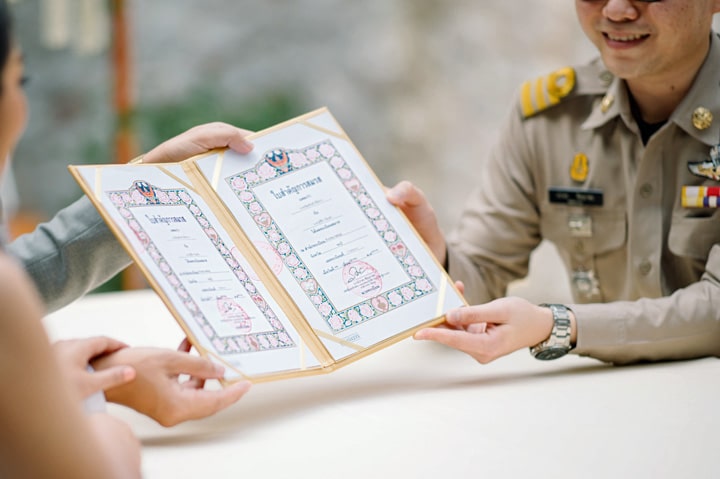
After the wedding ceremony, you receive the at the amphur Korror 3, the marriage certificate itself. This document confirms that the marriage took place and lists the details of both partners. The Korror 2 It is an extract from the marriage register and proves that the registration in the Thai civil registry has taken place. For a one-year extension of your Non-immigrant O visa based on marriage, you will regularly need a fresh extract from the Kor Ror 2 later on.
You receive the Kor Ror 3 once. You can request the Kor Ror 2 again during every subsequent visit to the amphur. In practice, for your Dutch or Belgian municipality, the legalized Kor Ror 2 in English translation is usually sufficient, but some municipalities require to see both documents. Therefore, be sure to explicitly ask about this before your appointment. Practical tip: many amphurs issue a certified English copy directly, allowing you to skip the translation step. Not every amphur offers this, so ask about it.

The legalization chain for Dutch citizens
The Dutch Ministry of Foreign Affairs prescribes three steps. If your document is only in Thai, you must first have it translated by a sworn translator into Dutch, English, French, or German. In Thailand, you have the original and the translation legalized; in the Netherlands, after legalization, you have it translated via a translator from Bureau Wbtv, after which the translation itself no longer requires legalization. With an English transcript from the amphur, you skip the translation step entirely.
Next, you go to the Consular Affairs Department from the Thai Ministry of Foreign Affairs on Chaengwattana Road in Bangkok. You make an appointment online via qlegal.consular.go.th. Translators work on-site who can arrange an English translation within half an hour. Afterwards, you have everything legalized again by the Dutch Embassy in Bangkok. In 2026, this costs €26,25 per document. You make an appointment via the VFS appointment system. No time to travel yourself? The Consular Service Centre in The Hague acts as an intermediary for €131 per document, but it does take months.
The legalization chain for Belgians
For Belgians, the procedure runs parallel, but with specific nuances. The Belgian Embassy in Bangkok updated the process at the end of 2025. After your marriage, have the Kor Ror 2 and a copy of the Kor Ror 3 ready. First, have these documents legalized at the Thai Ministry of Foreign Affairs. Then, have them translated into Dutch, French, or German, either through an embassy-recognized translation agency or a sworn translator in Belgium. Finally, the Belgian Embassy legalizes the originals and the translations for €20 per document, payable exclusively in Thai baht.
If you have the translation done through the embassy's translation agency, the embassy legalizes both the Thai version and the translation. If you have the translation done in Belgium, the embassy only legalizes the Thai original. You will then receive both the paper originals and an electronic legalization with a QR code by email. This is convenient for Belgian authorities that work digitally. Has the amphur issued an English-language extract? Then the Belgian embassy legalizes that directly, provided the MFA has first affixed its stamp to it.
The home route: registration with the municipality
Once all stamped documents have been returned, make an appointment in the Netherlands at the municipality where you are registered. Bring the legalized and translated marriage certificate, a valid passport, and, if necessary, your partner's birth certificate, also legalized and translated. Previously married or widowed? Then the municipality will require proof of the dissolution. The registration itself is usually free; only extracts cost money. If you live outside the Netherlands, you can have the certificate converted into a Dutch certificate at the Municipality of The Hague.
In Belgium, this is handled through your municipality of registration. The civil registrar verifies the marriage against Belgian international private law and updates your national register. Inclusion in the DABS is not legally mandatory — this is stated on the website of the Belgian embassy and in Article 68 of the Civil Code — although some Flemish municipal websites claim the opposite. Without DABS registration, you must request each extract from Thailand. If you are registered with a consular post in Bangkok, that post arranges for the updating of your national register.
Pitfalls regarding surnames
This is where things most often go wrong. Since 2005, a Thai woman has been allowed to choose for herself whether to keep her maiden name, take her husband's name, or use her maiden name as a middle name after marrying a foreigner. The law gives her sixty days to update her ID card, house book, and passport. This must be done at the amphur where she is registered in the house book, not just anywhere. For her passport, it goes through the Department of Consular Affairs.
In the Netherlands, your official surname does not change due to marriage. It remains your birth name, including on your passport and driver's license. What is possible, however, is an adjustment of your naming convention In the BRP: your partner's name, your birth name, or a combination. For an actual change of surname, you must go to Justis, which takes up to ten months. In Belgium, the Dutch system of name usage does not exist; a formal change is handled through the FPS Justice. Consequence: after a name change, your wife's Thai passport may state something different than her registration in the BRP or the Belgian National Register. This causes endless hassle with banks, the Tax Authorities, and visa applications. Many Thai lawyers therefore advise simply retaining the maiden name.
Consider matrimonial property law
An often underestimated issue. In the Netherlands, the limited community of property has been the standard since 2018. In Belgium, the statutory system of community of acquisitions has been the norm for decades. In Thailand, you marry by default under a form of community of property in Thai law, the so-called sin sogrosWhich law applies to *your* marriage depends on the nationality of both partners, where you went to live after the marriage, and whether you made any written agreements.
If you marry in Thailand and continue to live there, Thai property law often applies. If you later move to the Netherlands or Belgium, conflicts with the European system may arise. According to Dutch practice sources, drawing up a prenuptial agreement in Thailand is difficult to implement. Anyone who considers this important—for example, as an entrepreneur or someone with accumulated wealth—arranges this before the marriage with a notary in the Netherlands or Belgium, or simply gets married at home.
Costs, lead times, and common mistakes
Expect a turnaround time of a few weeks if you arrange everything yourself in Bangkok, and a few months if you use mediation via The Hague or Brussels. The bottleneck is usually not in the legalization, but in translations and appointments. Approximate costs:
- English extract amphur: a few tens of baht;
- Legalization of Thai MFA: approximately 200 baht per document;
- Translation at MFA (indicative): approximately 200 baht per page;
- Legalization at the Dutch embassy: €26,25 per document;
- Legalization at the Belgian Embassy: €20 per document, in THB;
- Mediation Consular Service Centre NL: €131 per document.
The classic mistakes: only showing up at your municipality with the Kor Ror 3; thinking that an English transcript from the amphur is automatically legalized; having your wife change her name in Thailand without realizing that the Netherlands does not automatically adopt this; and waiting too long after the issuance of your civil status declaration, which has limited validity.
What cannot be determined with certainty
The exact rates charged by Thai MFA translators are not officially fixed and vary by agency. The 200 baht per page is an indication. Whether your specific Belgian municipality treats DABS registration strictly as mandatory varies in practice: the federal line refers to it as a right, while some municipal websites refer to it as an obligation. Matrimonial property law regarding a marriage concluded in Thailand remains a matter of international private law to which only a notary or lawyer can provide an answer in your specific situation.
Ready to see how Snowflake works?
You can have your Thai marriage recognized at home, but only if you follow the legalization process exactly and all documents align. Kor Ror 2 carries more weight than Kor Ror 3. Registration is mandatory for residents in the Netherlands and practically indispensable in Belgium. The biggest mistake is not a missing stamp, but thinking that a name change in Thailand automatically takes effect in your European records.
Sources: Netherlands Worldwide (Ministry of Foreign Affairs), Embassy of Belgium in Bangkok (Federal Public Service Foreign Affairs), Vreemdelingenrecht.be, National Agency for Identity Data, Justis, Royal Thai Consulate General Los Angeles
About this blogger

-
This article has been written and reviewed by the editorial team. The content is based on the author's personal experiences, opinions, and independent research. Where relevant, ChatGPT was used as a tool for writing and structuring text. We also sometimes generate photos using AI. Although the content is handled with care, it cannot be guaranteed that all information is complete, up-to-date, or error-free.
The reader is responsible for the use of the information on this website. The author accepts no liability for any damage or consequences resulting from the use of the information provided.
Read the latest articles here
 Traffic and transportApril 24, 2026How to travel smartly and affordably through Thailand: the complete taxi guide for 2026
 Food and drinksApril 24, 2026Michelin-star food in Bangkok often costs less than a sandwich in Amsterdam.
 HealthApril 24, 2026Buying medicine in Thailand: what you are allowed to bring back and where it is punishable
 Expats and retireesApril 24, 2026Yellow house book in Thailand: why this inconspicuous little book makes your expat life a lot easier
In my case, the Belgian embassy had indeed forwarded everything to the National Register in Belgium.
For the pension service, everything was OK. However, I applied for a family pension afterwards, and that was OK too.
But I had to register the marriage with the civil registry myself afterwards, as I was still listed as “unmarried” by the tax authorities! So, no marriage quotient.
I would also like the process from marriage contracted in the Netherlands to recognition in Thailand. I hope that works out. We live in the Netherlands and travel to Thailand often. In which country is it easier?
A small addition, if I may? If officially married in Thailand and residing in Thailand, it is not possible to register the marriage in the Netherlands. These persons are listed in the RNI (Registration of Non-Registered Persons).
Registration can only take place upon return to the Netherlands and inclusion in the BRP.
Another minor hurdle is permission from the landlord, if applicable.
My wife moved in with me in Dordrecht in 2009, but after registering with the municipality, it turned out that the housing corporation also had to give permission.
Fortunately, we have been living in Khon Kaen since late 2019.
I married a Thai woman in 2002 but I don't even remember the details anymore; in any case, she came with me to Belgium and a year later we were allowed to go pick up her little daughter. So I was married under Belgian law, divorced under Belgian law in 2011 after 7 years, and now I realize that I am still married under Thai law? It is not easy to get a divorce here in Thailand, so be careful if you get married, Belgians.
Why: "It is not simple to get a divorce here in Thailand"? You have apparently defaulted, and so you are just shifting the blame to Thailand again. How is the amphur supposed to know that you are in Belgium to divorce? Art. 1514 Thai Civil Code: A divorce can only take place by mutual consent or by a court ruling. A divorce by mutual consent must be recorded in writing and ratified by the signatures of at least two witnesses. How easy do you want it to be?
We got married on Koh Samui. This municipality also issued the extracts in English. This saves costs and time on translation.
At the Dutch municipality where you register the marriage, don't forget to check the local requirements. Some ask for things like a birth certificate, etc.
Finally, to register your partner with your pension fund, ensure that he/she applies for a BSN.