

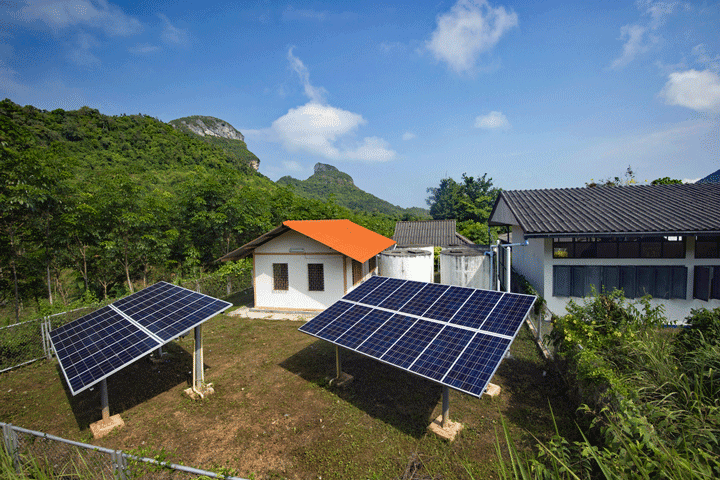
Those living in Thailand have seen their electricity bills rise for years. Air conditioners are running at full capacity, MEA and PEA rates are rising along with global fuel prices, and the idea of using your roof as a power plant is becoming increasingly attractive. Since March 2026, a fiscal incentive has been added on top of this, which is the deciding factor for many households.
However, things work fundamentally differently in Thailand than in the Netherlands or Belgium. Net metering at the full electricity rate does not exist here. Anyone who sizes their system to “make money back” through feed-in will be disappointed. The profit lies in self-consumption. In this article, I outline what you can expect in 2026 regarding costs, permits, payback period, and pitfalls.
Net billing instead of net metering
In Thailand, a system of net billing applies, not net metering. That difference is the most important thing you need to understand before signing a quotation. The electricity you feed back into the grid is purchased by MEA or PEA for approximately 2,20 baht per kilowatt-hour, whereas you pay 4 to 5,50 baht for electricity consumed. Therefore, you are structurally selling at a lower price than you are buying, and surpluses intended to “make money” yield little return.
A genuine grid metering scheme, in which feed-in is offset at the full retail rate, has been on the drawing board for years. The Thai government has rejected its implementation so far, arguing that it would jeopardize the stability of the grid and tariffs for households without solar panels. The practical conclusion is clear: size your system based on your own daytime consumption, not on an imaginary feed-in tariff.
Permits: significantly relaxed in 2025 and 2026
In November 2025, the Thai Ministry of the Interior put an end to a lot of paperwork via Ministerial Regulation No. 72. Solar panels on a roof no longer qualify as a structural modification, provided that the total weight of the installation remains below 20 kilograms per square meter. Most modern systems fall well below that, so in practice, the building permit is no longer required for virtually all households.
What formalities remain? The application for grid connection with MEA (Bangkok, Nonthaburi, and Samut Prakan) or PEA (the remaining 74 provinces), an inspection by the electricity company, the installation of a bidirectional meter, and a Power Purchase Agreement for up to ten years. Count on six to twelve weeks for all the paperwork. In Bangkok, it is sometimes possible within two to three weeks, but that is the exception, not the rule. A good installer will handle this entire process for you.

What an installation will actually cost in 2026
Prices have fallen sharply in recent years. The amounts below are all-inclusive: panels, inverter, installation, cables, security, and grid connection.
| System | Price in baht | Suitable for |
|---|---|---|
| 3 kWp | 90.000-130.000 | Small household, basic consumption |
| 5 kWp | 150.000-200.000 | Average home with 1 or 2 air conditioners |
| 8 kWp | 240.000-320.000 | Larger house, heavy air conditioning use |
| 10 kWp | 300.000-400.000 | Maximum for residential housing scheme |
| 10 kWp + battery 14 kWh | from 400.000 | clear evening usage |
A 5 kWh (LiFePO4) storage battery costs approximately 60.000 to 100.000 baht including installation; 10 to 14 kWh comes to 100.000 to 180.000 baht. Keep in mind that a battery only pays for itself financially after 8 to 12 years. For those affected by power outages, this can still be interesting, but that is a different consideration than pure return on investment.
Tax deduction up to 200.000 baht
Since March 2026, an attractive deduction has been formally in effect via Royal Decree No. 805. You can deduct up to 200.000 baht (including VAT) from your gross income, provided the system is connected to the MEA or PEA grid and does not exceed 10 kWp. The installation must have been carried out by a certified supplier and paid for via a VAT-registered company, with an electronic tax invoice. One installation per household, and the meter must be in the name of the person claiming the deduction. The scheme applies to installations completed between 3 March 2026 and 31 December 2028.
For expats, this is crucial: only Thai taxpayers—usually those who stay in Thailand for more than 180 days a year—who are actually liable for Thai tax, benefit from this. Many pensioners with only a pension from the Netherlands or Belgium fall wholly or partially outside of this. Have this recalculated by a Thai tax advisor who knows your personal situation and understands the bilateral tax treaty.
Get started step by step
The order of actions determines whether you save money or lose money. Follow these steps:
- Review your electricity bills from the past 12 months. Below 3000 baht per month, it usually yields too little. Between 3000 and 8000 baht, it is worthwhile. Above 10.000 baht, it is almost always interesting.
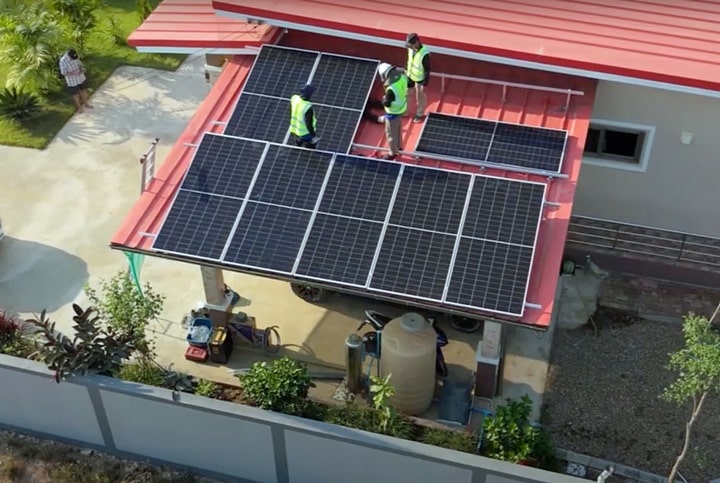
- Have your roof assessed for orientation, shading, and load-bearing capacity. Maximum 30% shading; have an older roof checked for leakage risk first.
- Request at least three quotes. Work exclusively with installers who use TISI-certified equipment.
- Check your home's paperwork. Owner or tenant? Is the meter in your name? This must be correct for the deduction and the PPA contract.
- Have the installer handle the application to MEA or PEA, including the entire approval process.
- Wait for the inspection and installation of the bidirectional meter before activating the system.
- Keep all invoices and e-Tax Invoices for your tax return for the year of connection.
Realistic payback period
The figures you come across online—sometimes 1,5 years is mentioned—are either marketing or apply only to heavy commercial users. For an average household, the picture is more realistic: with high daytime usage (air conditioning during the day, working from home, pool pump), you will recoup the cost of a well-dimensioned system without a battery in 5 to 7 years. With average usage, that becomes 7 to 10 years. Anyone who is only home in the evenings and on weekends is looking at 10 years or more and would be better off opting for a smaller system or considering a battery.
Panels last 20 to 25 years in the Thai sun and humidity. The return, therefore, lies not so much in the first few years, but in the free electricity thereafter. Commercial installations on factories and warehouses typically achieve a payback period of 5 to 7 years, simply because during the day, the entire production immediately consumes the generated electricity.
Risks and pitfalls that expats often miss
Ownership of the house is the biggest stumbling block for foreigners. Many expats live in a home registered in the name of a Thai spouse, in-laws, or Thai limited liability company. If you install six hundred thousand baht worth of panels on it, you are installing an investment on someone else's property. In the event of relationship problems or death, you are in a weak legal position. Agree on this in writing beforehand, or only install on a condo or house that is demonstrably yours. The same applies to the electricity meter: for the PPA, tax deductions, and subsequent sale, the registration must be correct.
In addition, there are practical pitfalls that you should not overlook:
- Construction quality of Thai roofs: older roof boards do not always withstand a 25-year load. Invest in sturdy brackets.
- Rainy season: from May to October, the yield drops significantly. An honest installer factors this into his annual yield.
- Warranty versus presence: A 25-year panel warranty is only worth something if the supplier still exists in 25 years. Choose brands with a demonstrable presence in Thailand.
- Insurance: Not every Thai building insurance policy automatically covers damage to or caused by solar panels. Check this in advance.
Ready to see how Snowflake works?
Solar panels in Thailand are financially sound in 2026, provided you consume electricity during the day, size your system based on your own consumption, and do not rely on feed-in as a revenue model. Permitting regulations have been relaxed, tax deductions are generous for those eligible, and prices are historically low. The biggest risks lie not in the technology, but in ownership, paperwork, and choosing a reliable installer.
Sources: Bangkok Post, Royal Gazette (Royal Decree No. 805/2026), Energy Regulatory Commission Thailand, Ministry of Interior Thailand, Hunton Andrews Kurth, Tilleke & Gibbins, HLB Thailand, Expat Tax Thailand, Krungsri Research, ExpatDen.
About this blogger

-
This article has been written and reviewed by the editorial team. The content is based on the author's personal experiences, opinions, and independent research. Where relevant, ChatGPT was used as a tool for writing and structuring text. We also sometimes generate photos using AI. Although the content is handled with care, it cannot be guaranteed that all information is complete, up-to-date, or error-free.
The reader is responsible for the use of the information on this website. The author accepts no liability for any damage or consequences resulting from the use of the information provided.
Read the latest articles here
 OrganizationsApril 25, 2026Marrying a Thai: why prenuptial agreements are not a luxury
 Living in ThailandApril 25, 2026Why some expats make it in Thailand and others don't (with video)
 Expats and retireesApril 25, 2026Solar panels in Thailand: how to invest smartly in solar energy in 2026
 ActivitiesApril 25, 2026Walking route through historic Bangkok: three hours through the heart of Rattanakosin