
Isaan towns like Loei and Nakhon Phanom: and the Mekong culture that few Dutch people know.
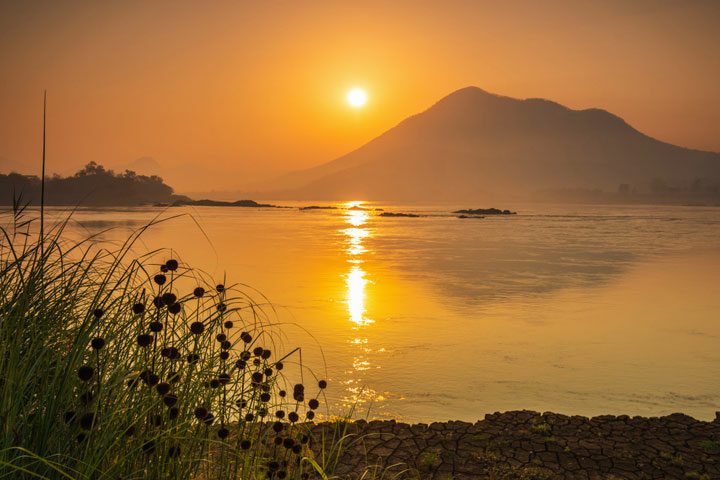
Anyone who thinks they know Thailand well discovers a different country here. The provinces in the north and east of Isaan carry what the Thais themselves call Mekong culture: a blend of Thai, Lao, and even Vietnamese influences, shaped by centuries of migration across the river. You can taste this intertwining in the food, hear it in the language, and see it reflected in the architecture of old teak houses.
With its hills and cooler winters, Loei feels almost northern, sometimes even compared to Mae Hong Son. Nakhon Phanom, on the other hand, has a wide riverbank, a lively boulevard, and spectacular views of the limestone mountains of Laos. Two different worlds, both still largely undiscovered by Western tourists.
Loei: against the northern hills
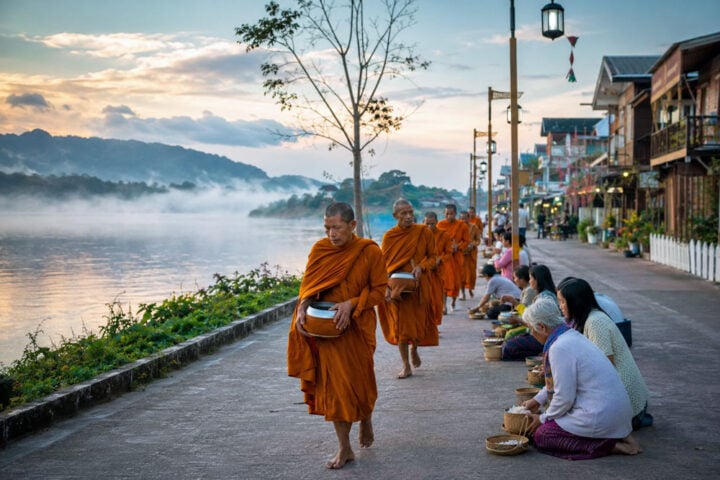
The provincial capital, Loei, is not a beauty, but it serves as a fine base. The real attraction lies outside the city. An hour to the north lies Chiang Khan, a small town on the Mekong River opposite Laos. Along Chai Khong Street stand restored teak houses, once built by Lao refugees who crossed the river in the late 19th century during the unrest in Lan Xang. In the evening, the street transforms into a walking street full of street food and artists. Early in the morning, you see something strongly reminiscent of Luang Prabang: monks on alms rounds along the river. The town is compact enough to explore by rental bike, and the bike path along the Mekong runs all the way to the rock formations of Kaeng Khut Khu.
Twenty kilometers to the west, the Skywalk Chiang Khan hangs 80 meters above the river, at the point where the Mekong bends northward and the Hueang River crosses the border. Behind the glass walkway stands a 19-meter-high golden Buddha statue. Admission costs about 60 baht (approximately €1,60), including the pickup ride up and shoe covers for the glass. Not recommended for those with a fear of heights, but the view of the confluence of the two rivers is unique. Try to go on a weekday, as Thai tourists flock here on weekends.
Phi Ta Khon and the mountains of Loei
Thailand's most bizarre festival takes place in Dan Sai, about 80 kilometers southwest of Loei. For three days, residents parade through the village in homemade ghost masks and rag costumes, accompanied by wooden phalluses and loud music. The masks are made from rice steamers and wood carvings, and the festival blends Buddhist merit-making with older animistic traditions. For 2026, the official dates are June 20 through 22. The dates are determined each year by a local spirit medium, so check shortly beforehand to see if this is correct. Outside the festival season, you can experience the atmosphere at the Phi Ta Khon Museum at Wat Phon Chai.
For hikers, Phu Kradueng and Phu Ruea are well worth a visit, two mountainous national parks with impressive views and, in the colder months, seas of mist at sunrise. Phu Kradueng requires a strenuous climb of about 9 kilometers and is closed during the rainy season. In December and January, night temperatures can be surprisingly low, sometimes below zero: be sure to pack a fleece.
Nakhon Phanom: city on the wide Mekong
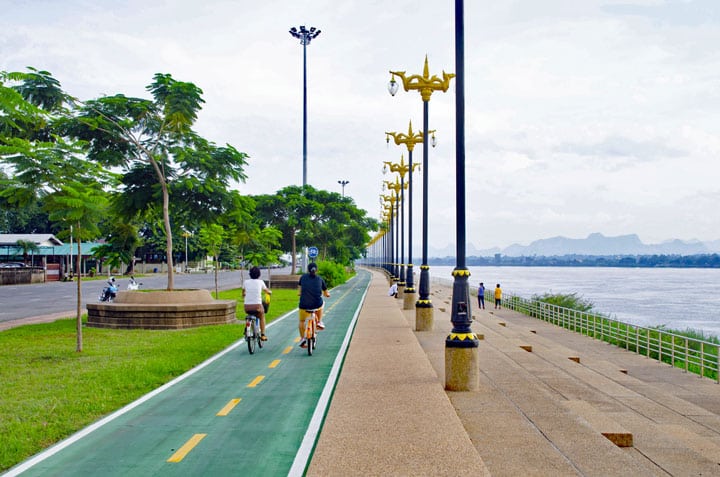
Nakhon Phanom has something Chiang Khan lacks: a real city setting on the river, with a wide boulevard, colonial buildings, and spectacular views of the Laotian limestone mountains. The name means “city of mountains,” referring to that view across the river. The locals like to say that Laos has the beautiful mountains, but Thailand has the beautiful view. Centrally located on the promenade stands the Phaya Sri Sattanakarat, a 15-meter-high bronze seven-headed Naga statue erected in 2016 that has been the symbol of the city ever since. From Friday to Sunday, Sunthon Wichit Street transforms into a walking street full of street food and street art. The city also has a remarkably well-maintained bike path along the Mekong, including a 307-meter-long steel bicycle tunnel.
Nakhon Phanom is culturally rich due to the Vietnamese presence. During the Vietnam War, a large American air force base was located here, but a Vietnamese community lived here long before that. The Ho Chi Minh House in a nearby village serves as a reminder of the time the future Vietnamese leader lived here in the 20s and 30s. St. Anne's Church, built in 1926, is one of the oldest Catholic churches in Thailand and reflects the mix of Thai, Lao, and Vietnamese believers. South of the city lies Wat Phra That Phanom, a 57-meter-high white-gold chedi considered one of the holiest Buddhist monuments in Isaan. According to tradition, it contains a breastbone relic of Buddha. The current chedi was rebuilt in 1979, after the old one collapsed due to heavy rain in August 1975. The monument is on the tentative UNESCO World Heritage List.
Lai Reua Fai: the flagship festival
Anyone in Nakhon Phanom in October will encounter the Lai Reua Fai festival, a procession of illuminated boats on the Mekong that marks the end of the Buddhist fasting period. Twelve districts each build an enormous boat, sometimes as long as 80 meters, decorated with tens of thousands of lights often made from recycled coffee cans. In the evening, they sail up the river in a spectacular procession.
In 2025, the festival attracted more than 100.000 visitors for the first time, after the Thai cabinet made nearly 30 million baht available to scale it up into an international event. The 2025 edition ran from September 27 to October 8. The exact dates for 2026 have not yet been confirmed, but expect a similar period around Ok Phansa. Book hotels well in advance, as the city fills up then.
Practical: how to get there and what to eat
Both provinces have their own airport with daily connections from Don Mueang in Bangkok.
| Loei (LOE) | Nakhon Phanom (KOP) | |
|---|---|---|
| Flights from Bangkok | Only Thai AirAsia, about 14 flights per week | Thai AirAsia and Thai Lion Air, approximately 30 flights per week |
| Flight time | Approximately 1 hour 5 minutes | Approximately 1 hour 20 minutes |
| Distance from Bangkok | Approximately 520 kilometers | Approximately 730 kilometers |
| Bus from Bangkok | From Mo Chit, about 9 hours | From Mo Chit, from approximately 350 baht |
From Loei Airport, it is about 5 kilometers to the city, and from Nakhon Phanom Airport, about 15 kilometers. In both cases, minibuses run for around 100 baht. For Chiang Khan and Dan Sai from Loei, a rental car or songthaew is convenient, as public transport is limited. The cuisine in both provinces relies heavily on Lao traditions: sticky rice, laab, som tam, grilled chicken, and river fish cutlets. In Chiang Khan, you will find khao chee and miang kham. In Nakhon Phanom, you can taste the Vietnamese influence alongside this: nem nuong, Vietnamese coffee, and freshly made spring rolls. The morning market in Tha Uthen, north of Nakhon Phanom, still attracts Lao vendors daily who cross by boat.
The dry season, from November to February, is the most pleasant time to travel. Be aware of the scorching season in March and April, when air quality deteriorates significantly throughout northeast Thailand. During major festivals, everything is fully booked weeks in advance, so book early or consider staying in a nearby town.
Slot
Loei and Nakhon Phanom are not destinations for those seeking maximum infrastructure or a lively farang scene. They are places for travelers who want to feel the slow rhythm of the Mekong: early mornings by the river, a conversation with a local guesthouse owner, a ghost mask you won't buy anywhere else. Anyone who thinks they know all of Thailand will discover here how much land remains undiscovered.
Sources: Tourism Authority of Thailand, Bangkok Post, The Nation Thailand, Travelfish, Thailand.go.th, Tripadvisor, Flightconnections
About this blogger

-
This article has been written and reviewed by the editorial team. The content is based on the author's personal experiences, opinions, and independent research. Where relevant, ChatGPT was used as a tool for writing and structuring text. We also sometimes generate photos using AI. Although the content is handled with care, it cannot be guaranteed that all information is complete, up-to-date, or error-free.
The reader is responsible for the use of the information on this website. The author accepts no liability for any damage or consequences resulting from the use of the information provided.
Read the latest articles here
 Expats and retireesMay 10, 2026What is a common monthly allowance for your Thai partner?
 BackgroundMay 10, 2026Thai bunkhun strikes up relationships with Dutch and Belgian men
 BackgroundMay 10, 2026What happens to Thai sex workers after their fortieth birthday?
 BackgroundMay 10, 2026Why Isaan has been and remains the poorest part of Thailand for generations
How funny to read about Nakhon Phanom in particular.
I just returned from Thailand myself and toured extensively around Nakhon Phanom and Bueng Kan.
I prefer coastal towns like Hua Hin or Krabi, but Nakhon Phanom, where my girlfriend is from, had a nice vibe!
I did indeed visit the Naga statue, and as part of Songkran, you could pour scented water over figurines named after a day of the week.
Songkran in Nakhon Phanom was a breath of fresh air compared to the idiocy in Pattaya, by the way!
I do have to add, however, that you shouldn't rely on Bolt or Grab. They are practically non-existent in Nakhon Phanom. I rented a car for those weeks, a rather difficult-to-drive Toyota Fortuner.
Best regards,