

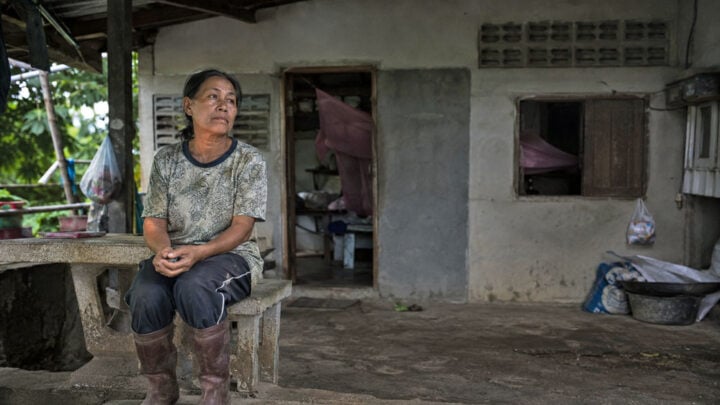
In Thailand, an estimated one hundred thousand to nearly a million sex workers are active. Most come from Isaan, the impoverished northeast where agriculture offers barely any livelihood security. They send their earnings to family back home, pay their children's school fees, and in doing so build the livelihood that the village could not provide.
Around their fortieth birthday, that story changes. Income declines, clients seek younger women, and the work becomes harder. These women do not know a formal retirement age. What they do know is a grey area between working and stopping, in which they are entitled to nothing and have to arrange everything themselves.
A law that does not see them
Sex work in Thailand falls under the Prevention and Suppression of Prostitution Act of 1996. Anyone found in a prostitution establishment for sexual purposes formally risks a month in prison or a fine of up to 1000 baht (approximately 27 euros). In practice, this law is rarely strictly enforced, and since late 2023, Thailand has been in a phase that legal experts call “soft decriminalization.” The police are no longer allowed to fine sex workers for soliciting clients. That task has been shifted to the Ministry of Social Development.
At the same time, a bill that would fully legalize sex work has been ready for years: the Sex Workers Protection Bill. According to legal analyses, the proposal is a priority for the governing coalition after February 2026, but whether the law will actually be passed and what it means for those who have already left the profession remains uncertain. For the generation that is now forty, any improvement comes too late in any case.
The meager safety net
The Thai government offers three forms of protection for the elderly, but for sex workers, only the most basic is accessible. Universal health insurance applies to everyone and covers basic healthcare, optionally with a voluntary contribution of 30 baht per hospital visit.
The Old Age Allowance does not start until age 60 and is modest. A House of Representatives committee deemed the amount insufficient as early as 2022 and proposed giving all those over 60 a minimum of 3000 baht per month. In February 2025, the government rejected that proposal due to the cost of over 400 billion baht. A flat benefit of 1000 baht for all seniors is still on the agenda, but at the time of writing, it is not law.
| source of income | Amount per month | In euros |
|---|---|---|
| Old-age allowance 60-69 years | 600 baht | about 16 |
| Old-age allowance 70-79 years | 700 baht | about 19 |
| Old-age allowance 80-89 years | 800 baht | about 22 |
| Old-age allowance 90+ years | 1.000 baht | about 27 |
| Proposed minimum (not a law) | 3.000 baht | about 80 |
| Income go-go bar Pattaya | 20.000 to 60.000 baht | 540 to 1.620 |
| Send money to family | 5.000 to 15.000 baht | 135 to 405 |
The third possibility is voluntary savings programs for the informal sector, including the National Savings Fund from 2015. The government contributes a matching amount, but participation remains low. Sex workers rarely join, because even a contribution of one hundred baht feels like money that should have gone to the village.
Four roads after the bar
Field research and stories from aid organizations reveal four main patterns for what happens to these women:
- Return to the village. This is the largest group. The woman returns to Isaan or the north, helps on the family land, and looks for odd jobs as a courier, at a 7-Eleven, or as an insurance agent. Life in the village is cheaper, but the income is a fraction of what she earned in Pattaya.
- A small business of my own. Whoever has saved enough opens a laundromat, market stall, mini-market, or small eatery. This only works if money has actually been set aside, which is often not the case.
- A foreign partner. For many, this is the actual retirement plan. Sometimes the wife moves abroad, sometimes she stays in Thailand with monthly support. The success rate is low and the dependency is high.
- Continuous vulnerability. An unknown but substantial group remains dependent on individual clients, family, or charity. Some move on to massage parlors in less touristy cities or become mamasan in a bar.
In bars, an older woman, a mamasan, often supervises the younger girls. It is a way to stay in the industry without actively working themselves, but the wages are modest and the job is temporary.
Risks, pitfalls, and what you can do
The greatest risk is the lack of pension accrual. Because the work is illegal, bar owners do not pay social security contributions, and women do not accrue rights through the Social Security Fund. Voluntarily joining via Article 40 or the National Savings Fund is possible, but rarely happens. Additionally, stigma in the village plays a major role. According to the aid organization Empower Foundation, eighty percent of sex workers support family, but returning home rarely goes smoothly. Women are interviewed anonymously because they may be ostracized by family or shunned by the community. Other pitfalls include debts for family or a home, health damage from years of night work, and dependence on a partner who may die or leave.
Readers who are closer to this theme, for example through a Thai partner or girlfriend, can practically make a difference:
- Discuss the National Savings Fund openly. A monthly contribution of one hundred baht, potentially supplemented by you, builds up an additional fund over ten to fifteen years with a matching contribution from the government.
- Check if she is registered in her tabian baan, the Thai household register, in her native province. Without that registration, it is difficult to apply for the old-age supplement at age sixty.
- Invest in something sustainable in the village, not in consumption. A small rice mill, a laundromat, a few cows, or a piece of farmland provides more security in the long run than a new pickup truck.
- Make agreements in writing. Money you lend or give for land or a house must be recorded; otherwise, it will almost certainly be disputed in the event of a dispute or death.
- Talk about a will. Thai inheritance rules work differently than in the Netherlands or Belgium, and without a will, your share of a joint home or property will not automatically go to her.
Slot
For most Thai women, leaving the sex industry is not retirement, but a setback. The law does not recognize their work, so they accrue no rights. The safety net only begins at age sixty and is symbolic at 600 baht per month. Those who have no savings, business, or partner fill the gap with the village's informal economy.
Sources: OECD, US Social Security Administration, World Bank, Bangkok Post, Nation Thailand, NPR, The Pattaya News, Prachatai English, Empower Foundation, SWING Foundation, Tilleke & Gibbins, Siam Legal, Hidden Compass, Hardstories.
About this blogger

-
This article has been written and reviewed by the editorial team. The content is based on the author's personal experiences, opinions, and independent research. Where relevant, ChatGPT was used as a tool for writing and structuring text. We also sometimes generate photos using AI. Although the content is handled with care, it cannot be guaranteed that all information is complete, up-to-date, or error-free.
The reader is responsible for the use of the information on this website. The author accepts no liability for any damage or consequences resulting from the use of the information provided.
Read the latest articles here
 Expats and retireesMay 10, 2026What is a common monthly allowance for your Thai partner?
 BackgroundMay 10, 2026Thai bunkhun strikes up relationships with Dutch and Belgian men
 BackgroundMay 10, 2026What happens to Thai sex workers after their fortieth birthday?
 BackgroundMay 10, 2026Why Isaan has been and remains the poorest part of Thailand for generations