

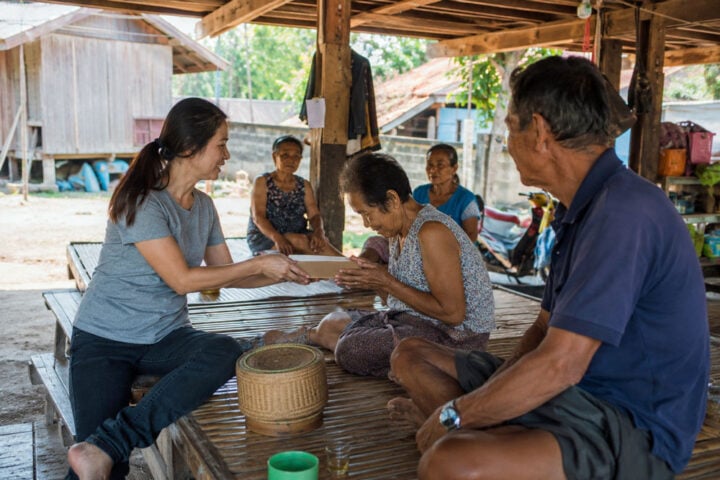
In Thailand, Bunkhun determines who owes whom loyalty, and that debt never ends. For Dutch and Belgian men with a Thai partner, this principle explains much of what seems illogical: money going to the in-laws, loyalty to an absent father, the unspoken “no” she can never say. This article shows how Bunkhun works, where it comes from, and what it means in your life.
Briefly
- Bunkhun (บุญคุณ) is a Thai norm: whoever has ever done you an important favor is entitled to your loyalty, respect, and support for life.
- The band is not business-like and does not issue invoices. Anyone attempting to settle the bill risks being labeled. nerakhun of akatanyuungrateful, and that is a serious moral indictment in Thailand.
- For you as a Western partner, bunkhun explains the money going to the in-laws, the silent expectations, and the loyalty to parents who gave little themselves.
- The greatest risk lies in abuse. Family, employers, and politicians know exactly how to use this duty to extract money, obedience, or votes.
- Whoever understands the rules of the game can set boundaries without putting their partner or themselves in an impossible position.
What exactly bunkhun entails
Bunkhun is difficult to translate. “Gratitude” does not capture the meaning, and “guilt” sounds too businesslike. The Thai social psychologist Suntaree Komin once described it as indebted goodness, a good deed that obligates the recipient. Whoever has done something important for you—given your life, raised you, helped you find a job, or forgiven a debt—receives no monetary compensation in return. He receives something much heavier.
That person will have a permanent place in your moral world. You ought to respect him or her, help when necessary, and never criticize them in public. That duty is called no bunkhun (หนี้บุญคุณ), literally the debt of bunkhun. Unlike a loan, it has no end date.
Where the idea comes from
Bunkhun is not a loose etiquette, but is interwoven with Thai Buddhism and the hierarchical structure of society. It stands alongside katanyu (กตัญญู), the active gratitude that you ought to show especially to parents, teachers, and benefactors. In the Buddhist reading, parents are your first benefactors: without them, no body, no life, no path. A son who puts on the monk's robe for his father's cremation does so, in this tradition, not for himself, but as the highest form of katanyu.
At a societal level, bunkhun runs parallel to the old division between phuu yai (ผู้ใหญ่), the “big people” with money, age and prestige, and phuu noi (ผู้น้อย), the “little people”. Phuu yai care for phuu noi, and phuu noi are loyal in return. Anthropologist Niels Mulder placed this logic in a broader Southeast Asian context as early as the 1990s, together with the Philippine utang na loob and the Javanese utang budiThey are variations on the same principle: a favor creates a bond that you do not easily break.
Why debt never expires
In the Netherlands and Belgium, gratitude is fleeting. You thank someone, perhaps send a card, and that is the end of the matter. Bunkhun works differently. A frequently cited example comes from a Thai television interview: a businessman said of a politician who had been removed from office for corruption that he would still support him because he had once received an important favor from that man. Whether the benefactor is virtuous or not no longer matters. The debt remains.
You see the same logic in small things. A former teacher remains, even after forty years, a figure you do not openly contradict. An aunt who gave you food as a child when your parents were struggling financially can still ask for a favor fifty years later that you find hard to refuse. A boss who helped you get your first job can count on loyalty that extends beyond the employment contract. In a country where social safety nets were long lacking and the government still plays a limited role, this network of mutual obligations is not folklore but a functional insurance system.
What this means for your relationship
This is often where the friction lies. Many men who marry a Thai woman from the northeast only gradually discover that they are not just marrying her, but a network of obligations. Her parents gave her life and raised her in often impoverished circumstances. For her, it is only natural that she now repays them, with your help. Not out of greed, but because the opposite is unthinkable. A daughter who abandons her parents loses her place in the community.
The anthropologist Patcharin Lapanun described in her study Love, Money and Obligation from 2019, she describes how Thai women with a farang husband in the Isaan village of Na Dokmai explain this principle in practice. In their perception, money going to the family is not a favor to parents or brothers, but the repayment of a moral debt. At the same time, her research shows that thanks to the foreign income, these families often acquire a new middle-class position, with the accompanying tensions in the village. Your role is twofold: formally, you do not bear the bunkhun, but because your income enables her to fulfill her duty, the moral bill tacitly shifts to you as well.
The downside: nerakhun and loss of face
The opposite of bunkhun is akatanyu (อกตัญญู) or nerakhun, ingratitude. In the West, that is a character flaw. In Thailand, it is almost a crime against the social order. Anyone publicly branded as someone who does not support their parents, mocks a teacher, or betrays a benefactor loses their standing. For your partner, the fear of being labeled that can outweigh the financial pressure itself. That is why you often see a Thai woman cutting back on herself rather than saying “no” to a request from her mother.
That pressure also comes from the outside. On a well-known Thai forum, a reader described how his wife was publicly criticized via social media for not “helping” enough, while nothing similar was expected of Thai sons-in-law in the same family. The stereotype of the wealthy farang reinforces the moral claim. Here, bunkhun is no longer a religious principle, but an instrument to put pressure on a foreign son-in-law.
How Bunkhun is abused
It is important not to romanticize bunkhun. Thai authors themselves are critical of it. In a much-discussed column in the Bangkok Post In 2022, a journalist wondered whether katanyu is not being misused to conceal the shortcomings of the Thai government. If children are obliged to financially support their elderly parents, the state does not need to organize a decent pension. Bunkhun then becomes a smokescreen for social policy that is lacking.
The same applies elsewhere. In politics, networks of bunkhun bind voters: whoever once received help from a local leader gives him their vote, even if they know the candidate is corrupt. In companies, loyalty is enforced through favors that are later recouped in overtime or silence. In multi level marketing-organizations psychologically hold onto dropouts. The pattern is always the same: someone with more power does you a favor, and that favor is claimed later at a time that is inconvenient for you.
Where generations diverge
Bunkhun is not immutable. Research among Thais Gen ZRaised on social media and with urban ambitions, it shows that young people are familiar with the old logic but no longer accept it blindly. They ask questions their parents never asked: I didn't ask to be born, so why am I obligated until my death to the people who made that choice for me? Another segment chooses its own interpretation: giving money when possible, setting boundaries when not, without letting themselves be pushed around.
At the same time, the center of influence is shifting. The reverence for the old pillars of Thai authority, collectively known as the “four Ms” (Mother, Monarchy, Monkhood, Military), makes partial way for ittiphon, influence bought or earned with money, appearance, and visibility. For you as an older Western reader, this is relevant: your wife or girlfriend, born in a village and raised with the old logic, likely thinks differently about her duty than her niece studying in Bangkok. Family conflicts are often more about this generation gap than about your money.
What you can practically do with this
Understanding bunkhun does not solve any concrete problems, but it does change how you look at things. A few practical conclusions:
- Do not treat requests for money for the in-laws as blackmail, but neither should you treat them as a mere token of love. It is a moral duty that your partner takes seriously.
- A fixed monthly amount that fits within your budget often works better than a large sum occasionally, because it keeps the debt moving without her ever having to be “finished.” Make that agreement with your partner, not with her family.
- Be cautious with large, unexpected favors from Thai business partners, officials, or neighbors. A smile and a symbolic reciprocal gift—a bottle of whiskey, a basket of fruit, or a suitable envelope—often seals the deal before things get too deep.
- Do not expect your own good deeds to earn you a comparable claim. Bunkhun operates most strongly within the Thai family line and hierarchy. A Dutch son-in-law who builds his mother-in-law's house rarely receives the lifelong loyalty that a Thai son-in-law in the same position would automatically receive.
- Explicitly discuss with your partner who in her network has a genuine bunkhun relationship and who is merely trying to free-ride. By distinguishing together between actual guilt and opportunism, you relieve her of the burden of having to say “no” on her own.
What remains uncertain
I have not specifically researched the legal status of financial obligations between Thai parents and adult children prior to 2026. In practice, bunkhun almost always concerns a moral and social duty, not an enforceable legal one. Figures on how much Dutch and Belgian men transfer money to Thai in-laws annually are not available. Estimates on forums and in journalistic pieces vary widely and cannot be reliably substantiated. The rate at which bunkhun is declining among young Thais is also difficult to substantiate.
Slot
Bunkhun is not a folkloric detail. It is a foundation of Thai relationships, families, and hierarchies, and it explains much behavior that seems illogical to you at first glance. Those who understand the rule will more quickly recognize where genuine loyalty turns into emotional blackmail. It does not change Thailand, nor your partner. It does change yourself, however, and the way you view this country.
Sources: Bangkok Post, WARC, ExpatDen, SEA Junction, ASEAN Now, EPIC People, The Freedom Story, Patcharin Lapanun (Love, Money and Obligation, NUS Press 2019), Suntaree Komin (Psychology of the Thai People, 1991), Niels Mulder (Inside Southeast Asia, 1996)
About this blogger

-
This article has been written and reviewed by the editorial team. The content is based on the author's personal experiences, opinions, and independent research. Where relevant, ChatGPT was used as a tool for writing and structuring text. We also sometimes generate photos using AI. Although the content is handled with care, it cannot be guaranteed that all information is complete, up-to-date, or error-free.
The reader is responsible for the use of the information on this website. The author accepts no liability for any damage or consequences resulting from the use of the information provided.
Read the latest articles here
 Expats and retireesMay 10, 2026What is a common monthly allowance for your Thai partner?
 BackgroundMay 10, 2026Thai bunkhun strikes up relationships with Dutch and Belgian men
 BackgroundMay 10, 2026What happens to Thai sex workers after their fortieth birthday?
 BackgroundMay 10, 2026Why Isaan has been and remains the poorest part of Thailand for generations