Songkran is the happiest festival of the year for many people, but in Thailand, it is also a period with many traffic fatalities, nuisance, and accidents. Therefore, the police and government are focusing heavily on stricter enforcement this year, with safety as the highest priority.
For you as a traveler, expat, or resident, it is wise to know these rules well. Some prohibitions may seem harmless, but they can still have major consequences. Especially in popular party areas and on busy roads, little is overlooked.
Strict approach in party zones
The Thai police are announcing a tough stance for Songkran 2026 under the motto of a safe and responsible celebration. Particularly in busy water zones and entertainment areas, officers will be paying extra attention to behavior that poses risks to others. This includes dangerous water toys, excessive noise, sexual harassment, and disturbances of public order.
In popular areas such as Khao San Road and Silom Road, additional restrictions also apply. There, authorities want to prevent revelers from obstructing drivers' views or causing dangerous situations in the crowd. The message is clear: having fun is allowed, but not at the expense of safety and public order.
Dangerous water toys and inappropriate behavior prohibited
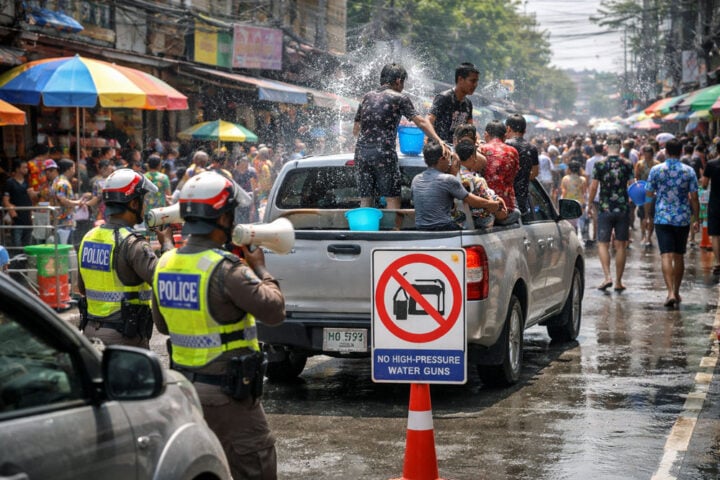
High-pressure sprayers, homemade PVC water cannons, and modified water pistols capable of causing injury are prohibited. Anyone caught with them faces a prison sentence of up to two years or a fine of up to 4000 baht. If someone is seriously injured as a result, the punishment may be even more severe.
Powder, paint, and colored sprays are also prohibited in enclosed party zones. The authorities want to prevent drivers from having poor visibility and visitors from being harassed. In some areas, foam parties have also been restricted because wet surfaces become slippery and electrical installations pose an additional risk. Additionally, indecent clothing or sexually suggestive behavior in public can result in a fine of up to 5000 baht.
Alcohol sales remain a sensitive issue
The sale of alcohol to young people under the age of 20 remains prohibited. In addition, legal sales regulations apply, and there are locations where alcohol may not be sold at all, such as national parks and government buildings. During Songkran, extra surveillance is added on top of this, especially in areas where many people gather to throw water and party.
It is important for visitors to realize that alcohol during Songkran is not just part of the festivities, but also a key focus for the police and authorities. The government aims to reduce the number of accidents and violent incidents. As a result, vendors, organizers, and revelers will be subject to stricter checks this year than usual.
The greatest risks apply on the road.
Traffic remains the biggest concern during Songkran. Drivers who get behind the wheel under the influence of alcohol run a high risk of severe penalties. With a blood alcohol level above the legal limit, a driver can face a maximum of one year in prison and a fine of 5000 to 20.000 baht. Even stricter standards apply to young drivers. In the event of a repeat offense within two years, penalties can increase to two years in prison and a 100.000 baht fine.
Speeding violations are also dealt with strictly. On major routes leading to the regions, speed cameras are operational day and night, including on recently opened highways such as the M6 and M81. Anyone driving too fast can immediately receive a fine of up to 4000 baht and penalty points on their driver's license. For many road users, it is precisely this combination of alcohol, speed, and traffic that makes Songkran a dangerous period year after year.
Additional rules also apply to pick-ups and at events.
Anyone playing with water from a pickup truck must be careful. Transporting water in the cargo bed is permitted, but sitting on the edge of the bed or standing on the roof while the vehicle is moving is prohibited. It is precisely this type of behavior that regularly leads to serious falls and fatal accidents during Songkran.
Organizers of smaller events and entertainment venues will also face additional obligations. Permission from the district office is required for the use of loudspeakers and event spaces. Anyone making excessive noise outside permitted hours risks a fine. With this measure, the authorities aim not only to safeguard safety but also to limit nuisance for local residents.
Songkran remains an exuberant folk festival, but in 2026, Thailand leaves little room for complacency. Those celebrating would be wise to take the rules seriously. This will not only help you avoid a fine or arrest, but also contribute to making Songkran a safer celebration for everyone.
Sources: Nation Thailand
About this blogger

-
This article has been written and reviewed by the editorial team. The content is based on the author's personal experiences, opinions, and independent research. Where relevant, ChatGPT was used as a tool for writing and structuring text. We also sometimes generate photos using AI. Although the content is handled with care, it cannot be guaranteed that all information is complete, up-to-date, or error-free.
The reader is responsible for the use of the information on this website. The author accepts no liability for any damage or consequences resulting from the use of the information provided.
Read the latest articles here
 Expats and retireesApril 16, 2026Transferring money to Thailand in 2026: how to compare costs, exchange rates, and speed
 Expats and retireesApril 16, 2026Work permit for Thailand in 2026: this is what you need to arrange step-by-step as a Dutch or Belgian national.
 Expats and retireesApril 16, 2026Hans Dekkers looks back on living, working, and surviving in Thailand after 35 years (video)
 Expats and retireesApril 16, 2026Paying for water and electricity in Thailand: how to arrange it smartly, safely, and as automatically as possible
What a joke. Cracking down, “strict enforcemen”—it is announced every year, and every year nothing comes of it.
The Thais will break all the rules so massively that the police can only watch helplessly (or stay sitting in their air-conditioned police booths/in their air-conditioned cars).
Very funny. Every time I come home after 3 or 4 months, I always have only one slogan. Pretty much everything I see in Thailand is forbidden in the Netherlands.
For a Dutch person, it would not be difficult at all to follow the rules.