
For those landing in Bangkok for the first time, the route from plane to hotel sometimes seems more complicated than it is. Yet, at Suvarnabhumi and Don Mueang, things usually go wrong due to small mistakes: a forgotten TDAC, an unclear hotel address, the wrong line at immigration, or an unofficial taxi after arrival.
That is why you won't find general travel advice here, but rather a practical step-by-step plan with official procedures, airport information, and real-world tips. You will read what Dutch and Belgian travelers need, how the two airports differ, what waiting times and pitfalls you might encounter, and how to get to your hotel without any hassle.
The first steps after getting out
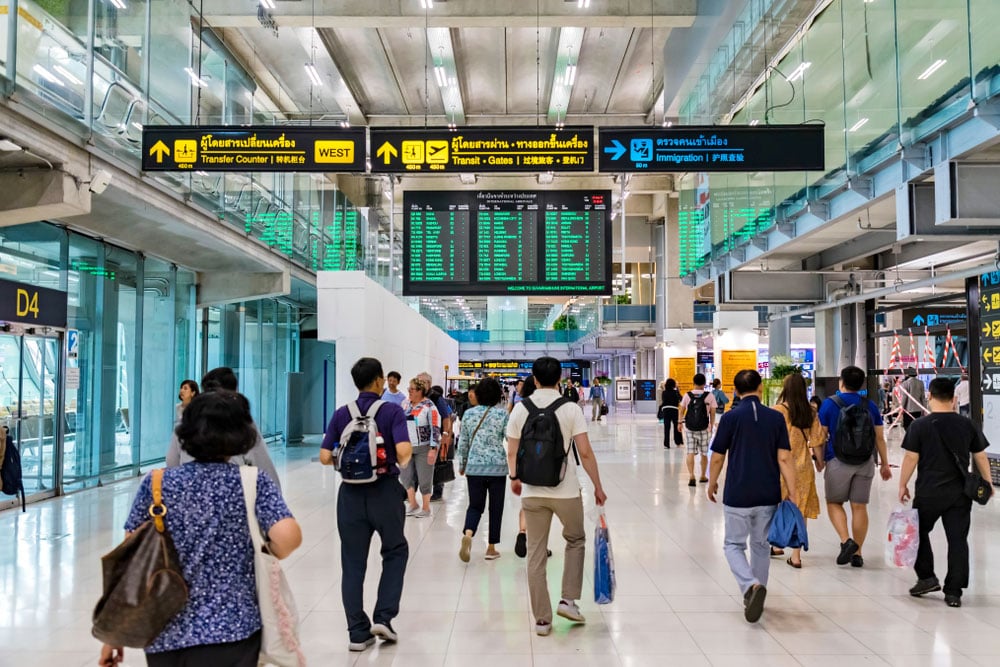
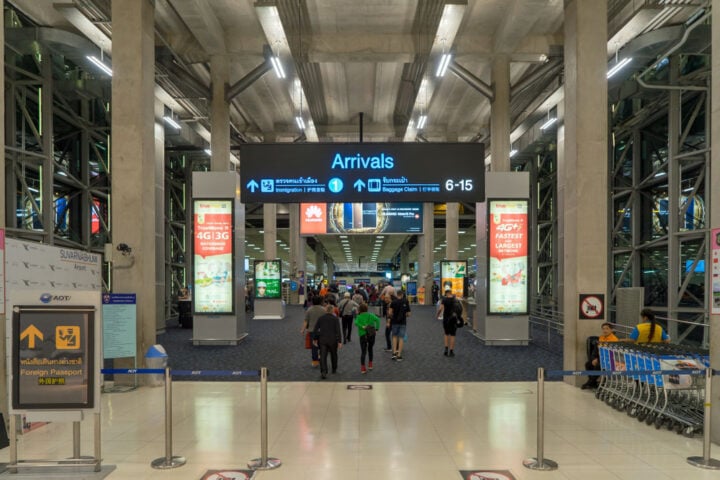
As soon as you step off the plane, follow the signs for Arrivals and Immigration. That sounds simple, but this is precisely where beginners often make their first mistake by walking too fast and not paying close attention to Transit or Domestic Transfer. At Suvarnabhumi, you enter through the main terminal. If you land at SAT 1, you first take the automated people mover to the main building. That ride takes about three minutes, including waiting time. At Don Mueang, international arrivals are more compact, but the sequence remains strict: arrival, any health check, passport control, baggage, customs, and only then transfer.
- Always follow Arrivals and Immigration, not Transit or Domestic Transfer, if Bangkok is your final destination.
- Keep your passport, TDAC, hotel address, and preferably your booking confirmation immediately at hand.
- If you are traveling with multiple people, prepare separate documents for each traveler.
- During busy hours, you lose more time searching through your bag than the official check itself.
TDAC, passport and immigration
The old paper arrival card has been replaced by the Thailand Digital Arrival Card, the TDAC. This is mandatory for all non-Thai travelers, including Dutch and Belgian nationals. You fill it out online within three days before arrival, including the day of arrival. To do so, you will need, among other things, your passport details, flight number, first accommodation address, email address, purpose of travel, and a health declaration. Children also need their own TDAC. If you forget to register, kiosks and Wi-Fi are available at both airports. The TDAC is free. Therefore, never pay an agency or intermediary that charges money for this.
For Dutch and Belgian nationals, normal visa-free entry applies for a maximum of 60 days upon tourist entry, with the option to extend this period by thirty days later. Your passport must be valid for at least six months upon arrival. A damaged passport may cause problems. For some other nationalities, visa on arrival or a prior visa requirement applies. The permitted duration of stay is always stated on the stamp in your passport. If you are travelling from or via a country with a risk of yellow fever, an international vaccination certificate may be required.
- Normally, Dutch and Belgian citizens do not have to stand in line for a visa on arrival.
- Check before departure whether your passport is valid for at least another six months.
- Also save your TDAC offline as a screenshot or PDF on your phone.
- Officially, the Thai immigration service requires you to be able to demonstrate that you have 20.000 THB per person (or the equivalent in euros, approx. €500-600). This can be cash, but credit cards or banking apps are often accepted as well.
- After the check, immediately check the stamp in your passport, as this determines your permitted length of stay.

Luggage, customs, SIM card and money
After passport control, proceed to the baggage claim area. At Don Mueang, international passengers officially use baggage belts 1 through 6. The airline service desks for lost or damaged baggage are located in the baggage hall of Terminal 1 on Level 1. The same practical advice applies at Suvarnabhumi: if your suitcase is missing or you are missing an item from the plane, report it immediately to the airline before leaving the arrival zone. Many travelers walk through to the exit too quickly and only realize afterwards that reporting becomes more difficult.
After baggage, you go through customs. If you have nothing to declare, take the green lane. Limits apply for personal use, such as goods up to 20.000 baht, a maximum of 200 cigarettes or 250 grams of tobacco, and a maximum of 1 liter of alcohol. If you have more with you, or are transporting restricted goods, you must go through the red lane. Anyone carrying more than 20.000 US dollars or the equivalent in other currencies must declare it. After that, you can get a SIM card, withdraw cash, or exchange money. Take your time and compare the exchange rate first, or only withdraw what you need immediately.
- Report baggage problems immediately at the airline desk, and not only outside the terminal.
- When exchanging money or withdrawing cash, use only official counters and machines in the terminal.
- At Suvarnabhumi, there is an official DTAC desk at Gate 7 in the arrivals terminal.
- At Don Mueang, there is a SIM card sales point on the arrival floor between Terminal 1 and Terminal 2.
- Take screenshots of your hotel name, address, and phone number in advance. You often need these for SIM card, taxi, or hotel contact.
This is how you travel from the airport to your hotel
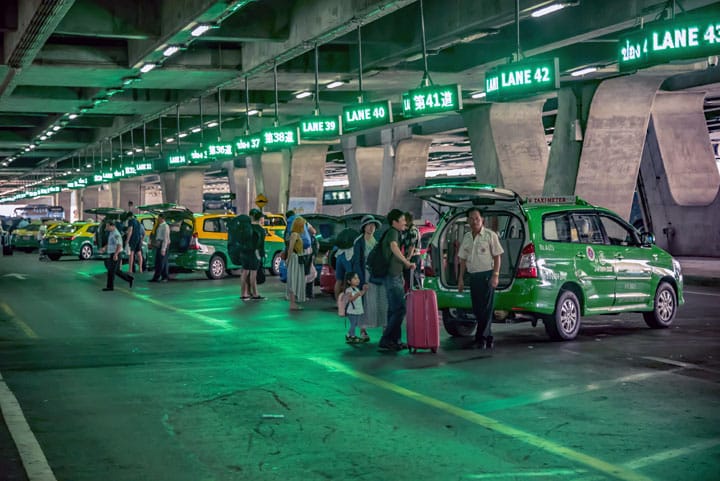
For transport to your hotel, Suvarnabhumi is usually the easiest option for beginners. Official taxis depart 24 hours a day from Level 1 between Gates 4 and 7 on the interior side. You first take a waiting ticket and pay a 50 baht airport surcharge on top of the metered fare. Grab departs from Level 1 at Gate 4 on the exterior side. The Airport Rail Link is located on Level B1 and runs from 05.30:24.00 to midnight. For hotels in districts like Phaya Thai, Siam, Sukhumvit, or Silom, this is often faster than a taxi, especially in heavy traffic in Bangkok.
Don Mueang is more compact, but slightly less direct for many hotels in the city center. Meter taxis depart 24 hours a day from Gate 8 in Terminal 1 and next to Gate 15 in Terminal 2. Grab operates via designated pick-up points at international exits 2 or 5 and at domestic exit 12. The Red Line stops at Don Mueang and runs towards Krung Thep Aphiwat starting at 05:00. Additionally, the Limo Bus runs to Silom and Khaosan, among other destinations, for 150 baht. In practice, Don Mueang sometimes feels faster, but Suvarnabhumi is often more straightforward for a first arrival.
- Never get into the cars of drivers who spontaneously approach you in the arrival hall.
- Use only the official taxi line, the designated Grab zone, or an authorized limousine desk.
- Always check the hotel name, neighborhood, and destination in the app or with the driver before departure.
- Take Bangkok traffic into account. A taxi is not automatically the fastest choice.
Practical overview for beginners
Waiting times at both airports vary significantly depending on the time of day, season, and the number of arriving long-haul flights. That is precisely why a clear overview helps. Most problems arise from minor errors: a missing TDAC, a passport that is valid for too short a period, an incorrect hotel address, walking through baggage check-ins too quickly, or boarding with an unofficial driver. If something goes wrong, report it immediately at the appropriate place. If you have not received a TDAC QR code or if registration is not working properly, ask for help at the immigration desk or with airport staff. For general airport assistance, you can contact AOT 1722, and for tourist issues, contact Tourist Police 1155.
Step-by-step overview from plane to hotel
- Get out and follow Arrivals and Immigration.
- Upon arrival at Suvarnabhumi via SAT 1, first take the people mover to the main building.
- Undergo any health check if your route or origin requires it.
- Go to immigration with your passport, TDAC, and hotel address at hand.
- Collect your luggage and report any problems to the airline immediately.
- At customs, choose the green or red lane.
- Only arrange the SIM card, internet, withdraw cash, or exchange money after that.
- Choose official transport to your hotel and check the destination and address before departure.
Key warnings
- TDAC is free. Never pay for registration.
- Dutch and Belgian nationals fall under visa-free entry and not under visa on arrival.
- A passport valid for less than six months can cause problems.
- Do not leave the baggage area until a missing or damaged suitcase has been reported.
- Do not thoughtlessly exchange a large amount at the airport.
- Do not board unofficial transport services in the arrival hall.
- Save hotel address, booking confirmation, and contact details offline on your phone.
Checklist for departure from the Netherlands or Belgium
- Check the validity and condition of your passport.
- Fill in your TDAC on time and save the confirmation digitally.
- Make sure your first hotel address and flight number are correct.
- Bring a return or onward ticket.
- Check whether proof of yellow fever vaccination is required for your travel itinerary.
- Install an eSIM or an app like Grab in advance if you want to use it.
- Save important numbers, such as AOT 1722 and Tourist Police 1155.
Anyone arriving in Bangkok well-prepared will find that the route from plane to hotel doesn't have to be complicated at all. The core is simple: have documents in order, calmly follow the official procedure, report baggage issues immediately, and only use authorized transport. With this approach, your first trip to Thailand starts off much more smoothly and organized.
Sources: Thai Immigration Bureau TDAC, Airports of Thailand, Royal Thai Embassy The Hague, Royal Thai Embassy Brussels, Thai Customs, SRT Electrified Train, Tourist Police, Bangkok Post, Khaosod English
About this blogger

-
This article has been written and reviewed by the editorial team. The content is based on the author's personal experiences, opinions, and independent research. Where relevant, ChatGPT was used as a tool for writing and structuring text. We also sometimes generate photos using AI. Although the content is handled with care, it cannot be guaranteed that all information is complete, up-to-date, or error-free.
The reader is responsible for the use of the information on this website. The author accepts no liability for any damage or consequences resulting from the use of the information provided.
Read the latest articles here
 emigrateApril 15, 2026Emigrating to Thailand: the 15 most common mistakes
 Expats and retireesApril 15, 2026Who is the best internet provider in Thailand in 2026: a comparison between AIS, True, 3BB, and NT
 Travel tipsApril 15, 2026First time in Thailand: arrival in Bangkok and step-by-step from airport to hotel
 Thailand in generalApril 15, 2026KLM doubles fuel surcharge on long-haul flights; travelers to Thailand also pay significantly more.