Hans Dekkers looks back on living, working, and surviving in Thailand after 35 years (video)
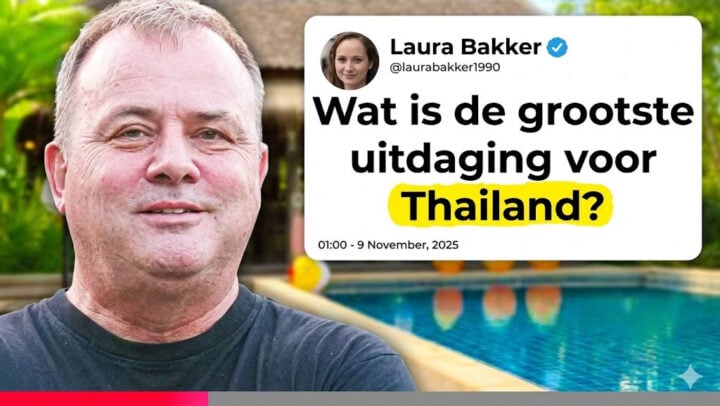
For many Dutch and Belgians, Thailand seems like an attractive country to start over. Hans Dekkers knows what that dream feels like, but also how stubborn the reality is. He has lived in Thailand for 35 years, in at least fifteen different places, from Bangkok and Hua Hin to the northeast and Chiang Mai.
His story is not a slick success tale, but an honest account of trying, moving, making mistakes, and moving on. That is precisely why it is valuable for anyone considering emigration, starting a business, or a longer stay. Thailand has a lot to offer, he says, but only if you are willing to look closely, learn, and adjust your expectations.
From backpacker to entrepreneur in Chiang Mai
Hans first arrived in Thailand in the early nineties as a backpacker, during a long journey that took him through China, Hong Kong, Nepal, Thailand, Malaysia, and Indonesia. He traveled for nearly a year on 10.000 guilders. Back in the Netherlands, he started working as a tour guide for groups to China and later also to Thailand. That work took him to Chiang Mai more and more often, making the choice for the north a logical one. Practical, because he could be home for a while during his travels, but above all personal. He loves motorcycling, cycling, and adventure, and found much more of that in the north than in Bangkok or on the islands.
In Thailand, he started various businesses. He rented properties and opened cafes, restaurants, and a guesthouse, among other things. Later, his work shifted to travel and bicycle tours. Now, he rents out bicycles and scooters in the center of Chiang Mai, organizes cycling excursions ranging from half a day to ten days, and arranges complete trips for families who want everything taken care of from Bangkok to Bangkok. Notably, he also offers self-guided bicycle tours, complete with GPX routes, hotel bookings, luggage transport, and panniers, but without a guide. According to him, this is particularly appealing to people seeking freedom and who are somewhat handy.
Why bike tours stand out and how Chiang Mai changed
Hans's routes originated from old-fashioned detective work. When he started, he rode his moped through the area for a month to try out every little road. At the time, many of those paths weren't even on maps or in digital systems. This is how routes emerged that tourists normally wouldn't find. According to him, that is the strength of his tours. You see places where almost no one goes, with rice fields, small villages, and contact with local residents. Even the multi-day trip from Chiang Mai to Bangkok largely follows the Ping River and later the Chao Phraya, avoiding major roads as much as possible.
At the same time, he saw Chiang Mai change dramatically. When he moved there, the city had about 80.000 inhabitants, according to him. Since then, the area has grown many times larger, partly due to the surrounding villages. In the past, there were no mobile phones, and you simply looked for acquaintances in one of the three popular cafes. There was a lot of live music and a distinct traveler's atmosphere. Now, Chiang Mai is more touristy, busier, and, in his view, less spontaneous. The era of real travel is largely over. Yet, for him, it remains the most beautiful region of Thailand, precisely because of the landscape, the freedom, and the room for adventure.
Life in Thailand requires more than enthusiasm.
Hans has gotten used to Thailand in many respects. He finds hot food in the morning, noodle soup, fried rice, or curry perfectly normal. He is no longer surprised by beer with ice either. But according to him, the biggest adjustment lies not in the food, but in communication. In the Netherlands, directness is often seen as honest and strong. In Thailand, it works very differently. You get further by responding indirectly, with politeness, and with a sense of proportion. He has learned that cultural shift over the years.
He also calls the Thai language indispensable. He himself started from scratch, took lessons, and used children's books to learn the alphabet. After that, things progressed quickly. First signs, later newspapers. According to him, your entire life improves as soon as you speak Thai. You understand more, meet more interesting people, and are less dependent on others. This is precisely where many foreigners go wrong. They enthusiastically open a café or other business, but without language skills, you are soon at the mercy of intermediaries, acquaintances, or advisors who do not always put your interests first.
Doing business, visas, and living are less simple than it seems.
According to Hans, doing business in Thailand is often easier on the surface than people think. Paperwork and permits can be simpler than in Europe, which tempts many newcomers to make quick decisions. But the real problem begins afterwards. Running a business without knowledge of the language, rules, and relationships is difficult. By his own account, he has seen more people leave than succeed. Dreams often clash with reality, especially if people are too trusting or think that an English-speaking lawyer automatically makes everything safe. Thailand is flexible, he says, but it remains a country with laws and pitfalls.
His advice is therefore clear. First, come and live there for an extended period without immediately starting a business. Stay in one place for a few months, get to know local life, and listen to people with experience. He summarizes this with a well-known warning: anyone who wants to end up with a small fortune in Thailand must arrive with a large fortune. When it comes to visas, too, preparation is everything. For those over fifty who primarily want to live peacefully, a retirement visa is relatively straightforward. Doing business is a different matter. Then you end up with a business visa, salary requirements, taxes, and many more obligations.
Money, care, and property remain the harshest reality
Hans is pragmatic about money. Thailand has become more expensive, he says, but compared to Europe, it is still affordable. Nevertheless, he believes that you shouldn't move to Thailand to live on the absolute minimum. According to him, anyone who cannot afford insurance, has hardly any transport, and can only take the cheapest room or meal is left with little of the supposed paradise. You can still eat cheaply, but a life on the edge doesn't make Thailand any better. He saw this during the COVID-19 period as well, when tourism ground to a halt, people found themselves without income overnight, and food aid in Chiang Mai became a dire necessity.
According to him, living and buying require at least as much realism. Renting is simple, but contracts are less binding than in Europe, and an extension does not always provide security. Buying land as a foreigner is not possible. You can work with a Thai partner, a trusted person, a company, or a long-term lease, but every model involves risks. Buying a condo in your own name is possible, however, as long as the building's quota for foreign residents has not yet been reached. Roughly the same logic applies to healthcare. According to him, state hospitals are medically good, but busier and slower. Private hospitals are more comfortable, but expensive. He himself pays around 2000 euros per year for private insurance with a deductible and coverage for hospitalization.
For Hans, Thailand is neither a fairy tale nor a disappointment. It is a country where much is possible, but only for those willing to learn patiently, take risks seriously, and not leave based on a holiday feeling. Those who do significantly increase their chances of a good life.
Source: Friday Feeling
About this blogger

-
This article has been written and reviewed by the editorial team. The content is based on the author's personal experiences, opinions, and independent research. Where relevant, ChatGPT was used as a tool for writing and structuring text. We also sometimes generate photos using AI. Although the content is handled with care, it cannot be guaranteed that all information is complete, up-to-date, or error-free.
The reader is responsible for the use of the information on this website. The author accepts no liability for any damage or consequences resulting from the use of the information provided.
Read the latest articles here
 Expats and retireesApril 16, 2026Transferring money to Thailand in 2026: how to compare costs, exchange rates, and speed
 Expats and retireesApril 16, 2026Work permit for Thailand in 2026: this is what you need to arrange step-by-step as a Dutch or Belgian national.
 Expats and retireesApril 16, 2026Hans Dekkers looks back on living, working, and surviving in Thailand after 35 years (video)
 Expats and retireesApril 16, 2026Paying for water and electricity in Thailand: how to arrange it smartly, safely, and as automatically as possible