

Hurdles in the NL-TH 2025 Tax Treaty – Part 2: Articles 18 and 19 – The Architects of Power (reader submission)
Pension | State Pension | Tax Credits | Fiscalization | KBB Status | Box 3 Dilution | Healthcare Costs
Beforehand: In Part 1, we established that the new treaty is not a minor adjustment, but a fundamental shift. The taxing power moves entirely from Thailand (country of residence) to the Netherlands (country of source). This leads to a directresidence fine of over €821 on an AOW pension income of €28.000 per year. Higher income, higher fine. And this due to the failure to include Thailand in the Income Tax Act 2001 (Wet IB 2001) within the group of countries referred to in Article 7.8, Section 6.
The circle of countries: A fiscal term referring to a specific group of countries with which the Netherlands has agreements regarding payroll tax credits. Residents of these countries who derive their income from the Netherlands retain their entitlement to credits. The group consists of all EU countries, the three EEA countries (Norway, Iceland, Liechtenstein), Switzerland, and the three BES islands (Bonaire, Sint Eustatius, and Saba). Thailand is conspicuously absent.
Today we look at how The Hague has legally secured the fundamental shift in the treaty with Articles 18 and 19, and what the direct impact is on our state pension and retirement pension. In the first chapters of this Part 2: the explanation; in the remaining chapters: the impact! There you can read exactly where you stand regarding your income within the circle of countries.
This Part 2 is also a long read. Take your time. If you don't manage to do everything today, do the rest tomorrow.
1. A conscious design: The Explanation!
The new tax treaty signed by the Netherlands and Thailand in Brussels on November 21, 2025, is the result of years of lobbying from The Hague to close 'fiscal loopholes'. The architects at the Ministry have designed a system whereby Dutch pensioners in Thailand are treated as residents for duties (taxes), but as foreigners for rights (tax credits).
What makes this treaty particularly bitter is that there is hardly any transitional arrangement to soften the blow. The government is paving the way to the treasury with legal jargon, while at the end of the month we see our purchasing power in Thailand coming under pressure. People forget that many planned their emigration based on the agreements from 1975. Now those agreements are being unilaterally cast aside.
In this and the upcoming three episodes, we dissect the treaty articles that serve as pillars supporting the treaty. The Income Tax Act 2001, specifically Article 7.8, Paragraph 6, is the lock on the door. It must be opened! The Netherlands wants to levy 100% tax and uses two treaty articles to achieve this levy. These are Articles 18 and 19.
2. Article 18: The Fiscal Coup
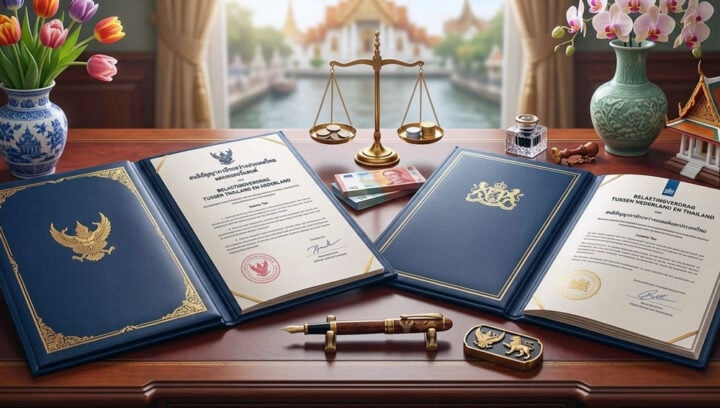
Value Articles 18 and 19 to be about the debt collection of tax money, is Article 22, that will be discussed next week, that of the settlementThese three articles give the Netherlands the full treatment and leave Thailand empty-handed. But we start with Article. With this article, the Netherlands has in the new treaty the primacy appropriated of all tax levies. Read how the comparison with the 1975 treaty looks like
In the new 2025 treaty, this is the text of Article 18, Paragraph 1: "Pensions, other similar remuneration as well as annuities and other benefits paid under the provisions of the social security legislation of a Contracting State to a resident of the other Contracting State shall be taxable only in the other Contracting State.
Paragraph 1 sounds beautiful so far: Pensions (…) paid to a resident of Thailand are taxable only in Thailand. This follows the tradition of the old treaty from 1975. Nothing to worry about, you might think: “I pay tax on my pension in Thailand, as is customary, and I simply get back the levies withheld monthly in the Netherlands via my annual tax return.” Paragraph 1 of 2025 resembles Paragraph 1 of 1975.
For the 1975 treaty states in Article Paragraph 1 a simple but powerful word: only: “Subject to the provisions of paragraph 2 of this Article and paragraph 1 of Article 19, pensions and other similar remuneration paid in consideration of past employment to a resident of one of the States and any annuity paid to such a resident,shall be taxable only in that State. "
This means that our pension only is taxed in Thailand. The Netherlands had no legal grounds whatsoever to withhold even a single euro. For many, this is the basis of financial planning in Thailand. In the new treaty, the word 'only' is being scrapped and replaced by a full Dutch claim. Paragraph 1 of 2025 puts us completely on the wrong track.
For in the new treaty of 2025, this is the text of Paragraph 2: "Notwithstanding the provisions of the first paragraph, pensions, other similar remuneration as well as annuities originating in a Contracting State, and other benefits paid pursuant to the provisions of the social security legislation of a Contracting State to a resident of the other Contracting State may also be taxed in the first-mentioned Contracting State.
Take a good look at it and remember a couple of words in the text of Paragraph 2: "Notwithstanding the provisions of the first paragraph, (which designate Thailand), may pensions (…) alsobe taxed in the first-mentioned contracting state (i.e. the Netherlands)." Which means that:The Netherlands as first-mentioned state levies taxes.
In the treaty of 1975 is Member 2 for a number of incomes a exemption methodThe Netherlands was allowed to 'see' the income to determine the tax rate on other income, but was required to actually exempt it from tax. As is done through the refund of payroll tax on ordinary pensions via the C-form.
Remarkable: in the 1975 treaty, the Netherlands has for pensions no right to levy, to such an extent not that in Article 23: “Elimination of Double Taxation”, that avoidance of double taxation does not even need to be mentioned. After all, there is no double taxation: only Thailand levies, or not, at its own discretion. The Netherlands stays off it!
All that will soon be over. In the treaty of 2025, Article 18 has a completely different status than it did back in 1975.
How is it possible that the Netherlands walks away with the money in Paragraph 2?, while Paragraph 1 states that Thailand may levy tax? The answer lies in the hierarchy of legal formulations: Paragraph 2 is the 'lex specialis', the special rule with absolute precedence over the general rule. The English text uses the word “Notwithstanding”. In modern Dutch: “in deviation from”. This legal jargon indicates that what follows is more important than what was stated earlier. Paragraph 1 states: Pensions are taxable in Thailand. Paragraph 2 states: But the Netherlands will levy absolute tax. With this, the Netherlands acquires 100% taxing power. A done deal for the tax authorities, a drain on our wallets.
OECD formulas and formats form the basis of the texts of the articles. See: https://www.oecd.org/en/topics/oecd-model-tax-convention-on-income-and-on-capital.html
3. Article 18: the 'fiscal vacuum cleaner' of the Netherlands
Whereas under the old treaty payroll tax was a temporary advance payment that you could reclaim via a tax refund, it is now becoming a definitive final levy. Our pension funds and the SVB are changing from payment agencies into the State's definitive collectors. They withhold the tax, but the government refuses to instruct them to apply the deductions to which you should be entitled. The collection is settled, but justice has been forgotten.
4. The Thai '2-year rule' and the Schumacker doctrine
Thailand intends a '2-year rule' (n+1) to introduce, whereby foreign income is only taxed if it is brought in from the second year after acquisition. But even if Thailand waives taxation, that is all the more reason for the Netherlands to grant tax credits. In the treaty, Thailand grants the taxation to the Netherlands. With the possible introduction this year of the 'n+1 rule Thailand waives the levy (which does not mean that Thailand abolishes the reporting obligation. That remains!).
In Schumacker doctrine under European law of the Court of Justice in Luxembourg, the crucial point is not or whether the country of residence levies taxbutwhether the country of residence is able to take into account the personal situation of the taxpayer. And that is no longer the case!
As soon as the Netherlands claims full taxing power via Article 18, it deprives Thailand of the actual ability to provide fiscal support through allowances. There is simply no 'fiscal mass' left in Thailand to actually cash in on those social corrections, deductions, and a tax-free allowance. In that situation, the obligation to protect the subsistence minimum shifts entirely to the source state: the Netherlands. But the Netherlands refuses because, by opportunistic reasoning, Thailand is not subject to EU law.
That is why, two weeks ago, in the Call to the Finance Committee of the House of Representatives, it was explicitly requested that Thailand be added bilaterally to the circle of countries. Anyone who has not yet sent the Call would be wise to do so without delay.
5. Article 19: Government pension moves
For the former civil servants among us (education, police, defense), the bottom line is that nothing changes regarding taxing power. Only a new legal framework has been formulated.
In the situation of 1975, the salaries and pensions of civil servants fell jointly under Article 19. The simple rule was: the State that pays is the State that levies. For a former civil servant, therefore, the Netherlands was always the tax-collecting authority.
In the new situation of 2025, Article 19 regulates the active salaries of civil servants who are still in service. The government pension technically moves to Article 18, Paragraph 2: the paragraph stating that the Netherlands as first-mentioned state levies taxes.
It is a formal reorganization according to contemporary OECD standardsAlthough this has no consequences for the tax burden in itself, the underlying message is clear: for the Tax and Customs Administration, any distinction is eliminated. Whether it concerns a private pension, an AOW benefit, or a government pension: the full levy now rests irrefutably and insurmountably with the Netherlands. If the funds were generated in the Netherlands, the taxation remains in the Netherlands. But with the obligations in the Netherlands, then also the rights from the Netherlands.
6. The door to Article 7.8, Paragraph 6 must be open.
The monthly withholding is no longer an advance payment, but an irreversible drain. Whereas the 1975 treaty still provided the basis for a refund, this right will be confiscated in 2025 because the door to qualifying foreign tax liability is locked.
The solution is as simple as it is just: add Thailand to the list of countries in Article 7.8, paragraph 6 of the Income Tax Act 2001. With this, the Dutch pensioner in Thailand experiences not only the burdens (100% levy), but also the benefits (tax credits) of our tax system. Articles 18 and 19 are the instruments with which the Netherlands has abolished fiscal borders to boost its own budget. It is the legal basis for what I already discussed in Part 1 as residence fine mentioned.
By bringing all forms of pension income under the Dutch flag, the Netherlands also assumes full responsibility. Consequently, the moral and legal obligation to ensure equal tax treatment – including the much-needed tax credits – rests entirely with the Dutch State. You cannot claim the benefits of collection without bearing the burdens of the human scale.
7. The Impact: the Circle of Countries a Bitter Necessity!
A new tax treaty with Thailand has thus been presented in the Netherlands, which will most likely enter into force next year. We will then have to deal with it in 2028 when filing our tax returns. The treaty itself is a fait accompli: the Netherlands and Thailand have signed, Thailand has agreed to taxation by the Netherlands, the Netherlands is in the process of ratification, and Thailand is following suit. Nothing will change regarding the treaty itself, which is determined by the OECD. Not the articles, not the content thereof, only the entry into force of the treaty.
The focus now is on the consequences of the implementation of the treaty. What we need to look at are the implications for our wallets. Is it fair that we in Thailand will soon have to pay tax to the Netherlands via those new Articles 18 and 19, while we do not receive the rights that Dutch citizens have elsewhere? Caution is advised, as it is expected that over the coming years, due to the fiscalization of social security, the tax portion in the first tax bracket will steadily increase.
7.1- How does that tax actually work?
To understand where the problem lies, we need to look at the structure of the taxes withheld from your income in the Netherlands. For 2026, there is a first rate of 35,75% on an income up to €38.883. Most of us have to deal with that disk. Of that, the State pension contribution 17,9%. State pensioners are exempt from this. Furthermore, there is a Wlz premium of 9,65% expats must register with the local municipality and obtain a ANW premium of 0,1%. You don't pay those two premiums in Thailand either. That is why you are not allowed to use it. That leaves a payroll tax of 8,1%. Adding those percentages together yields that 35,75%.
7.2- Fiscalization: the Danger of the Future
Since 2020, there has been a political discussion to fiscalize Wlz and Anw premiums. This increases the payroll tax from 8,1% by 9,65% and 0,1% to 17,85%. That is more than a doubling. It is to be expected that around 2030, we will all, both in the Netherlands and abroad, have to deal with this fiscalization. At the moment, the political debate surrounding the state pension is at a standstill. Fortunately, full fiscalization of the state pension contribution is still a contentious topic and is currently not part of the coalition agreement. However, the plan is on the table among senior civil servants as an option to finance the aging population. If that contribution is also fiscalized, we in Thailand will be in for a rude awakening. https://www.thailandblog.nl/lezers-inzending/aow-pas-op-de-plaats-het-politieke-idee-achter-de-motie-stoffer-markuszower-lezersinzending/
The issue is that we in Thailand, over the coming years, those 17,85% start paying. The same applies in the circle of countries, but that tax assessment is reduced by personal deductions and tax credits. The attempt is to persuade politicians in The Hague to add Thailand to the circle of countries.
In the Netherlands, a pensioner pays payroll tax and subsequently reduces that tax using credits and deductions. If necessary, they make use of the facilities under the Wlz and Anw. In Thailand, a pensioner pays the same tax on the AOW and pension, but no credits, no deductions, and no use of the Wlz and Anw if necessary.
Paying the same, but getting nothing in return! And why? Because Thailand is so cheap? Life is just as cheap in Bulgaria and Portugal. So that can't be the argument. That leaves only a deliberate geographical argument. And that can be twisted politically. That is the whole point!
7.3- What is the solution? The Circle of Countries!
If we manage to get Thailand into that circle of countries, you get the status of Qualifying Foreign Taxpayer (KBB)That sounds complicated, but it actually just means that you are seen as a full-fledged taxpayer again. What do you get with that?
i. The Tax Credits: In the Netherlands, everyone is entitled to tax credits. The most important ones for us are the General Tax Credit and the Senior Citizens' Tax Credit. In Thailand, we miss out on that. For a single person with a state pension and a small private pension, it quickly amounts to an amount between the €820 and €1.360 per year that you pay extra now, but will have extra in your household budget later. This is calculated using a division factor of 8,1/35,75. If the fiscalization of the Wlz and the Anw materializes to a levy of 17,85%, the loss will be double.
ii. The Fiscal Partnership: For many people in Thailand, this is the biggest advantage. If Thailand is included in the group of countries, you may designate your spouse as a tax partner. Does she have little or no income of her own? Then you can have part of her general tax credit paid out or offset it against your tax. Colloquially also known as the kitchen sink subsidy mentioned. You can just do this €400 to €800 extra yield per year. For a married couple, the total benefit can amount to as much as €1.200 to €1.600 per year.
iii. Towards €0,0 tax: a married pensioner with only a state pension of approximately € 14.400 currently pays gross on an annual basis € 1.166 regarding tax. If Thailand joins the group of countries and you have a tax partner, all those deductions combined ensure that the tax payable ultimately amounts to € 0,0. You then have your full net state pension, exactly the same as in the Netherlands for people with a low income. Thailand is not in the group of countries, and without KBB status, it costs him now € 1.166 to taxes, and much more later!
iv. The 90% requirement: to be eligible for the mentioned benefits, at least 90% of your worldwide income must be taxable in the Netherlands.
- Savings: The Tax Authorities calculate with a very low notional return. In Thailand, you can easily have many millions of Baht (up to 20 million) in the bank without exceeding that 90% limit.
- Own home: Owning a condo or a house in Thailand does count towards your Thai income (Box 3), but you will only run into problems if the value is very high.
- Living with 'usufruct': According to the Tax and Customs Administration, this constitutes a proprietary right, for which they charge a notional return. Naturally, this is less than for ownership.
v. Didn't you reach that 90%? Then nothing changes; you simply revert to the current situation of 8,1% tax without deductions. So you have nothing to lose, only to gain.
vi. A safety net in case of illness: perhaps the most underestimated “hidden gain” of the group of countries. A major problem in Thailand is that insurers often exclude pre-existing conditions from coverage. You pay a high premium, but still have to pay the most expensive bills yourself. Under Dutch tax law, those paid bills are, after all, non-reimbursed medical expenses. Provided one is (supplementarily) insured, the Tax Authorities often say “yes” to the deduction of specific healthcare costs under the KBB status, after calculating a threshold amount. This makes the inevitable healthcare bill considerably more bearable.
vii. Deduction of donations: applies to recognized (ANBI) purposes with KBB status.
viii: Spousal maintenance: is deductible as an 'expense for maintenance obligations'.
7.4- The Logic for Higher Income Groups
Now you might be thinking: 'I have a substantial income; those few hundred euros in tax credits won't make a difference to me.' But make no mistake. Although tax credits are phased out at higher incomes, the circle of countries offers an indispensable shield for everyone. Here too:
i. as a safety net in case of illness: It is precisely those who earn more who have often opted for high-quality (and expensive) care. Without a circle of countries, these medical costs are 100% at your own expense. With the status of Qualifying Foreign Taxpayer (KBB), your highest medical bill changes, under certain conditions, into a tax deduction, allowing you to recover a portion of those costs.
ii. in the case of Fiscal Partnership: Not a minor detail, but a structural advantage. Thanks to the Circle of Countries status, you are allowed to include your partner for tax purposes. The tax credits that you cannot (fully) utilize yourself still end up in your wallet via your partner. That adds up with any income.
iii. as protection against arbitrariness: Without the circle of countries, you will gradually pay the full 17,85% tax over a number of years due to political arbitrariness in The Hague, without any rebuttal. With the circle of countries, you are a 'full taxpayer'. This means that in the event of future tax increases or amendments to the law, you enjoy exactly the same rights and protection as a taxpayer in the Netherlands. You are then no longer an 'exported citizen', but a citizen with rights.
Summarizing: The circle of countries is crucial for small budgets, as it provides a necessary safety net for tax credits, but it offers fuller budgets just as much tax certainty and a predictable legal framework, for example against excessive flat-rate levies.
8. The burden of proof becomes easier
The good news is that as of January 1, 2026, the requirement for an official Thai signature on the income statement has been dropped. You still need to keep your annual income statements and bank statements (for interest), but the administrative hassle will be significantly reduced.
Finally: The attempts to get Thailand included in the circle of countries are not a beg for a privilege, but a plea against an unjust 'residence penalty'. The Dutch pensioner in Thailand must be treated according to his personal situation and financial capacity, just like a former colleague in the Netherlands or a celebrity in Spain.
Have you not yet submitted the Call to the Finance Committee? Then go ahead and do so. https://www.thailandblog.nl/expats-en-pensionado/hordelopen-in-het-belastingverdrag-nl-th-2025/
Next week Part 3: The Tax Credit Paradox – How the Netherlands appropriates the profit in the Theatre of the Zero Return.
Submitted by: Ruud B.
About this blogger
Read the latest articles here
 Reader questionMay 1, 2026Thailand reader question: computer shop in Isaan?
 Living in ThailandApril 30, 2026Diary of a Thailand Traveler (Part 35) – The stone I keep running into
 Reader questionApril 29, 2026Thailand reader question: Which documents do I need to open a bank account at Krungsri Bank?
 Tax in the NetherlandsApril 28, 2026Hurdles in the NL-TH 2025 Tax Treaty – Part 2: Articles 18 and 19 – The Architects of Power (reader submission)
Another clear piece from Ruud; my sincere thanks for this. I am very curious how politics will react to the country classification. I recently wrote to the Financial Committee, the Council of State, as well as all the parliamentary party leaders of the House of Representatives about this, although I started doing so as early as last year. I received only one reply, which amounted to an acknowledgment of receipt. I have serious doubts that anything will change, and the inequality, or rather discrimination, will persist. As a pensioner, especially outside the EU, you simply don't count anymore. Nevertheless, it is good to keep reacting to this discrimination. I think that if they don't change it, it will fail in the (European) courts; however, who is going to raise that issue there?
Compliments on this crystal-clear message.
Call to the Commission sent by email today
Hello Ruud, B.
Thanks again for this next chapter. It is quite a challenge to understand everything if you are not well-versed in this subject matter. Is it a good idea to bundle all your documents and send that to the Finance Committee as well?
Thanks again.
Ruud
My compliments on your explanation. I can follow it reasonably well.
and
Point 8: The burden of proof towards the Netherlands becomes easier.
And to Thailand?
I understand that Thailand is also allowed to levy taxes (with the application of a tax credit, it becomes 0). Especially if they might require the legalization of the Dutch annual statements/assessment notices in Thailand.
I am already experiencing problems with my tax return in Thailand.
LeoP
Preaching to the choir is certainly nice for those living in Thailand. But if the circle of countries is considered objectively, one quickly arrives at other countries such as Morocco and Turkey, with major financial consequences if they were admitted to the circle. Just explain to me why Thailand would be admitted to this circle and other countries not; that is why I am quite certain that the circle is not being expanded, because if one country is added, it means that other countries have just as many rights and must also be admitted.
The argument that pensioners should be treated the same way based on personal situation and financial capacity is another one of those things. Housing costs, groceries, and transport costs are significantly lower than in the Netherlands, and that actually argues against including Thailand in the circle of countries. That someone with lower income or assets moves to Thailand is still their personal decision and results in everyone's individual situation; arguing afterwards that it turns out financially unfavorably in certain areas is a consequence of the choice to move, just as you might choose to pay 1000 euros for a ticket to go to Thailand, whereas a pensioner in the Netherlands does not have to pay this. Therefore, citing personal situation and financial capacity makes no sense, because then you would also have to mention to the politicians that
you end up saving a lot of money in many areas, because only then are you telling an honest story.
Dear Ger Korat,
I fully agree with the first part of your response.
There are certainly a few remarks regarding the second part of your response. Regarding cheaper living conditions, you are overlooking a significant financial aspect, namely the expensive health insurance, which takes a large bite out of spending. But the most important fact, in my opinion—and I speak for myself now—is that my well-considered decision to emigrate was based entirely on existing laws and regulations. Some disadvantageous (expensive health insurance), others advantageous (existing tax rules). Naturally, I have also factored in potential financial setbacks and can absorb a reasonable number of them.
The fact remains, however, that the Netherlands is going to change the rules of the game during the game (conscious, well-considered emigration). And it is difficult to adapt to that if you have already emigrated. In my opinion, that is the biggest problem.
That is also part of the 'honest story'.
Dear Ger, I already have the answer ready for a reply like yours. So I can respond quickly. In a separate article, I will ask the Editors to publish it tomorrow. Your response is the classic example of the “moralistic headwind” that we will be seeing more of. The series still has 10 parts left. You cite three commonly heard arguments: the precedent effect (other countries), the cost of living (it is cheap in Thailand), and personal choice (you wanted to leave yourself). I will fine-tune all three tomorrow.
For now, I do find it fascinating once again that you, as a Dutch national in Thailand, are advocating for a 'residence penalty' for yourself. The fact that you paid for the 'ticket' means you exercised your right to freedom of establishment. It does not mean that you surrendered your right to equal tax treatment at the gate at Schiphol back then. The ability-to-pay principle is universal; it does not stop at customs at Schiphol. Precisely because you live in Korat, you should understand that we are fighting for legal certainty, not for a handout. More tomorrow.
Jowe says on April 15, 2026 at 07:16
I don't know anything about this, but could it be that they prefer to sweep these kinds of matters under the rug?
Could it be that they are not publicizing it because they might receive claims from “Dutch people” who have obtained Dutch nationality and are now living in their home country again?
Would it be possible that half of Morocco or Turkey will soon start making claims and potentially also want to be entitled to Dutch health insurance while living somewhere else?
Is there anyone who has an answer to that?
Ger, because you are afraid that Morocco and Turkey will also be added to a list of countries with KBB status, you say that we in Thailand shouldn't complain. We brought it upon ourselves that, in the long run, our tax rate of 8,1% will shift to that 17.8%, or more if the state pension is also taxed.
It is our own fault, that is your reasoning; we shouldn't have gone to live in Thailand. A very strange line of reasoning, because you are giving the Dutch government carte blanche to do whatever they want with our state pension and private pensions. If we remain silent, we consent. Be glad that there is one person sounding the alarm and trying to convince and mobilize us. He does not do this with an opinion; he provides arguments, facts, and figures.
Even if the politicians in The Hague remain silent and declare the treaty acceptable, the next step rests with the interest groups. Stichting Goed recently made itself known on Thailandblog, and Stichting NIHB also appeared to be on board. These foundations have contacts in The Hague and hold periodic consultations with civil servants and politicians, as stated on their websites. If recourse to the courts proves necessary, they will have to act as representatives.
If nothing is heard from the pensioners in Thailand, and we just sit quietly in a corner and think it’s all fine because it’s so cheap here, what is the motivation for those foundations to come to our aid? Now that you have indicated that you do not mind losing more of our state pension and private pension amounts to taxes due to further fiscalization in the Netherlands, I may surely assume that you will remain silent during the rest of the discussion, because whining is of no use to us.
I am sitting here with a small pension alongside my state pension, and if you have read the impact in the article, surely you understand that Ruud B.'s calculations apply to me. It doesn't bother you otherwise, so I'm done with you.
No, Ger-Korat, you make a decision to move to Thailand based on the rules and laws in force at the time. What the Netherlands is doing is just like changing the rules of the game at half-time in a football match. I moved permanently to Thailand in early 2004, and I knew my Dutch health insurance would stop; I never complained about it. But the fact that in 2015, Messrs. Wilders and Rutte, in a dirty game, would strip/steal the payroll tax credit and elderly tax credit from people going to Thailand is not complaining afterwards, but rightly protesting against an unfair change in regulations. And in the current situation, using ability to pay and lower cost of living as justification for a new, incorrect change to rules and laws is, of course, nonsense. The only reason is to squeeze pensioners outside the circle of countries even further due to the budget deficit. Moreover, people in The Hague think those people don't have enough clout to fight back.
No Rob, they are going to change the rules after the match, not during. If we follow your reasoning, nothing should ever be allowed to be changed because once you live in Thailand, NOTHING can be changed anymore. Nonsense, of course.
What about pension legislation, for example? The retirement age has been continuously pushed back. Was this during or after the game? Everyone is feeling the impact.
Be glad that anything at all is being done to keep the budget deficits under control. The selfish attitude of many is a disgrace to our descendants. My grandchildren also have a right to a pension and a decent social safety net. Or perhaps you want the system of Thailand? The choice is yours…
Dear Andrew,
Of course, the rules may be adjusted over time. That is not pleasant, but sometimes it is simply necessary.
However, a transitional arrangement must also be made for those who have emigrated based on currently applicable rules and laws. As it stands, many will soon be faced with additional costs that were not in effect when the decision to emigrate was made.
It is a bit like deciding to have an expensive swimming pool installed with the agreement that the maintenance will be provided free of charge by the contractor for the next 10 years, and then after just one year the contractor casually tells you that the maintenance is no longer free and that you have to pay a hefty sum for it. If you had known that beforehand, you probably would have made a different choice as well.
It is the same here. The emigration of many is based on rules and laws that now threaten to be changed AFTER the emigration. They can do little to change that anymore. That is the point.
Still hardly 'a bit the same', Raymond: upon your departure from the Netherlands, of course, no promises were ever made or agreements reached that nothing would change in the relevant legislation and regulations in the years that followed…….
Major personal decisions, such as emigrating abroad, always involve a risk; no one guarantees that everything will remain the same. Even in your 'new' country, the situation can change so fundamentally over time that, had you known this at the time, you would have made a completely different decision. Are we talking, then, about 'changing the rules during the game'? I don't think so……
Then we disagree, Cornelis.
The government is, of course, allowed to change rules and laws, but that same government must also act properly. If the government changes existing rules and these could have detrimental effects on citizens or businesses, then the interests of citizens or businesses must be taken into account.
In the event of far-reaching changes (such as tax rules or, for example, state pensions or housing allowance), transitional provisions are often included to limit the damage and give citizens and businesses the opportunity to adjust their investments and spending patterns. Therefore, if existing cases (those who have already emigrated) were to be included in a form of transitional arrangement, that would simply be good governance. Emigrated citizens can do little to change the fact that they have emigrated. The government could also abolish the mortgage interest deduction, but surely a transitional arrangement would be made in that case as well?
I thought so….
There are an estimated 10.000 Dutch people living in Thailand, a significant portion of whom are pensioners.
Would those 10.000 pensioners really reduce the budget deficit?
Every little bit helps, Werner; any sensible person knows that.
Fleeing your country in the hope of being spared from every change is really hypocritical.
Many farang want to enjoy a dirt-cheap life in Thailand BUT continue to benefit from all the advantages their own homeland offers them. Well, those many advantages simply come with a price tag, a price tag that can fluctuate…
I think many Thais would want to trade places with us. A well-established pension, the ability to still receive high-quality medical care in your own country if needed, and many other advantages that a Thai person simply does not have.
But anyway, the blog has made it clear many times that when it comes to money, many here put up strong resistance. Is it really all that dramatic???
I agree with you, Jacob. However, it could be dramatic for a small group that might no longer be able to meet the income requirement.
Dear Bert, I think Jacob is wrong. Studies are underway in the government departments to set up a completely different type of tax system. The social security contributions we know in the Netherlands, such as for the AOW, Wlz, and Anw, will disappear, and to cover the costs, those contributions will be incorporated into income tax. We will also pay that income tax in Thailand. The AOW will simply contribute via income tax, and to compensate them, the elderly tax credit will increase significantly. And that happens to be one of the tax credits we do not receive in Thailand, besides the standard general tax credit. The reactions to the articles in *Hordelopen* are very naive. I think most people only read those articles halfway, because judging by the reactions, the gist is not being properly understood.
Jacob, I think you really need to read Ruud B.'s submissions again carefully, because you haven't understood. The group of pensioners in question precisely does not benefit from all the advantages because they have permanently emigrated to Thailand. Under the new treaty, they will immediately start paying taxes, and that is it. What you are talking about are the pensioners who can afford to live in the Netherlands for 4 months and in Thailand for 6 months. A 6-month round trip. After all, you say: "if necessary, you can still receive high-quality medical care in your own country." Yes, they can, because they have one foot in the Netherlands, benefiting from all the good things in the Netherlands and all the cheap things in Thailand. But that is not the group we are talking about. The SVB states that there are between 10.000 and 12.0000 Dutch people living in Thailand. Of those, about 5.000 are permanently receiving their state pension in Thailand. The other 7000 is the group you are referring to. And then what you say is correct: “Quite a few farang want to enjoy a dirt-cheap life in Thailand BUT continue to benefit from all the advantages their own home country offers them.” Warnings have been issued frequently that the SVB might conduct a residency investigation after living in the Netherlands for 4 months. Let’s hear how they react then. Those who live in Thailand and also benefit from the Netherlands are the ones who already enjoy tax credits and deductions. So they simply have their health insurance in the Netherlands as well. Once again: it is not about that group. Inform yourself better.
Ruud B,
Thanks again for your article.
I wonder if the Dutch government has already concluded many new agreements with countries outside the EU, and particularly in Asia.
And if so, are these based on an agreement that closely resembles that of Thailand and the Netherlands?
Then I fear that getting Thailand into a circle of countries stands little chance.
What bothers the Dutch government most, I suspect, is that the net pensions are being paid out in Thailand.
So for the Netherlands, no revenue from VAT and excise duties, etc., causing them to miss out on a significant source of income.
So that's why there are no tax credits?
I think people do not know what the Netherlands means today.
Of course, you may try to make the government think differently, but it will not work.
Even if you were to litigate, you still wouldn't win. People disregard the court ruling and muddle along.
I give you the “benefits scandal”: 70000 people trampled over about 20 years, both financially and mentally.
Condemning a man of integrity and wishing him somewhere else! Right? You recognize that, don't you?!
Do you really think this game is being turned in your favor? NO way, Jose.
They discourage you and want to keep you trapped in the Netherlands, certainly not let you go to Thailand.
You should be glad they haven't followed “opinion maker” Annemarie van Gaal yet.
No more state pension if you are outside the EU!
The government is now going to help due to high gasoline prices; selected groups will receive some compensation.
The rest is nothing. Even better, they do that by raising the tax on alcohol!
So if you are in a selected group, you compensate for it yourself should you drink alcohol.
People who do not drink alcohol and are in a certain group are the winners.
The government helping you from the frying pan into the fire, from the frying pan into the fire
Another example? An elderly couple (in their 80s) committed suicide after contact with the government.
The government imposed a fine of 30000 euros on them in the game “to live or not to live in a holiday park”
Sad, sad in man.
We let Greece stew in its own juices as much as possible. Ukraine is now receiving loans worth 90 billion euros.
I won't go into further detail, but that is our government today.