
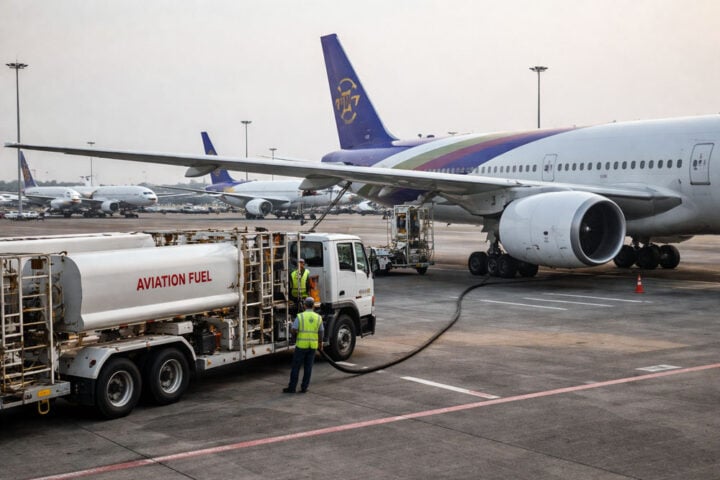
The likelihood of planes remaining grounded due to a kerosene shortage is increasing by the day. As long as the Strait of Hormuz remains closed, pressure on global supplies continues to mount. Asia, in particular, and to a slightly lesser extent Europe, are vulnerable, as both regions rely heavily on oil from the Gulf and on refineries in that region. However, it remains unclear when the first real shortages will become apparent.
Meanwhile, experts, industry associations, and energy companies warn that difficult choices may be necessary within a few weeks. Smaller airports and some airlines, in particular, risk facing partial cancellations.
Shortages are drawing closer
In Paris, concerns are growing that a shortage of aviation fuel could quickly become a reality if the situation around Hormuz does not change. The Strait of Hormuz is of great importance to the global energy market. Before the war, approximately one-fifth of all crude oil and liquefied natural gas passed through this route. Since the United States and Israel began bombing Iran on February 28, shipping traffic there has been virtually completely blocked. According to energy consultancy Rystad, the situation could become systemic within three to four weeks. This means that the problem will no longer be local or temporary, but could cause a broader disruption to air traffic.
Europe feels the pressure, but not every country equally.
Energy economist Claudio Galimberti said on CNBC that Europe could face significant restrictions on the number of flights as early as May and June. He also stated that flights have already been cancelled due to fuel problems. The European Commission partially contradicted this picture, saying that there are currently no indications of shortages in the European Union. However, Brussels acknowledged that supply problems could arise in the near future, particularly regarding aviation fuel. Vulnerability varies widely within Europe. Austria, Bulgaria, and Poland have ample stocks, while Great Britain, Iceland, and the Netherlands are in a weaker position. France occupies a middle position.
Warnings for May and June are piling up
The warnings are becoming more concrete. Airports Council International Europe wrote to the European Commission last week that shortages could arise within three weeks, i.e., early May, if tankers do not sail through Hormuz again sooner. IEA chief Fatih Birol also warned that Europe could be hit in early May. In its most recent monthly report on the oil market, the International Energy Agency issued a slightly later estimate. It states that European stocks could fall back to the critical level of 23 days in June if the global market comes under further pressure and Europe manages to absorb less than half of the lost volumes from the Middle East.
Not every airport and airline is hit equally hard.
According to economist Rico Luman of ING Bank, smaller domestic airports in particular will be in a weaker position than major hubs. He does not expect a complete standstill of air traffic, but rather partial cancellations at certain airports and airlines. This is especially difficult for airlines, as they have little insight into the exact fuel schedule. Trade association Airlines for Europe, which includes Air France-KLM, Lufthansa, and Ryanair, among others, therefore wants the European Union to make real-time information available regarding aviation fuel stocks at airports. This data is currently held primarily by fuel suppliers, who are reluctant to share such commercially sensitive information with their largest customers.
Oil companies and the aviation industry are seeking emergency solutions.
A stern warning is also coming from the energy sector. TotalEnergies stated that the company will not be able to supply all its customers if oil supplies from the Gulf remain blocked in June. CEO Patrick Pouyanne said that in the event of a war and blockade lasting longer than three months, serious supply problems will arise in some areas, including for jet fuel. Airlines for Europe has therefore proposed that the European Commission exceptionally allow the import of American jet fuel, even though it is produced according to a slightly different standard than in the rest of the world. Due to political and logistical obstacles, it is unlikely that such a solution will become available soon.
The threat is therefore not yet an acute European fuel crisis, but the window is narrowing rapidly. This is relevant for travelers to and from Thailand, as disruptions in Asia and Europe can reinforce each other. If the blockade persists, partial flight cancellations will become increasingly realistic in the coming weeks.
Source: Bangkok Post
About this blogger

-
This article has been written and reviewed by the editorial team. The content is based on the author's personal experiences, opinions, and independent research. Where relevant, ChatGPT was used as a tool for writing and structuring text. We also sometimes generate photos using AI. Although the content is handled with care, it cannot be guaranteed that all information is complete, up-to-date, or error-free.
The reader is responsible for the use of the information on this website. The author accepts no liability for any damage or consequences resulting from the use of the information provided.
Read the latest articles here
 Expats and retireesApril 16, 2026Transferring money to Thailand in 2026: how to compare costs, exchange rates, and speed
 Expats and retireesApril 16, 2026Work permit for Thailand in 2026: this is what you need to arrange step-by-step as a Dutch or Belgian national.
 Expats and retireesApril 16, 2026Hans Dekkers looks back on living, working, and surviving in Thailand after 35 years (video)
 Expats and retireesApril 16, 2026Paying for water and electricity in Thailand: how to arrange it smartly, safely, and as automatically as possible