

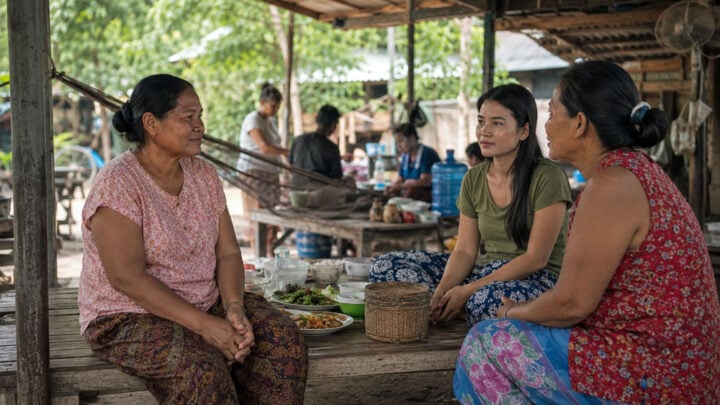
Anyone who is a farang in a relationship with a Thai woman will sooner or later have to deal with the stares and judgments of those around her. Not only from her family, but also from friends, neighbors, and strangers on the street. What do Thai women actually think among themselves about a relationship with a foreigner?
The answer is not a short one. There is no such thing as “the Thai woman,” and therefore no unanimous opinion. What a market woman in Udon Thani thinks differs fundamentally from what a lawyer in Bangkok thinks. Research by Thai universities shows that the conversation about this is rarely solely about love. It is also about class, status, a sense of duty, and the tension between tradition and modern life.
Class and region determine the verdict
The sharpest dividing line runs along class, not between men and women. In Isaan, the poor northeast where most farang-Thai couples come from, marriage to a foreign man has become increasingly common over the past twenty years. Anthropologist Patcharin Lapanun of Khon Kaen University conducted two years of fieldwork in a village in Udon Thani. She interviewed 26 women who were married to a farang and concluded that together they form a new middle class in the countryside.
These women live in larger houses, drive better cars, and donate an above-average amount to the temple. At ceremonies such as the pha pa collection, they are often the largest donors. Among village women, this results in a mix of admiration, jealousy, and criticism: admiration for those who lifted their families out of poverty, jealousy because they are better off than their neighbor, and resistance from the old local elite who see their status slipping away.
In Bangkok, a different sound is heard.
In the big cities, the situation is different. There, the image of the mia farang often still persists as a woman who supposedly sold herself for money. Anthropologist Sirijit Sunanta demonstrated that it is precisely Thai women from the urban middle and upper classes who pass the harshest judgment. They view women who marry a farang as a stain on the image of Thai women in general.
The greatest criticism, therefore, does not come from men, but from other women. On forums like Pantip, in Thai media, and in daily conversations, judgments such as “uneducated,” “materialistic,” and “shameless” regularly surface. This judgment affects not only women from Isaan but resonates far beyond the countryside. Many Thai women with a farang notice that they are never entirely free from that gaze, no matter how much they achieve.
The myth of money
The common assumption, even among Thai men themselves, is that women choose a farang for the money. The research points to a different pattern. Two out of three women Lapanun spoke to had previously been married to a Thai man. In most cases, that experience ended disappointingly: alcohol abuse, infidelity, and little responsibility for wife and child.
A mother told Lapanun that she herself had encouraged her daughter to choose a foreigner. Her reasons: in her eyes, Thai men were unfaithful, took no responsibility, and never had enough money to support their families. According to the research, what village women value among themselves in farang men is primarily a combination of fidelity, supporting the entire family, and not drinking or gambling. Money plays a role, but it is intertwined with reliability and a duty of care.
A new generation is changing the picture.
The stereotype of the poor, uneducated rural woman marrying an older Western man is becoming less and less accurate. Researcher Supitchaya Promboon of Thammasat University analyzed dating sites and social media and observed a clear shift. A growing group of young, middle-class Thai women between the ages of 18 and 30 are consciously choosing a Western partner. These women are educated, have their own income, and are not financially dependent.
Their motivation lies more in lifestyle, communication, and equality in the relationship. Among women, this results in a nuanced conversation. In some urban circles, this choice is considered emancipatory: a Thai woman choosing herself and no longer accepting what traditional roles expect of her. In other circles, the old stigma persists, and even the highly educated farang bride is sometimes pigeonholed into the same category as the mia farang from a village in Isaan.
What women really tell each other
The word mia farang has traditionally carried a double meaning. Literally, it means “wife of a foreigner,” but to Thai ears, it often resonates with more. Its roots lie in the 1960s and 1970s, when American soldiers were stationed in Isaan and some Thai women were referred to as mia chao, “hired women.” That association with prostitution persists today, even though the reality has little to do with it.
Researcher Paul Statham found that many "mia farang" (foreign nationals) live in a kind of social in-between space. They have achieved a great deal materially, but other Thai women often keep them at a distance. In private circles, at the market, and in Facebook groups, women primarily exchange practical matters among themselves:
- warnings for specific nationalities or age groups with which there have been bad experiences;
- tips to distinguish a serious farang from a tourist;
- comparisons of the monthly amount that goes to the in-laws;
- stories about visas, residence permits, and retired couples who are suddenly at home together 24 hours a day.
The tone among women is usually more pragmatic than moralistic. The stigma comes mainly from the outside, from Thai media and from women from other classes. Within their own circle, the conversation is primarily about how to make it a good marriage.
What remains unknown
Hard figures on the number of farang-Thai marriages in 2026 are lacking. A frequently cited government census from 2004 mentioned nearly 20.000 Isaan women with a foreign husband, 87 percent of whom had a Western husband. Recent official counts are not available. Most ethnographic studies also date from the period 2010 to 2020. The broad outlines likely still hold true, but the rise of dating apps and social media may have shifted the picture in recent years in ways that research has not yet captured.
Slot
What Thai women think among themselves about farang relationships depends heavily on who you ask. In Isaan, the conversation is pragmatic and increasingly accepted. In the urban middle class, the old stigma still persists. The assumption that it is only about money is too simplistic. Anyone who is a farang with a Thai woman would do well to realize that she constantly lives with those judgments.
Sources: NUS Press, Springer, Wiley Online Library, Prachatai English, The Isaan Record, Khaosod English
About this blogger

-
This article has been written and reviewed by the editorial team. The content is based on the author's personal experiences, opinions, and independent research. Where relevant, ChatGPT was used as a tool for writing and structuring text. We also sometimes generate photos using AI. Although the content is handled with care, it cannot be guaranteed that all information is complete, up-to-date, or error-free.
The reader is responsible for the use of the information on this website. The author accepts no liability for any damage or consequences resulting from the use of the information provided.
Read the latest articles here
 BackgroundMay 7, 2026This is how the money machine of a go-go bar on Soi Cowboy works: rent, drink prices, cash, and profit
 Living in ThailandMay 7, 2026Investing in your partner's Thai business requires firm agreements.
 OrganizationsMay 7, 2026What Thai women really think about a relationship with a farang
 Money and financeMay 7, 2026Foreign nationals in Thailand often lose their home, money, and rights after a relationship breakdown.