
More and more Western men in Thailand are consciously choosing a life without a Thai partner.
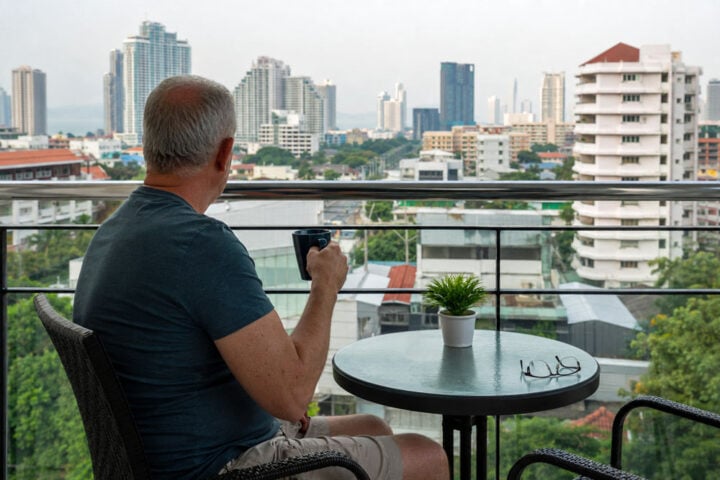
In the bars of Pattaya, on Facebook groups for retirees, and in the condo hallways of Hua Hin, one image predominates: the older Western man with a much younger Thai partner. For a large group of expats, that picture holds true, but it is far from the whole story. An increasingly visible group of Dutch and Belgian men in Thailand are choosing the exact opposite.
No girlfriend, no marriage, no in-laws, and no money flowing towards Isaan. Just living alone, and being content with that. That choice goes against a strong social norm in farang circles, where being single is often seen as an intermediate phase rather than a final destination. Yet, more men are consciously taking that position.
The man who doesn't fit the stereotype
The typical reader of Thailandblog is male, over fifty, and has a connection to Thailand that usually originated through a partner. Many retirees also live there not so much because they consciously chose the country, but simply because their Thai partner lives there. Within that reality, the group choosing to live solo stands out particularly.
They are often men who have already been married, sometimes in the Netherlands or Belgium, sometimes in Thailand itself. Some are widowers, some are divorced, and some have never been married. What they share is experience. They know what a relationship in Thailand looks like from the inside, with all the financial obligations, cultural misunderstandings, and family expectations that come with it. And they have decided that starting over is no longer worth their energy and peace of mind.
Three reasons to consciously stay single
The motives vary, but a few themes keep recurring in reader submissions, forums, and conversations.
- Financial. A relationship with a Thai partner often entails obligations that extend beyond the two of them. Money for the in-laws, caring for grown-up children, loans to family, and a house that is never legally truly in your name. Those who live off their pension and have to keep a close eye on the numbers sometimes choose a life without that pressure.
- Cultural Misunderstandings in intercultural relationships hit harder than in casual encounters. Money, jealousy, family, and loss of face become intertwined. What the partner says about Thailand is easily confused with what Thailand actually is. Those who have experienced this before sometimes view a new relationship as a repetition of the same pattern.
- Personal. After decades of work, family, and obligations, some men finally want to experience what it is like to wake up alone, have breakfast alone, and structure their own day. Not out of bitterness, but out of curiosity.
A long-term German study among people aged 40 to 85 shows that those who consciously remain single score higher on life satisfaction over time. The difference in loneliness between people with and without a partner even decreases in later life.
Being alone is not the same as being lonely
Herein lies the core of the story, and this is where many discussions go wrong. Being alone and being lonely are not the same thing. The Netherlands Interdisciplinary Demographic Institute published figures in March 2026 showing that retirement migrants do not feel more emotionally lonely than their peers at home. To the statement “I often feel abandoned,” 8 percent of retirement migrants answered affirmatively, compared to 10 percent in the Netherlands.
The difference lies elsewhere, namely in social loneliness: the lack of acquaintances, neighbors, and club contacts. For expats who are consciously single, this is an important fact. The emotional void that a partner is supposed to fill turns out to be less persistent than is often assumed. What does need to be actively filled, however, is the surrounding social fabric. Men who manage to do this for longer exercise, learn basic Thai, have a regular restaurant where they are welcome, call family back home regularly, and know a handful of farangs they see not only in the pub.
Why Thailand might be particularly suitable for this choice
Although Thailand is often presented as ideal for couples, the country offers several advantages for those who wish to be alone that are less self-evident in the Netherlands or Belgium. The cost of living is lower, meaning that with an average pension, you have more room for sports, culture, travel, and healthy food. The climate makes daily exercise easier. Markets, eateries, and neighborhood cafes offer everyday social contact without the need to schedule an appointment. Moreover, the Thai attitude towards the elderly is generally more respectful than in Europe.
At the same time, Thailand is not an obvious choice for seniors living alone. Healthcare requires personal insurance and personal funds, legal protection in the event of illness or death differs from that at home, and those who do not speak Thai are dependent on friends or paid help for formal matters. Living alone by choice works best for people who have their affairs in order, actively manage their health, and do not leave their social life to chance.
The silent backlash you need to take into account
There is a side of this story that cannot be left out. Many expats experience a psychological setback the moment Thailand is no longer a holiday, but has simply become their life. Awareness of mental health is low in Thailand, and the stigma surrounding seeking help is persistent. Moreover, for those living alone, an important early warning system is lost: the partner noticing that things are deteriorating.
Men who choose to be single by choice would do well to take this risk seriously. In concrete terms, this means having a Dutch- or English-speaking support worker on standby, a few people who can ask without embarrassment how things are really going, and honestly monitoring the difference between rest and isolation yourself. Being content with being alone requires maintenance, just as a good relationship does.
How to make this choice workable in practice
Scientific research paints a nuanced picture. Men living alone score slightly lower on subjective well-being on average than married men, according to long-term Japanese research, among others. However, that average hides large individual differences. Those who are socially active, do volunteer work, maintain a network, and stay physically active often score just as high or higher than their married peers. In the United States, approximately one in five older men lived alone in 2023, and that group is growing.
For those considering intentionally staying alone in Thailand, these are the key building blocks:
- Choose a place to live where you can lead a normal life without a car and without a partner, with a market, doctor, gym, and eateries within walking distance.
- Learn at least the basics of Thai. Not for deep conversations, but to be visible as a resident rather than a tourist.
- Build a social network that consists not only of drinking buddies. A sports club, volunteer work, a reading group, or a walking group does more for your mental health than a regular stool at the bar.
- Organize your paperwork properly: health insurance, a trusted contact person for emergencies, a will that aligns with Thai practices, and clear agreements regarding your important documents.
- Keep your connection with home alive. Regular video calls with family and friends, an annual visit where possible, and a bank account and address that continue to work in the Netherlands or Belgium.
- Be honest about your boundaries. Anyone who says they want to remain single on principle, but is looking for company every evening, is in fact not making a conscious choice. That is no shame, but it is something to acknowledge.
For decades, the Thailand dream for the Western man has been sold as a package: a warm climate, lower costs, and a younger partner. Those who fully adopt that dream sometimes find themselves in a reality where the partner comes to dominate social, financial, and cultural life. Consciously remaining single breaks that package and separates living in Thailand from having a Thai relationship. For those who know themselves well, this is not a consolation prize but a valid choice.
Sources: Thailandblog.nl, Netherlands Interdisciplinary Demographic Institute, AARP, Journal of Gerontology
About this blogger

-
This article has been written and reviewed by the editorial team. The content is based on the author's personal experiences, opinions, and independent research. Where relevant, ChatGPT was used as a tool for writing and structuring text. We also sometimes generate photos using AI. Although the content is handled with care, it cannot be guaranteed that all information is complete, up-to-date, or error-free.
The reader is responsible for the use of the information on this website. The author accepts no liability for any damage or consequences resulting from the use of the information provided.
Read the latest articles here
 Expats and retireesMay 9, 2026Older Thailand expats often unknowingly lose control over their finances and home.
 HealthMay 9, 2026A Thai pharmacist treats much more than just your cold.
 Expats and retireesMay 9, 2026More and more Western men in Thailand are consciously choosing a life without a Thai partner.
 Expats and retireesMay 9, 2026Emigrating to Thailand: this is the capital you really need to live comfortably