

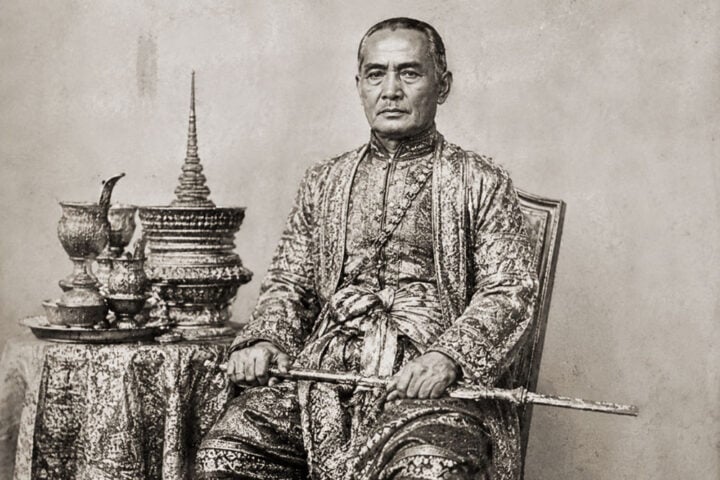
Imagine a country literally lying in pieces. Cities destroyed, the government fragmented, warlords fighting each other. That is what Siam looked like after the old capital, Ayutthaya, was burned to the ground by the Burmese in 1767. Fifteen years later, that came to an end, but not peacefully.
What happened in April 1782 is still read in Thailand with mixed feelings. It is the beginning of the modern monarchy, but also a story of a coup, an execution, and questions that remain unanswered to this day.
A country that had fallen apart
To understand why a general could simply become king, you need to know how deep Siam was in trouble. The fall of Ayutthaya in 1767 left the kingdom divided and vulnerable. The Burmese armies had almost completely destroyed the old capital. What remained was a patchwork of regions under rival rulers.
In that chaos, one man rose up: Taksin. He played a leading role in the liberation of Siam after the second fall of Ayutthaya and reunited the fragmented country. He founded a new capital in Thonburi, on the west bank of the Chao Phraya. Under him, a promising military man, Thongduang, served alongside his younger brother in the wars against the Burmese. Thongduang rose to become the country's strongest military commander and received the noble title Chao Phraya Chakri. It was under that name that he would go down in history.
The coup of 1782
In the final years of Taksin's reign, things went wrong. According to surviving accounts, the king exhibited increasingly strange behavior. A French missionary staying in Thonburi at the time wrote that Taksin spent all his time praying, fasting, and meditating, convinced that this would enable him to fly. Whether those reports provide an accurate picture remains questionable. They largely date from a time after the seizure of power, and it is quite conceivable that they served primarily to justify the coup.
What is certain: an uprising broke out. The coup against Taksin was initially led by Phraya San, whose troops captured the then-capital, Thonburi. Chao Phraya Chakri was far away at the time, on a campaign in Cambodia. The unrest in the capital brought him back in the spring of 1782. On April 6, he ascended the throne of Siam. With that, the Chakri dynasty was born.
How did Taksin die? A question without a conclusive answer.
This is where the story gets uncomfortable, and let's be honest: the sources contradict each other. It is certain that Taksin was executed after his removal from office. How he died is another story.
One version follows the traditional Siamese method for executing people of royal blood. The victim was placed in a velvet sack and beaten to death with a club made of fragrant sandalwood. The idea behind this: royal blood was not to touch the ground. This version is the best known in Thailand and is often taught in schools.
Another account is much more direct. According to the Thai chronicle, Chao Phraya Chakri decided to have the deposed Taksin put to death. Taksin was reportedly beheaded in front of the Wichai Prasit Fort in early April 1782, after which his body was buried at Wat Bang Yi Ruea Tai. The exact date of death varies by source, as does the method. No single account can be identified with certainty as the correct one.
There is even a persistent rumor that the entire execution was staged. According to that story, someone else was in the sack and Taksin escaped to the south to spend his final years there. Historically, that is unlikely. At that time, it was customary to kill all the heirs of a deposed ruler as well, precisely to rule out future claims to the throne.
Why this is still a sensitive issue
You would think that an event from over two centuries ago is undisputed by now. In Thailand, however, the situation is different. The issue touches upon the legitimacy of the current dynasty, and that makes it politically charged.
During a commemoration day of the Chakri dynasty, demonstrators held a protest with banners reading “April 6, who killed King Taksin?” and reenacted his execution. For some Thais, therefore, 1782 is not a closed chapter in a history book, but a question that still resonates in the present.
The Bangkok Foundation
His first major act as king was the relocation of the center of power. Taksin's palace was situated on the west side of the river, vulnerable to a Burmese attack from the west. Rama I chose the opposite bank. The strategic location on the Chao Phraya offered natural defense against invaders and a vital waterway for trade.
The palace on the Thonburi side was abandoned in favor of a new seat of power on the island of Rattanakosin, the area we now know as Bangkok. This marked the beginning of the Rattanakosin era, named after that island. The year 1782 is fixed, although sources differ somewhat regarding the precise day of the formal founding. Some mention April 21, while others place the move slightly later.
More than a general
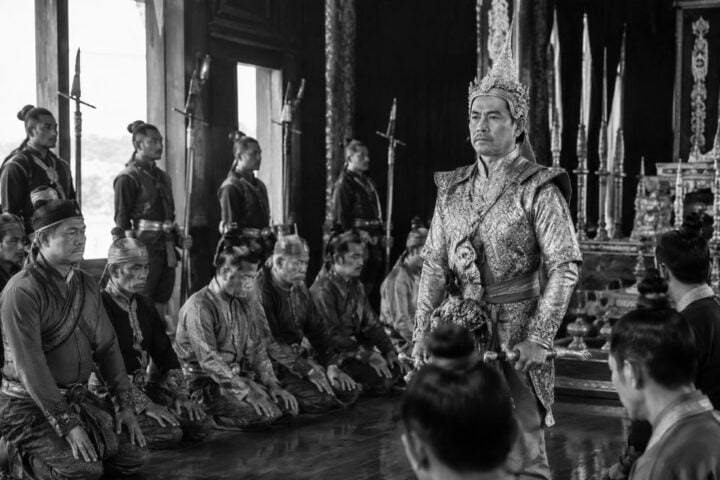
Rama I was not just a soldier who happened to end up on the throne. He built a state. He ordered the construction of the Grand Palace and the Temple of the Emerald Buddha, and breathed new life into traditional Thai art, literature, and legislation.
He also left lasting traces in religious and legal matters. He strengthened the Buddhist monastic order and convened a synod between 1788 and 1789 to establish the Orthodox Buddhist scriptures. In 1805, he implemented the first complete codification of Thai law. At the same time, he had to continue defending the country. During his reign, he reorganized the Siamese defense to repel Burmese attacks in 1785, 1786, 1787, 1797, and 1801.
Where does the name Chakri come from?
The name of the dynasty is no coincidence. Before his accession to the throne, Rama I held the title of Chakri, the civil chancellor, for many years. At the founding of the dynasty, the king chose that name himself.
The word is much older and traces back to Sanskrit. “Chakri” is derived from “chakra,” the double-edged disc held by the Hindu god Vishnu. A name with weight, therefore, rooted in ancient symbolism.
A line that never broke
The royal line that began in 1782 has never been broken since. The descendants of Rama I ruled in an unbroken series after him. The current head of the house is King Vajiralongkorn, better known as Rama X. By now, there have been ten monarchs across more than two centuries of Thai history.
For those who live in Thailand or visit regularly, that continuity is visible everywhere. The Grand Palace, the Temple of the Emerald Buddha, the portraits of the king along the roads: they are all echoes of what one general set in motion in 1782.
Ready to see how Snowflake works?
The Chakri dynasty did not arise from a peaceful succession, but from a coup. Rama I came to power, had his predecessor executed, and founded Bangkok as the new capital. The year is fixed, but the death of Taksin remains disputed. And precisely for that reason, 1782 remains a living story in Thailand.
Sources: Britannica, Wikipedia, Prachatai English, Bangkok Post
About this blogger

-
This article has been written and reviewed by the editorial team. The content is based on the author's personal experiences, opinions, and independent research. Where relevant, AI has been used as a tool in writing and structuring text. We also sometimes generate photos using AI. Although the content is handled with care, it cannot be guaranteed that all information is complete, up-to-date, or error-free.
The reader is responsible for the use of the information on this website. The author accepts no liability for any damage or consequences resulting from the use of the information provided.
Read the latest articles here
 Expats and retireesJune 2, 2026Thai healthcare versus healthcare in your home country: world-class at the top, but not for everyone.
 BackgroundJune 2, 2026The Isaan buffalo was nearly extinct but is now worth a fortune.
 Flight ticketsJune 2, 2026THAI Airways must fly more to smaller Thai airports
 Expats and retireesJune 2, 2026Brussels Public Prosecutor's Office investigates Wise Europe for possible shortcomings in money laundering controls
Perhaps it would also be interesting and educational to read the story of King Taksin (reigned 1767–1782). The son of a Chinese immigrant and a simple Thai woman, he rose to become a general and king. It was he who liberated Siam from the Burmese and united the country. What a diverse country Thailand is!
https://www.thailandblog.nl/achtergrond/koning-taksin-een-fascinerende-figuur/