

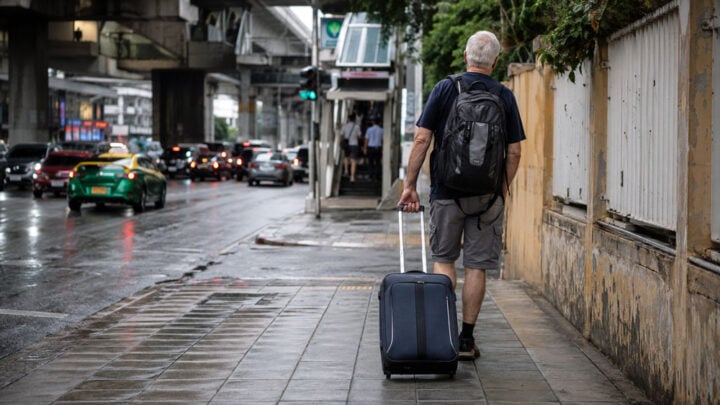
For decades, Thailand was known as the ultimate place for a carefree retirement. Warm weather, friendly people, low costs, and a tropical atmosphere that made you forget the winters in Amsterdam or Antwerp. Once you had smelled the scent of fried garlic, diesel exhaust, and rain on hot asphalt, you usually wanted to return again.
But in recent years, the picture has shifted. More and more Dutch and Belgians are packing their bags and returning, sometimes carefully planned, often completely unexpectedly. What lies behind this? A look at the numbers, the stories, and the silent trends.
One in three returns before the age of eighty
The dream ends more often and sooner than hoped. This is evident from research by the Netherlands Interdisciplinary Demographic Institute (NIDI). Based on a survey of over 6.000 migrants in forty countries, combined with registration data from 2021 to 2024, researcher Juul Spaan reached a striking conclusion.
Only five percent of emigrated pensioners indicated they wanted to return within three years, but nine percent ultimately did so. Even among those who were convinced they would stay away permanently, four percent returned. If this trend continues, about a third of Dutch pensioners will be back home before the age of eighty. The main motives, according to the researchers, are deteriorating health, loneliness, and the enduring allure of family in their home country.
For Belgium, comparable public return figures are lacking. The direction is visible there, but the exact extent is not.
Loneliness that you don't see coming beforehand
Loneliness is perhaps the most underestimated factor. The NIDI compared some 1.300 Dutch pensioners in the Netherlands with pension migrants in France, Spain, Portugal, Thailand, and the United States. The outcome was surprisingly nuanced. Pension migrants do not feel significantly more emotionally alone than their peers at home, as long as their partner is still present. However, social loneliness—meaning the lack of a broader network of acquaintances, neighbors, and clubs—is higher.
The treacherous part lies in the timing. As long as you are healthy and your partner is sitting beside you, you hardly feel the emptiness. But if that partner passes away, or your health deteriorates, the thin network becomes painfully visible. Many Dutch and Belgian men still do not speak fluent Thai after ten or fifteen years. Deeper friendships with the local population therefore remain difficult. And in an Isaan village, the circle of compatriots is usually limited.
The tax landscape has completely changed.
Anyone who moved to Thailand could count on an attractive starting point for years. You had your pension paid out in the Netherlands or Belgium, and after a year, you transferred it to Thailand tax-free. Completely legal. The double taxation treaty assigned pension tax to Thailand, and Thailand effectively exempted foreign income. The trick was to live off the savings of the first year.
This will come to an end with the new tax treaty between the Netherlands and Thailand, signed in November 2025 and possibly entering into force on January 1, 2027. The Netherlands will then regain the full right to levy taxes on Dutch pensions, state pensions (AOW), and annuities. In concrete terms: many emigrants who once chose Thailand based on different tax rules will face a structural decline in net income. In letters to the Council of State, readers estimate that this could amount to a lifelong decline of around five percent, without a transitional arrangement.
And there is more. Due to the fiscalization of national insurance contributions (Wlz and Anw) as of 2026, the effective tax burden for residents of Thailand in the first bracket will nearly double: from approximately eight to approximately eighteen percent. Without any corresponding social or fiscal compensation. Anyone living in Spain who meets the 90% requirement benefits from all tax credits as a 'qualifying foreign taxpayer'. If you live in Thailand, the tax authorities say: that country is not included in the circle of countries. Many involved consider this pure discrimination based on residence.
For those who consciously chose Thailand ten years ago based on the agreements in force at the time, this feels like a breach of trust.

A strong baht and rising costs
The myth that you can get by in Thailand on a few hundred euros a month is definitely over. The euro-baht exchange rate fluctuated between approximately 36,2 and 38,6 baht over the past year. Not disastrous, but much less favorable than twenty years ago, when you got ten to eleven baht for one guilder.
At the same time, prices in Thailand have risen sharply. Rents in Bangkok, Phuket, and popular coastal towns are approaching Western European levels. Energy bills are rising. Imported products are expensive. On islands like Koh Chang and Koh Samet, prices for hotels, drinks, and food have multiplied in just a few years. A half-liter of Sinja on tap at the beach there easily costs two hundred baht. Neighboring countries like Vietnam, Malaysia, and the Philippines are explicitly positioning themselves as cheaper and more expat-friendly alternatives.
Those who rely solely on the state pension see their margins melt away. A reader put it this way: “Bangkok isn't a cheap city.” The days of a beer for 65 baht and a plate of nasi for 25 baht are history.
At the same time, another voice is heard. Some long-term residents call it 'all nonsense', point to a baht exchange rate of nearly 38 per euro which is actually favorable, and to a Toyota service for 2.400 baht or domestic help for 500 baht per day. It depends heavily on where you live, how you live, and what you are comparing.
Visa uncertainty
Nothing bothers a foreigner more than changing rules of the game. In recent years, Thailand has introduced new visa categories: the Destination Thailand Visa (DTV) for digital nomads and the Long Term Resident visa (LTR) for wealthy retirees. On paper, these are relaxations; in practice, they often come with snags. No automatic access to bank accounts, uncertainty regarding work permits, and supporting documents that are interpreted differently by immigration office.
The 90-day notification to Immigration still causes frustration for some, even though this can now be done online and you receive a reminder fourteen days in advance. Ten minutes at the PC, and it is taken care of.
Limited property rights remain a barrier
Foreign nationals cannot own land in Thailand. They can own a condo, but not a house with a garden in their own name. Anyone building a house together with a Thai partner does so legally in that partner's name. In the event of death, divorce, or conflict, the foreigner is often left empty-handed. A well-drafted will and clear agreements are essential, but offer no complete guarantee.
For those who have built up capital and seek security for old age, this remains a significant obstacle. According to recent research, Thailand is no longer even in the top thirty of favorite retirement destinations. Malaysia attracts thousands of foreigners with its 'Malaysia My Second Home' program. Vietnam is relaxing the rules for long-term residency and investments. Both countries explicitly position themselves as more expat-friendly alternatives. Thailand is losing ground.
Healthcare: good, but pricey
Thai private healthcare is of international standard. But without insurance, a single serious hospital stay can easily empty your savings. The problem lies in age. For a healthy sixty-year-old, an international policy is still manageable. Above seventy or seventy-five, premiums skyrocket, and pre-existing conditions are often excluded or lead to refusal. Anyone who becomes chronically ill or requires intensive care discovers that repatriating to the Netherlands or Belgium, with its mandatory basic insurance and Wlz safety net, suddenly becomes more attractive.
A common pattern among experienced visitors is a split life: summer in Europe, winter in Thailand. One reader sums it up: I eat from two plates. Others opt for good European travel insurance during their months in Thailand, which can turn out to be significantly cheaper than a comprehensive local health insurance policy.
Air pollution is destroying the outdoors.
Between approximately December and April, large parts of Thailand are covered in a veil of particulate matter. PM2.5 levels in Chiang Mai, the north, and even Hua Hin regularly exceed World Health Organization standards. The cause is a combination of agricultural fires (rice, corn, and sugarcane being set on fire), traffic, industry, and weather conditions. This poses a serious health risk to the elderly, people with respiratory or heart problems, and children.
The Dutch travel advisory recommends wearing a KN95 face mask during high PM2.5 concentrations. Many retirees adjust their seasons and head south or to Europe during the worst months. A workable solution, but one that undermines the original 'living in the tropics all year round' image. Pattaya, once a sunny paradise, is even described by some residents as a city where every breath feels like a risk.
Political and regional unrest
Thailand has repeatedly changed governments in recent years. A ceasefire between Thailand and Cambodia has been in effect since the end of December 2025, but the Dutch government still maintains:
- Color code red for the five-kilometer strip along the border with Cambodia.
- Color code orange for the zone of five to twenty kilometers along that border, the southernmost part of Thailand (Yala, Pattani, Narathiwat) and the border area with Myanmar.
- Color code yellow for the rest of Thailand.
For those who do not live in these areas, it does not directly affect their daily lives. Nevertheless, it contributes to a sense of unpredictability and erodes the image of Thailand as a quiet, stable base. Added to this are concerns about food safety (chemical contamination, poor controls) and the notorious traffic. In 2025, 577 foreign travelers died in traffic accidents in Thailand, including seven Dutch nationals. Another 197 Dutch nationals were seriously injured. Almost ninety percent of those accidents involved motorcycles and scooters.
The psychological pitfall: this is no longer a vacation
Anyone who has ever spent a three-week holiday in Thailand knows the feeling of letting go. Living there is something fundamentally different. Psychologists distinguish four phases in adapting to a new country: the honeymoon, the culture shock, recovery, and adjustment. Many older emigrants get stuck in phase two, after the structure of work disappears and the social network turns out to be thinner than expected.
At first, it is wonderful: no commute, no boss, no gloomy winters. After a few months, the lack of structure becomes a different kind of challenge. Alcohol is lurking (a large beer is cheap, and the bar already knows you), depression remains unspoken, and financial worries are hidden from the Thai partner. You have Thai friends, but you don't talk about your money worries. You have a Thai partner whom you love, but you remain silent about your gloomy mood.
In recent years, Thailandblog has repeatedly reported on suicides in expat hotspots such as Pattaya, Phuket, and Chiang Mai. Recurring factors include relationship breakdowns, financial worries, loneliness, alcohol, and chronic pain. Conclusive figures regarding Western expats are lacking, but the pattern is consistent.
The impulsive return after the loss of a partner
A specific group deserves extra attention: widowers. When a Thai partner passes away, many Dutch and Belgian men experience a panic reaction. The house is sold in haste; the boat to the homeland arrives within six months. There, an unpleasant surprise awaits. The old network is no longer the same. Children lead their own lives, the housing market is locked down, and the Dutch or Belgian winter feels brutally cold after fifteen years in the tropics.
A significant proportion of these widowers fly back to Thailand within two years, with significantly less money in the bank than before. Other common pitfalls after a loss:
- AlcoholBeer is cheap, the people in the bar are familiar, and it numbs. Within a few months, a grieving process turns into a health problem.
- A new relationship within the year: often with someone younger who becomes financially dependent. The grief is overwhelmed instead of processed.
For whom do things continue to go well?
The picture is not unequivocally negative. In 2025, Thailand ranked fourth in the InterNations Expat Insider survey, its highest ranking ever. Many long-term residents are still happy and are not thinking about returning. I have no reason to want to leave here,” writes a reader who has lived there for almost twenty years. I am leaving my Dutch glasses at home and accepting how Thailand conducts its business. Fortunately, this is not the Netherlands, and let's keep it that way.
The common denominator among this satisfied group:
- A stable income, well above the minimum.
- A balanced relationship and realistic expectations.
- Sufficient social roots, both Thai and Western.
- Reasonable knowledge of the country and, ideally, of the language.
- A sober acceptance of what Thailand does and does not offer.
Those who have these ingredients in order often live more pleasantly here than in the present-day Netherlands or Belgium, with their overheated housing market, regulatory burden, and political tensions.
The guiding principle
What stands out about all those stories is that rarely is a single factor decisive. It is almost always an accumulation. Rising costs plus visa uncertainty plus tax changes plus declining health plus loneliness plus homesickness plus a specific event: a death, an illness, a family tragedy in the Netherlands. Until a moment comes when the balance tips.
Anyone leaving for Thailand thinking, 'if I don't like it, I'll just go back,' underestimates how drastic remigration is at a later age. Finding an affordable rental home in the Netherlands is difficult, and elderly care is by no means free. Fortunately, some returnees still own a home. Others are begging at the municipality for help.
Ready to see how Snowflake works?
Thailand hasn't suddenly become a bad choice, but it has become a much more conscious one. Do your homework thoroughly, keep a financial buffer and a return scenario in reserve, learn at least functional Thai, and remain honest about how you are really doing. The difference between staying and leaving unexpectedly rarely lies in Thailand itself. It lies in your preparation.
Sources: Thailandblog.nl, Netherlands Interdisciplinary Demographic Institute (NIDI), GOED Foundation, Population Studies (Juul Spaan), Ministry of Foreign Affairs (Netherlands Worldwide travel advice), FPS Foreign Affairs Belgium, Taxence, Typisch Thailand, The Thaiger, Issa Compass, InterNations Expat Insider 2025, Thai Revenue Department instruction Por. 161/2566.
About this blogger

-
This article has been written and reviewed by the editorial team. The content is based on the author's personal experiences, opinions, and independent research. Where relevant, ChatGPT was used as a tool for writing and structuring text. We also sometimes generate photos using AI. Although the content is handled with care, it cannot be guaranteed that all information is complete, up-to-date, or error-free.
The reader is responsible for the use of the information on this website. The author accepts no liability for any damage or consequences resulting from the use of the information provided.
Read the latest articles here
 BankingMay 18, 2026How safe is your money at a Thai bank? The hard facts about solvency and the deposit guarantee scheme.
 BackgroundMay 18, 2026Thai or Filipino partner: which relationship really has a better chance?
 Expats and retireesMay 18, 2026Why the Dutch and Belgians are turning their backs on Thailand
 Visa Short StayMay 18, 2026Thai travelers receive a multi-year Schengen visa more easily.