

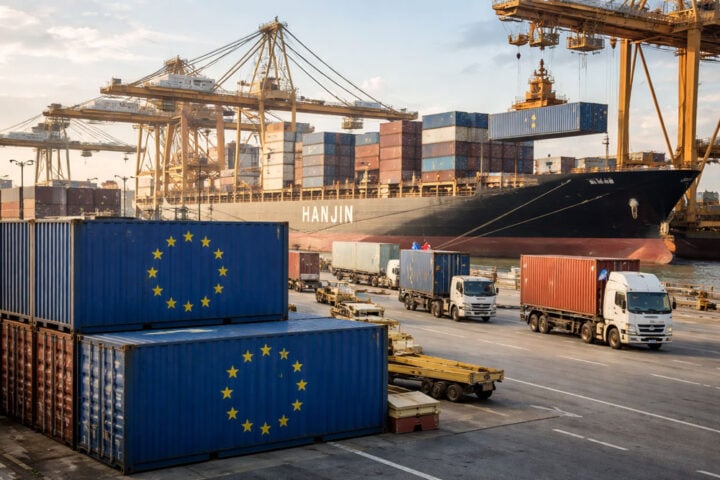
Thailand is pushing hard for a free trade agreement with the European Union. This is happening at a time when global trade is changing rapidly, trade barriers are increasing, and countries are relying less on multilateral systems. Much is at stake for Thailand, as the EU is one of its most important export markets and new trade deals from competitors are putting pressure on the position of Thai companies.
At the same time, Bangkok also sees opportunities. Negotiations with Brussels are making progress, while economists emphasize that Thailand needs to position itself more intelligently within regional supply chains. The recent free trade agreement between the EU and India, in particular, makes clear how urgent this reorientation has become.
Negotiations with the EU are making visible progress
According to Chotima Iemsawasdikul, Director-General of the Department of Trade Negotiations, Thailand and the EU have now completed eight rounds of negotiations. The most recent round took place in Chiang Mai, where both parties reached agreement on three additional chapters.
This concerns trade protection measures against sudden import peaks following tariff reductions, exceptions for public health, environmental protection, and national security, and rules on national treatment and market access for trade in goods. Agreement has also been reached on a part of the regulations for delivery services within the services and investments chapter. This is intended to ensure greater competition and transparency in that sector.
Eleven chapters completed, but important files remain open.
With the latest results, 11 of the 24 chapters have now been completed. In previous rounds, Thailand and the EU had already reached agreements on good regulatory practices, transparency, customs procedures and trade facilitation, sustainable food systems, trade and sustainable development, SME policy, technical trade barriers, and capital flows.
At the same time, tough issues remain on the table. Clear progress has been made regarding state-owned enterprises, competition policy, and the automotive annex within technical trade barriers. Furthermore, talks are still ongoing concerning intellectual property, dispute settlement, institutional provisions, market access for goods, services, and investments, and public procurement. Thailand intends to accelerate the pace in the next round in June, together with the relevant ministries and agencies. Both parties aim to conclude the negotiations this year.
The EU remains a crucial market for Thailand.
That importance is significant. In 2025, the EU was Thailand's fourth-largest trading partner. Bilateral trade amounted to 45,03 billion dollars, an increase of 3,44 percent compared to the previous year. Thailand exported 26,4 billion dollars to the EU and imported 18,5 billion dollars.
The most important Thai export products to Europe are computers, parts and peripherals, gemstones and jewelry, air conditioners, rubber products, and transformers with components. From the EU, Thailand primarily imports machinery and parts, medical and pharmaceutical products, chemicals, electrical machinery and parts, and medical devices. For an open economy like Thailand, access to the European market is therefore directly linked to employment, production, and investment.
The EU-India deal puts extra pressure on Thai exporters.
The urgency has increased because the EU and India concluded their negotiations on a free trade agreement on 27 January 2026, after more than twenty years of talks. According to economist Aat Pisanwanich, this is the largest trade deal both parties have ever concluded. Together, they represent nearly 2 billion people, approximately a quarter of the world's population and around 20 percent of global GDP.
Before the deal, Indian exporters to the EU paid import tariffs of 4 to 26 percent, primarily on labor-intensive products such as textiles, clothing, leather goods, footwear, and fish products. Under the new agreement, the EU grants tariff benefits on 99,5 percent of India's total export value. For many products, import duties will disappear immediately, while other goods will benefit from phased reductions or tariff quotas. Full implementation is expected in early 2027, following ratification, legal finalization, and translations.
Thailand needs to raise quality and reposition itself.
Now that India is receiving zero or near-zero import tariffs towards the EU, Thai products will continue to fall under the most-favored-nation policy for the time being. Depending on the product, these tariffs range from 0 to approximately 26 percent. As a result, Indian goods enjoy a clear price advantage, and the risk of European buyers switching from Thai to Indian suppliers is growing.
Clothing, textiles, fish, seafood, and processed fish products are particularly vulnerable. Precious stones and jewelry are also facing increased competition, although Thailand can hold its own in the mid- and high-end segments through quality, design, and added value. Aat therefore proposes three directions. Thailand must supply semi-finished products to Indian export industries more quickly, especially in chemicals, coatings, cotton fabrics, synthetic fibers, and automotive parts. Additionally, Bangkok must accelerate the EU deal to protect market share against India and Vietnam. Finally, Thai products must better align with European requirements regarding sustainability, human rights, labor, and the carbon border mechanism.
Thailand therefore faces not only a threat but also a strategic choice. If the country acts quickly, raises its product standards, and concludes the EU negotiations, it can secure its export position. If this does not happen, competitive pressure on the European market will only increase.
Source: Bangkok Post
About this blogger

-
This article has been written and reviewed by the editorial team. The content is based on the author's personal experiences, opinions, and independent research. Where relevant, ChatGPT was used as a tool for writing and structuring text. We also sometimes generate photos using AI. Although the content is handled with care, it cannot be guaranteed that all information is complete, up-to-date, or error-free.
The reader is responsible for the use of the information on this website. The author accepts no liability for any damage or consequences resulting from the use of the information provided.
Read the latest articles here
 Expats and retireesApril 19, 2026Dying in Thailand can quickly turn out to be expensive for Dutch and Belgian citizens.
 Expats and retireesApril 19, 2026Hua Hin is the best place to live for retirees in Thailand, and here is why.
 EconomyApril 19, 2026Thailand wants a quick trade agreement with the EU to protect its export position.
 News from ThailandApril 19, 2026Detective from Pattaya charged after deadly shooting at Walking Street