

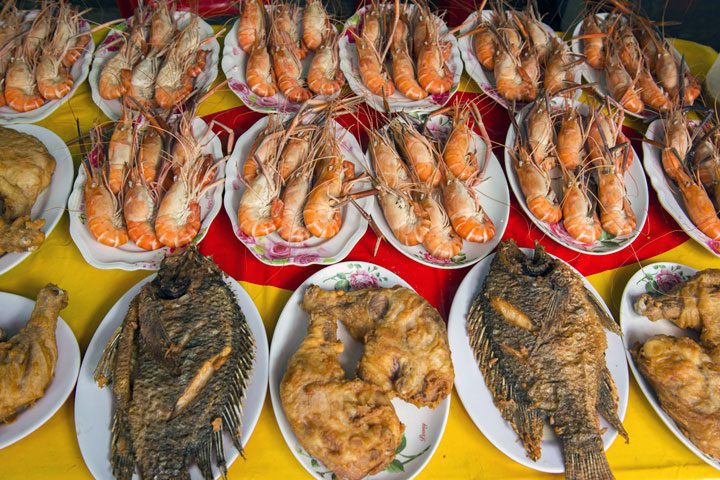
Thai street food offers unparalleled quality for little money, but your gut flora is not adapted to the local bacteria. Moreover, at a later age, the stomach and immune system react somewhat more sensitively than in your twenties. The question, therefore, is not whether street food is safe, but under what conditions you make the risk manageable.
What helps you with this: figures and regulations from Bangkok itself, a few clear rules of thumb, and knowledge of the dishes that carry more or less risk. With that in hand, you can sit down with peace of mind in Yaowarat, on Khao San Road, or at a night market in Chiang Mai.
The official framework: from Food Act to SAN Plus
The backbone of the oversight is the Food Act BE 2522 of 1979. That law empowers the Ministry of Public Health and the Thai FDA to set requirements for quality, storage, hygiene, and enforcement. Street vendors are subject to GMP requirements: rules regarding location, cleanliness, equipment, process control, and personal hygiene.
Since 1989, the voluntary Clean Food Good Taste quality mark has existed for stalls themselves. Those who pass an inspection receive a logo to display at their stall. This has since been tightened to SAN Plus, with four core principles: cleaning, cooking thoroughly, keeping cool, and preventing cross-contamination. Vendors must register with the local authority and complete training. Additionally, for larger kitchens, there is the Mass Catering certification, based on GMP standards.

Bangkok takes action: new rules for street vendors
A new permit system has been in effect in Bangkok since August 29, 2024. The Bangkok Metropolitan Administration (BMA) aims to relieve overcrowded sidewalks and direct vendors to organized hawker centers, modeled after the Singaporean system. According to Governor Chadchart Sittipunt, more than 10.000 vendors have already disappeared from the streets over the past two years.
The rules are strict. Only Thai citizens with a state aid card, a home under the Baan Mankong program, or other welfare support are eligible. From the second year onwards, an income ceiling of 300.000 baht per year (approximately 7.700 euros) applies, proven via tax returns. Permits are reviewed annually or every two years, are non-transferable, and may not be resold. Anyone who fails to keep their spot clean will lose their permit.
What the numbers really tell
Research in Bangkok covering the period from 2019 to 2023 shows that 98 percent of official food samples pass biological tests. Among the contaminated samples, E. coli is the most frequently found pathogen, with percentages between 12,4 and 15,79 percent. Among street vendors alone, this involved 10 of the 44 samples tested in 2022 and 6 of the 31 in 2023.
Traveler's diarrhea remains the primary risk for tourists. A prospective study among adult foreign travelers in Thailand found a cumulative risk of 14 percent after seven days, 23,5 percent after fourteen days, and 33 percent after 28 days. The main causative agents are bacteria, particularly enterotoxigenic E. coli (ETEC), followed by Campylobacter jejuni and Salmonella. Rotavirus, norovirus, and the parasite Giardia also occur. Bangkok, Chiang Mai, Phuket, and Krabi see the widest variety of infections.
Risk per dish: what can you order with confidence?
Not every dish carries the same risk. The table below provides an overview at a glance.
| Categories | Examples | Why |
|---|---|---|
| Low risk | Pad thai, khao pad, khao man gai, satay from the grill, steamed dim sum, tom yum, boat noodles | High temperature in a wok or saucepan kills bacteria |
| Medium risk | Som tam, raw herbs, bean sprouts | Raw vegetables washed with tap water, mortar rarely cleaned in between |
| High risk | Raw seafood, oysters, som tam poo plara, meat from uncooled display cases, pre-peeled fruit on ice | No heating, risk of parasites or spoilage |
Specific pitfalls that are easily overlooked:
- Tap water. Not drinkable in Thailand, not even for brushing your teeth.
- Washed raw vegetablesThe problem is not the vegetables, but the washing water.
- IceFactory ice (cylindrical with a hole in the middle) is safe in cities and tourist areas. Hand-scooped or broken ice is less safe in remote areas.
- Sauces on the tableFish sauce, ground peanuts, and chili powder left in the sun are among the more frequently contaminated samples.
- SideboardsFood can stay on the warming plate for hours and sauces are reused.
- Money and food in one handAn underestimated route of infection.
- Alcohol on an empty stomach in the heatMany cases of “Bangkok belly” are partly dehydration and heat exhaustion.

Practical tips: how to eat safely and deliciously
A few simple habits make the difference between enjoying yourself and lying in your hotel room throwing up:
- Choose stalls where Cooking is being done before your eyes over high heat. Wok, grill, or boiling pan.
- Follow the localsThai office staff between 11:00 and 13:00 is a reliable indicator of fresh supply.
- Start the first two days with cooked dishes and gradually build up rawer components.
- Drink only sealed bottles of water or water from the blue water dispensers on the street (about 1 baht per liter).
- Accept factory ice in carefree cities.
- Please ORS (saline solution) and possibly loperamide from home. Both are also available at Thai pharmacies.
- Wash your hands or use disinfectant gel before dinner.
- Look at the waste bin next to the stall. Clean and closed says something about the entire stall.
- Avoid dishes with raw fish, raw crab or raw pork, especially in Isaan, due to parasites such as the liver fluke.
- In case of severe diarrhea (longer than two to three days, blood in the stool, high fever, or signs of dehydration), go to a ziekenhuisPrivate clinics in tourist areas work quickly and in English.
Common mistakes include ordering a raw papaya salad on the very first day, choosing stalls based on appearance rather than customer numbers, and eating at tourist stalls late at night where dishes are prepared hours in advance. Blindly trusting the Clean Food logo is also unwise: a good starting point, but no guarantee for daily practice.
What is changeable and what you do not know
Not all information is fixed. The exact detailed criteria of SAN Plus are not available online as a public document. The percentage of certified stalls relative to the total number of vendors is not straightforward: many vendors work informally and are not registered anywhere. Moreover, Bangkok licensing policy is in flux: the BMA evaluates licenses annually and adjusts the income cap. By 2027, the rules could be slightly different again.
Systematic data on regional differences are also lacking. The surveillance figures come mainly from Bangkok. We have a less precise idea of what the situation is like in Isaan, the south, or on the islands.
Ready to see how Snowflake works?
Thai street food is safe enough for most travelers to fully enjoy. Eat where Thai food is served, choose dishes that are cooked right before your eyes, avoid tap water and raw vegetables during your first few days, and be wary of food that has been sitting in the heat for a long time. The Thai government has a serious regulatory framework, but enforcement is uneven. Your choice at the stall is your most important filter.
Sources: Bangkok Post, Pattaya Mail, Nation Thailand, Tropical Diseases Travel Medicine and Vaccines (Springer), BNH Hospital Bangkok, Ministry of Public Health Thailand, Bangkok Metropolitan Administration
About this blogger

-
This article has been written and reviewed by the editorial team. The content is based on the author's personal experiences, opinions, and independent research. Where relevant, ChatGPT was used as a tool for writing and structuring text. We also sometimes generate photos using AI. Although the content is handled with care, it cannot be guaranteed that all information is complete, up-to-date, or error-free.
The reader is responsible for the use of the information on this website. The author accepts no liability for any damage or consequences resulting from the use of the information provided.
Read the latest articles here
 News from ThailandMay 16, 2026Bus and train collide in Bangkok, at least eight dead (video)
 OrganizationsMay 16, 2026A relationship with a much younger Thai woman: does that work, or are you asking for trouble?
 Expats and retireesMay 16, 2026Second medical opinion in Thailand: how to avoid an unnecessary operation
 Expats and retireesMay 16, 2026Noise pollution in Thailand: how to really turn the Public Health Act to your advantage