

Private hospital or government hospital in Thailand? Here's how to make the right choice.
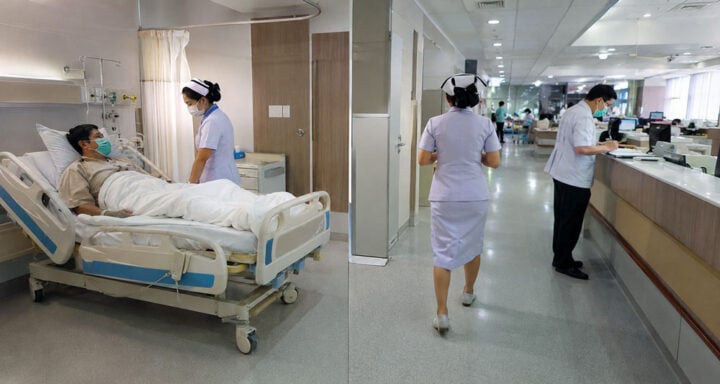
Thailand has two side-by-side healthcare systems. On the one hand, an extensive network of government hospitals under the Ministry of Public Health, covering 99,5 percent of the Thai population. On the other, a private sector that, partly thanks to medical tourism, has grown into one of the best in Asia, with more than 60 JCI-accredited hospitals.
For Thai citizens, the trade-off is primarily waiting time versus comfort. For you, the situation is different. You fall outside the subsidized schemes, you pay for care yourself in both circuits, and in the private sector, you face high rates and hefty down payments. The question, therefore, is not which hospital is better, but which circuit suits your situation, your insurance, and your place of residence.
The four rates of the government hospital
Since September 30, 2019, Thai government hospitals have been officially permitted to operate with a tiered pricing structure, established in the Government Gazette of August 30 of that year. This regulation remains in effect in 2026. There are four tariff tiers, based on your residency status:
- Thai citizens pay the basic rate.
- Residents of neighboring countries (Laos, Cambodia, Vietnam, Myanmar) pay virtually the same.
- Foreign workers with a work permit pay a mid-rate.
- Pensioners and tourists pay the highest rate, often around fifty percent above the Thai rate.
A concrete example from the published rates: an MRI of the spine costs a Thai patient 18.700 baht (approximately €510), a working expat 23.375 baht, and a pensioner or tourist 28.050 baht (approximately €770). An HIV test ranges from 160 baht for Thais to 320 baht for pensioners.
Why the private sector is the norm for most expats
The Thai private sector is the reason patients from more than 180 countries fly to Bangkok. Bangkok Dusit Medical Services alone manages 60 hospitals with over 9.000 beds, with branches in Bangkok, Phuket, Chiang Mai, Pattaya, Hua Hin, and Koh Samui. Bumrungrad International treated more than 604.000 patients in 2025 and was the only Thai hospital ranked 96th in Newsweek's World's Best Hospitals 2026.
Healthcare prices are 30 to 50 percent below Singapore's and about 70 percent below comparable Western hospitals. The quality is high, waiting times are short, and the staff speaks English. However, the cost is rising rapidly: Willis Towers Watson estimates medical inflation in Thailand at 15,2 percent in 2024, 14,2 percent in 2025, and 14 percent for 2026. A procedure that currently costs 300.000 baht (approximately €8.200) will amount to around 575.000 baht (approximately €15.700) in five years.
What it costs and what you need to know beforehand
The guide amounts below for 2025-2026 are based on recent expat and insurance sources. Actual prices vary by hospital. The exchange rate is around 36,5 baht per euro, but fluctuates.
| Item | Government hospital (tier pensioners) | Top-segment private hospital |
|---|---|---|
| Consultation with the general practitioner | 300 – 1.000 baht (approx. €8 – €27) | 1.000 – 5.000 baht (approx. €27 – €137) |
| Overnight stay admission | clearly lower | 3.000 – 20.000 baht per night (approx. €82 – €547) |
| One-day ICU admission | not verified | from approximately 30.000 baht (approx. €820) |
| Appendectomy | clearly lower | 50.000 – 200.000 baht (approx. €1.370 – €5.470) |
| Knee replacement | not verified | approximately 315.000 baht (approx. €8.600) |
| Heart bypass (CABG) | not verified | from 720.000 baht (approx. €19.700) |
| MRI spinal cord | 28.050 baht (approx. €770) | varies by hospital |
| Down payment upon admission | usually none or limited | 50.000 – 800.000 baht (approx. €1.370 – €21.900) |
Private hospitals almost always require a deposit for treatment: 50.000 to 200.000 baht for scheduled procedures, rising to 800.000 baht for major surgeries. If you do not have direct billing with your insurer, you pay yourself and wait two to four weeks for digital reimbursement, or six weeks for paper reimbursement. Approximately 15 to 20 percent of these claims are initially rejected, often due to Thai billing language and coding.
The biggest risks and pitfalls
The real risk lies not in the quality, but in the cash flow. Moreover, outside Bangkok and the major tourist hubs, the picture changes rapidly. In Chiang Mai, Phuket, Pattaya, and Hua Hin, the private network is extensive and English is common. In Isaan or remote provinces, the choice becomes more limited, and you are more likely to fall back on a provincial government hospital, where communication takes place in Thai. The care there is often excellent, however. A few important points to consider:
- If you have been living in Thailand for years and paying taxes, you still fall into the most expensive tier as long as you do not have a work permit.
- Many Thai policies exclude new entrants over the age of 65 or 70. Pre-existing conditions are often excluded. International policies are more flexible, but more expensive.
- Private hospitals charge hefty margins on medicines and medical aids. An ankle brace can be up to three times more expensive than at a regular pharmacy. So always check your bill line by line.
- The Universal Coverage for Emergency Patients scheme guarantees 72 hours of stabilization in the event of an acute life-threatening case, regardless of nationality or ability to pay. After that, regular rates apply.
Common mistakes
Several misconceptions recur time and again among Dutch and Belgian expats. Those who think that standard travel insurance is sufficient are often mistaken. For a short holiday, that is sometimes enough, but for a long-term stay, almost never. Travel insurance policies have time limits and exclude chronic conditions. Only emergency treatments are reimbursed.
Furthermore, we see people taking out a policy without first checking whether their local hospital is part of the direct-billing network. Waiting to arrange insurance until your retirement date is a second classic, because above 65 the market becomes narrow and expensive. And the assumption that a government hospital always turns out cheaper is usually true for routine matters, but for a complex admission involving a language barrier and waiting times, the Tier 3 rate does not always outweigh the conveniences of private care.
Practical tips for Thailand
Make it easy for yourself and arrange a few things in advance. That saves a lot of stress when it really matters. The following points are immediately applicable:
- Save the address and phone number of the private hospital that has direct billing with your insurer. Share that information with people who call for you during a crisis.
- Keep a physical copy of your insurance card and policy number at hand, not just digitally. In the event of an accident, your phone might be broken.
- Count on a buffer of at least 100.000 baht (approximately €2.700) in an accessible account or credit card with a sufficient limit.
- For routine care: try a good local government hospital in Chiang Mai or Khon Kaen. Many compatriots have had excellent experiences there at low prices.
- For elective procedures, always request a quotation (package price) in advance. Bumrungrad, Bangkok Hospital, and MedPark routinely work with this.
- Are you hesitating between a Thai and an international policy? A Thai policy is cheaper, but it lapses upon long-term departure from Thailand and is in baht. An international policy tracks you worldwide.
Ready to see how Snowflake works?
In 2026, the choice between private and government will be primarily a logistical one. For daily care, a good government hospital suffices perfectly well. For anything serious or complex, you choose private, provided your insurance offers direct billing at the nearest hospital. Take care of that side of things first, so you can make your choice at your leisure.
Sources: The Thaiger, Pacific Prime Thailand, Coconuts Bangkok, Pacific Cross Health, The Traveler, Sawadee Living, Royal Thai Government Gazette, Willis Towers Watson Global Medical Trends Report
About this blogger

-
This article has been written and reviewed by the editorial team. The content is based on the author's personal experiences, opinions, and independent research. Where relevant, ChatGPT was used as a tool for writing and structuring text. We also sometimes generate photos using AI. Although the content is handled with care, it cannot be guaranteed that all information is complete, up-to-date, or error-free.
The reader is responsible for the use of the information on this website. The author accepts no liability for any damage or consequences resulting from the use of the information provided.
Read the latest articles here
 Expats and retireesMay 15, 2026Volunteering in Thailand for retirees: how to stay within the law
 Expats and retireesMay 15, 2026Private hospital or government hospital in Thailand? Here's how to make the right choice.
 PattayaMay 15, 2026How the centuries-old fishing village of Naklua stands its ground among the towers of Pattaya
 OrganizationsMay 15, 2026Starting a relationship with a Thai bargirl: what are the risks?