

Train travel in Thailand is a unique experience not to be missed
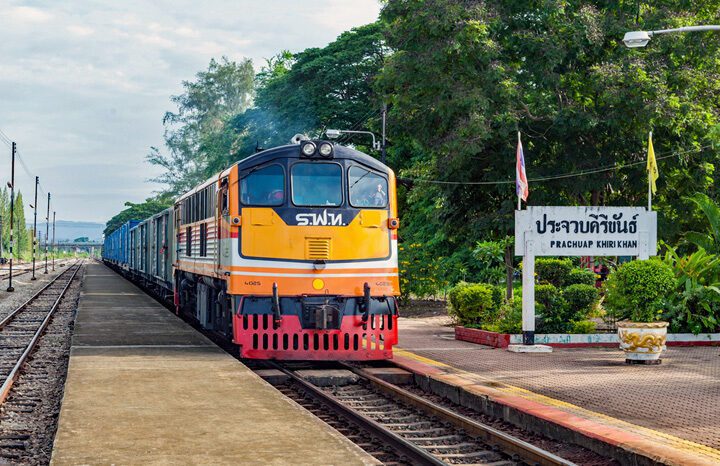
Train travel in Thailand has a charm that's hard to match. The pace is just right: slow enough to see the scenery, fast enough to cover great distances. While a bus mostly sees asphalt and a plane mostly sky, the train offers a glimpse into real life. You travel past rice paddies, temples, villages, and markets. The world literally slides past your window.
The social aspect is just as valuable. In the carriages, you'll encounter a diverse mix of people: Thai families with children, monks, students, and travelers from all over the world. Friendly vendors board at small stations, offering snacks, fruit, or rice dishes. It makes the journey lively and human, far from anonymous.
Then there's the nostalgia. Third class means wooden benches, open windows, and gently rotating fans. For those seeking more comfort, there are sleeper cars with soft beds and air conditioning. This choice makes it accessible to every type of traveler.
The great thing is that every route in Thailand has its own atmosphere and story.

Bangkok–Chiang Mai
- Travel time: 11 to 14 hours
- Price: from 300 baht (third class seat) to 1.600 baht (first class sleeper compartment)
This line is perhaps the most famous. From Bangkok, you travel away from the bustling city life and watch the plains slowly transform into rolling hills. At night, the train winds through tunnels and mountains, and at sunrise, the misty valleys around Lampang appear.
Bangkok–Surat Thani
- Travel time: 8 to 9 hours
- Price: from 250 baht (third class) to 1.200 baht (first class sleeper compartment)
This route is popular with travelers who want to visit the islands in the Gulf of Thailand. In Surat Thani, you can easily transfer to the ferry to Koh Samui, Koh Phangan, or Koh Tao.
Bangkok–Nong Khai
- Travel time: 9 to 10 hours
- Price: from 300 baht (third class) to 1.400 baht (first class sleeper compartment)
This route takes you to the Mekong River and the Friendship Bridge with Laos. A less touristy route that offers an authentic glimpse into life in Isaan.
Bangkok – Hua Hin
- Travel time: 4 to 5 hours
- Price: from 44 baht (third class) to 400 baht (second class with air conditioning)
A short, charming route to the coast. Hua Hin boasts one of the country's most beautiful stations, complete with its regal waiting room.
Bangkok – Kanchanaburi
- Travel time: 2,5 to 3 hours
- Price: from 100 baht (third class)
A line that offers both beauty and history, with highlights including the famous Bridge over the River Kwai and the impressive Hellfire Pass.
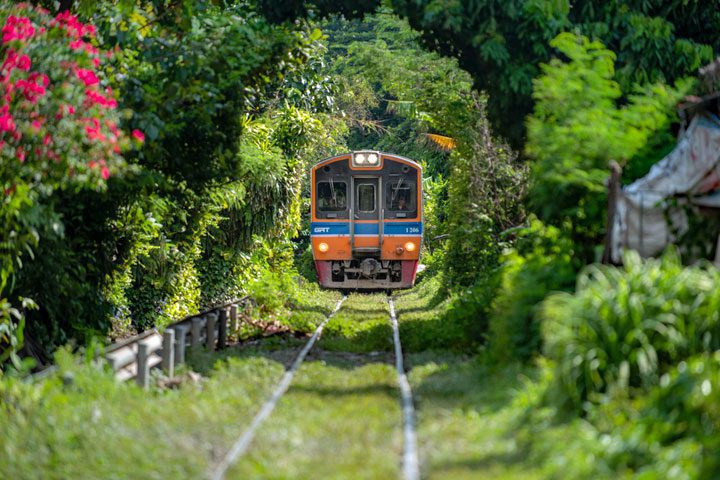
Practical tips for train travel in Thailand
Book tickets
You can buy tickets at major stations or online through the official website of the State Railway of Thailand. For popular routes like the overnight train to Chiang Mai, it's wise to book early.
Which class to choose
- Third class: cheap and authentic, but simple.
- Second class: comfort with soft seats or beds, often air conditioning.
- First class: private compartments with air conditioning, for those seeking peace and privacy.
Handy luggage
Bring a light cardigan for the air conditioning, some snacks for the journey and perhaps a neck pillow for the long journeys.
Food and drinks
Vendors regularly hop on and off, and on long routes, there's often a dining car. The meals are simple, but tasty and affordable.
Delays
Trains often depart on time, but delays can occur along the way. Think of it as part of the experience: you're not just traveling to your destination; the journey itself is an adventure.
A journey in itself
Train travel in Thailand is more than just transportation. It's an experience that combines landscape, culture, history, and human connection. Each route tells its own story and gives you the chance to experience the country in a different way.
About this blogger

-
This article has been written and reviewed by the editorial team. The content is based on the author's personal experiences, opinions, and independent research. Where relevant, ChatGPT was used as a tool for writing and structuring text. We also sometimes generate photos using AI. Although the content is handled with care, it cannot be guaranteed that all information is complete, up-to-date, or error-free.
The reader is responsible for the use of the information on this website. The author accepts no liability for any damage or consequences resulting from the use of the information provided.
Read the latest articles here
 Expats and retireesMay 15, 2026Volunteering in Thailand for retirees: how to stay within the law
 PattayaMay 15, 2026How the centuries-old fishing village of Naklua stands its ground among the towers of Pattaya
 Flight ticketsMay 15, 2026Night flight or day flight to Thailand? Here's how to choose smartly between jet lag and costs
 Expats and retireesMay 15, 2026Private hospital or government hospital in Thailand? Here's how to make the right choice.
I miss the line from Bangkok to Hat Yai, the line to the south doesn't stop at Surat Thani but goes quite a bit further
Why doesn't the train stop in Surat Thani? Is there a plausible reason for this?
The train stops, but the line doesn’t.
It remains a fantastic way to see all corners of Thailand at your leisure...but it's always underexposed because 'we' are always in a hurry and prefer to take a plane for everything.
Beautiful new train station in Bangkok, you almost get lost there!
Indeed. Hua Lamphong has lost much of its charm. But trains, besides boats, are my favorite mode of transport. Especially the ordinary ones, and especially those with long wooden benches extending from the compartment, a configuration that easily encourages social interaction and conviviality. You'll usually find these carriages attached last, which also has the advantage of less or no noise from the locomotive.