
How the army and police in Thailand use Buddhist rituals as weapons, shields, and legitimation
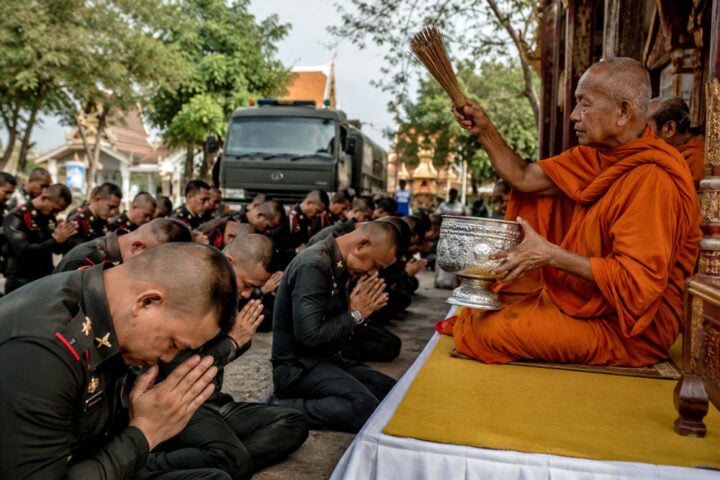
From blessed patrol cars to soldier-monks in the south: in Thailand, the armed forces, the police, and Buddhism are inextricably intertwined. What Westerners often view as folklore functions in practice as personal protection, a binding force within units, and a source of political legitimacy for successive governments and juntas.
Briefly
- In Thailand, the army, police, and Buddhism are institutionally intertwined. What appears in the West as religious folklore functions in Thailand as political legitimation and personal protection.
- Rituals range from overtly state-like, such as blessings at oath-takings, barracks ceremonies, and funerals of the fallen, to personal and magical, such as amulets, sak yant tattoos, and writings believed to provide bulletproof protection.
- In the deep south, in Pattani, Yala, Narathiwat, and parts of Songkhla, the entanglement is most visible and most controversial. Soldiers live on temple grounds and there are so-called soldier-monks, thahan phra.
- Since the coup of 2014 and the accession of King Vajiralongkorn to the throne in 2019, the military-monarchical complex has tightened its grip on the sangha through legislative changes and state ceremonies.
- The greatest risk for the country: Buddhism as an instrument of the state and armed forces stifles the space for religious diversity and helps perpetuate the conflict in the south.
The core: three pillars, one power bloc
In Thailand, they belong chat, sasana, phra mahakasat (Nation, religion, king) have been officially united since King Rama VI. The army and the police present themselves as protectors of all three. Consequently, Buddhist rituals are not an optional decoration of the work of security services, but sit at their very heart. They function simultaneously as personal protection for the individual officer or soldier, as internal discipline and solidarity within a unit, and as a public display of the moral authority of the state.
What that entanglement looks like in practice
In practice, these overlap on three levels: official state ceremonies, daily routines within units, and private use by individual military personnel and officers. The annual Royal Guards parade and oath-taking ceremony at the Royal Plaza in Bangkok has been a fixed part of the military year since 1953. Since 2019, police units have also participated. During this ceremony, eleven battalions swear allegiance to the King as Commander-in-Chief. On December 3, 2024, General Pornpipat Benyasri led the oath again, in the presence of King Vajiralongkorn. The oath-taking itself is not Buddhist, but is flanked by tham bun-ceremonies in which monks receive alms on behalf of the unit and the king.
At barracks, units, and in the field, you see a fixed pattern. New barracks, flagpoles, vehicles, and even airplanes are blessed by monks. They sprinkle took mon, holy water, recite paritta-texts in Pali and apply protective symbols with white sandalwood paste. The ritual to bless vehicles is called jerm rot and is common throughout Thailand. In police and army units, it is applied as standard on new patrol cars and transport vehicles. At funerals of fallen soldiers and police officers, the Royal Thai Armed Forces provides the funeral escort with a band and gun salutes, while Buddhist clergy perform the actual ritual.
Amulets, sak yant and the magic of being bulletproof
Many soldiers and police officers wear amulets, phra khrueang, takrut-scrolls with sacred Pali texts, and get tattooed with sak yant-designs. The message is always the same: protection against bullets, knives, and accidents. The best-known example is Phra Somdej Jitlada, an amulet that King Bhumibol personally had made between 1965 and 1970 and distributed to selected military personnel, police officers, civil servants, and civilians. A maximum of 3.000 copies were made, each with a certificate. Today, such a copy is worth at least two million baht.
Sak yant-tattoos, applied with a metal or bamboo point by monks or ajarn, carry a similar promise. Some designs, such as the Suea Hiaw Lang (tiger looking back) or the Soy Sung Warn (chain form), are said to make the wearer invulnerable to weapons. They are popular among soldiers, police officers, taxi drivers and, sometimes to the frustration of the police themselves, also among criminals and gang members. The magic is not without obligation: the believer must observe the five Buddhist precepts, otherwise the image loses its power.
The South: temples become outposts
A low-intensity conflict involving Malay-Muslim separatists has been raging since 2004 in the three southern provinces of Pattani, Yala, and Narathiwat, and in parts of Songkhla. According to the Bangkok Post, between 2004 and late 2015, 6.543 people were killed and nearly 12.000 wounded. Buddhist monks have been targeted in attacks because insurgents view temples as symbols of the Thai state. On January 18, 2019, armed men attacked the Wat Rattananupab temple in Narathiwat and killed two monks, including the abbot.
The Thai response has led to a unique phenomenon: military monks, thahan phraThese are initiated monks who are also soldiers, walk around armed, and receive a military salary. They protect temples that would otherwise be abandoned. In addition, many temples in the south are militarized: soldiers are permanently stationed there, and some temples effectively function as military posts. Human rights organizations point out that this undermines the symbolic separation between religion and violence and increases rather than reduces tensions with the Malay Muslim population.
Political use by the juntas
Following the coups of 2006 and 2014, successive military governments actively attempted to substantiate their authority with Buddhist legitimacy. The National Council for Peace and Order (NCPO) under General Prayut Chan-o-cha (2014-2019) intervened decisively with the sangha. The key steps are listed below:
- Constitution 2017: for the first time, it was stipulated that the state must specifically support the Theravada movement and safeguard it against 'desecration'. This is a notable shift compared to the more pluralistic constitutions of 1997 and 2007.
- Sangha Law 2016/2017The law governing the monastic order was amended so that the king gained more direct influence over the appointment of the Supreme Patriarch.
- Raid at Wat Phra Dhammakaya in 2017Soldiers and police surrounded the temple for weeks on end in search of Abbot Dhammachayo, who was accused of money laundering. Many viewed the operation as partly politically motivated, as Dhammakaya was known for sympathies with the Shinawatra side.
- Mass ordinations surrounding the coronation of Vajiralongkorn in 2019In all 76 provinces, 6.810 men were temporarily consecrated, including civil servants, military personnel, and police officers, to dedicate merit to the new king.
What it yields, and to whom
For the individual: a sense of protection in a dangerous profession, social anchoring in the unit and, what Westerners often underestimate, religious merit, good, for yourself and your family. For the state: a ritual apparatus that grants security services moral authority without the need for democratic legitimacy. Researchers such as Khemthong Tonsakulrungruang and Duncan McCargo identify this as a core function: in times when the military has little public support, following a coup or during unpopular measures, it falls back on religious legitimacy as a reserve.
Critical voices and growing tensions
Not everyone takes this for granted. The Suan Mokkh school in the tradition of Buddhadasa Bhikkhu criticized monks blessing vehicles and washing machines decades ago. According to this movement, monks ought to teach Dharma, not produce amulets and blessings. Since 2020, a new generation of activists has been raising a more fundamental critique: they use Buddhist cosmology themselves, such as divination and cursing rituals, to undermine the moral claim of the military-royalist bloc.
In addition, there have been incidents where ultra-nationalist monks went too far. Phra Apichart Punnajanto openly called for the burning down of mosques and was forced to leave the order. Furthermore, the misuse of led sak yant-tattoos by foreign tourists, on the lower body, on female skin, or as a fashion statement, to official discussions regarding possible restrictions.
What this means for you as a visitor
If you stay in Thailand, you see it everywhere: the yellow sai sin-wire around the steering column of a police car, a Buddha statue on the dashboard of a military pickup, an amulet around the neck of a guard. Treat that with respect, not only because it is polite, but because in Thailand it is on par with the formal identity of that soldier or officer. A few practical points:
- Do not take photos of monks performing rituals for army or police units without permission, especially not in the south.
- Do not speak lightly about amulets or sak yant in the company of Thai soldiers or police officers. To them, this is serious.
- Realize that a Buddha statue on a military vehicle in Thailand carries a different meaning than in Western eyes. It is not folklore; it is functional.
- In the south: do not go 'just to take a look' inside a Buddhist temple under military guard. You are effectively entering a state post in a conflict zone.
Ready to see how Snowflake works?
For the Thai army and police, Buddhist rituals are not an afterthought, but a tool. They offer personal protection, esprit de corps, and political legitimacy to institutions without a democratic mandate. Since 2014, and strengthened under King Vajiralongkorn, that grip has been tightened. In the south, you can see where that leads: temples as military posts, monks acting as soldiers. Anyone wishing to understand Thailand cannot dismiss this layer as folklore. It is operational.
Sources: Bangkok Post, Human Rights Watch, ISEAS-Yusof Ishak Institute, Journal of Southeast Asian Studies, Lion's Roar, SIPRI Policy Paper 20, South China Morning Post, The Diplomat, Wikipedia (Royal Thai Armed Forces, Thai Buddha amulet, Yantra tattooing, Coronation of Vajiralongkorn).
About this blogger

-
This article has been written and reviewed by the editorial team. The content is based on the author's personal experiences, opinions, and independent research. Where relevant, ChatGPT was used as a tool for writing and structuring text. We also sometimes generate photos using AI. Although the content is handled with care, it cannot be guaranteed that all information is complete, up-to-date, or error-free.
The reader is responsible for the use of the information on this website. The author accepts no liability for any damage or consequences resulting from the use of the information provided.
Read the latest articles here
 News from ThailandMay 16, 2026Bus and train collide in Bangkok, at least eight dead (video)
 OrganizationsMay 16, 2026A relationship with a much younger Thai woman: does that work, or are you asking for trouble?
 Expats and retireesMay 16, 2026Second medical opinion in Thailand: how to avoid an unnecessary operation
 Expats and retireesMay 16, 2026Noise pollution in Thailand: how to really turn the Public Health Act to your advantage