
The Chinese-Thai minority has been helping to build Thailand for centuries: from CP Group to pad thai
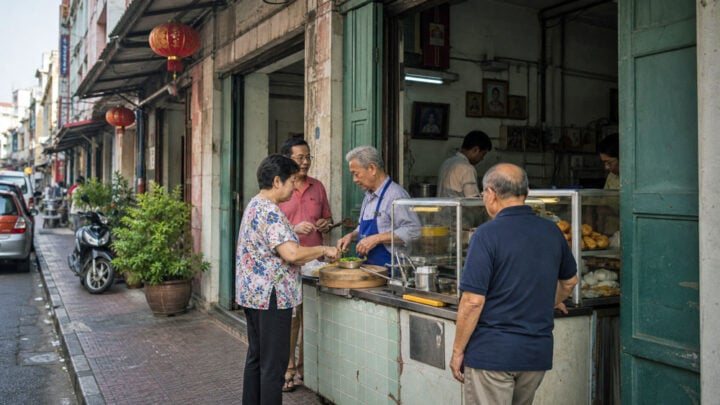
Anyone walking through Yaowarat in Bangkok in the evening smells and hears it immediately. Crackling woks, orders shouted back and forth in a mixture of Thai and an older Chinese dialect, red lanterns swaying gently in the evening breeze. This is Chinatown, and it is much more than a tourist attraction.
It is the beating heart of a population group that has largely shaped Thailand, without many outsiders realizing it. The Chinese-Thai community has merged into society, at times visibly, at other times invisibly. And yet, without them, Thailand would be a very different country than it is today.
How big is the group actually?
Estimates vary widely, and there is a good reason for this. According to virtually all sources, ethnic Chinese make up between ten and fourteen percent of the Thai population. That amounts to about 9 to 10 million people out of a total of nearly 66 million inhabitants. If you include everyone with any Chinese ancestors, the figure is much higher. Some researchers estimate that up to a third of the Thai population has mixed Chinese roots. This makes it the largest Chinese community outside of China and Taiwan, and at the same time one of the most assimilated in Southeast Asia.
Slightly more than half of the Chinese-Thai population is descended from Teochew migrants from the Shantou region in Guangdong. In addition, there are Hakka (about 16 percent), Hainanese, Hokkien, and Cantonese. These dialect groups are primarily still culturally visible in associations, at cemeteries, and during family rituals. In daily life, virtually all Chinese-Thai simply speak Thai with each other. Estimates suggest that about 80 percent speak Thai at home, no longer Chinese.
A history of trade, policy, and assimilation
Chinese merchants came to Siam as early as the time of the Kingdom of Ayutthaya (1350–1767). King Taksin, who ruled Thailand from 1767 to 1782, was himself the son of a Chinese immigrant and actively encouraged Chinese settlement. However, the great wave of migration occurred in the nineteenth and early twentieth centuries. Tens of thousands of men fled from southern China to escape hunger, war, and poverty, and went to work as coolies, merchants, rice millers, and tin workers. Initially, they integrated easily, partly because many Chinese men married Thai women.
That changed in the 1920s. Under King Rama VI, openly anti-Chinese policies emerged. In the 1930s and 1940s, Prime Minister Plaek Phibunsongkhram, himself of part Chinese descent, excluded Chinese people from some 27 professions and restricted Chinese-language education. Many families adopted Thai surnames at the time to blend in. By 1970, an estimated 90 percent of Chinese born in Thailand had acquired Thai nationality. From the 1980s onwards, the picture shifted again: China became an economic power, and suddenly displaying one's Chinese roots became a status symbol. Former Prime Minister Kukrit Pramoj once aptly put it: almost every Thai person has a Chinese ancestor somewhere on their family tree.
The economic heavyweight
This is where the story becomes truly striking. The Chinese-Thai community accounts for the vast majority of private enterprise in Thailand. Estimates vary but consistently point in the same direction: somewhere between 60 and 90 percent of large Thai-owned companies, banks, and industries are run by families of Chinese descent. Of the eleven Thai dollar billionaires counted by Forbes in 1995, ten had Chinese ancestors.
The most striking example is the Charoen Pokphand Group, or CP for short. Two brothers from Shantou, Chia Ek Chor and Chia Siew Whooy, opened a small seed shop in Bangkok's Chinatown in 1921. One hundred years later, CP is one of the largest corporations in Southeast Asia, with operations in more than one hundred countries. Here are a few facts:
- CP is the world's largest producer of animal feed and shrimp, and third in chicken and pork.
- In Thailand, the company owns over 15.000 7-Eleven stores through its subsidiary CP All (2024 figure).
- Through CP Axtra, the group operates the Lotus's supermarkets and Makro wholesalers.
- CP is also the owner of telecom giant True Corporation.
- CP Foods alone reported approximately $17,8 billion in revenue in 2024.
The Chearavanont family, which leads the group under honorary chairman Dhanin Chearavanont, is among the wealthiest families on the continent according to Forbes Asia. Besides CP, there are other well-known names: the Yoovidhya family behind Red Bull, the Sirivadhanabhakdi family behind Chang Beer and ThaiBev, and the Sophonpanich family behind Bangkok Bank. Not to forget the Shinawatra family. They once started in the silk trade in Chiang Mai and eventually produced four prime ministers: Thaksin (2001-2006), brother-in-law Somchai Wongsawat (2008), sister Yingluck (2011-2014), and daughter Paetongtarn (2024-2025). All of Hakka Chinese descent, with ancestors from Guangdong.
Politics: from outsiders to Government House
For a long time, Chinese people were not welcome in Thai politics. That has changed drastically. Since the 1990s, a striking number of Thai prime ministers have Chinese ancestors. Chuan Leekpai (Hokkien), the four Shinawatra leaders, and the current Prime Minister Anutin Charnvirakul (Cantonese), who was re-elected on March 19, 2026, following the elections of February 8. Anutin comes from a wealthy family behind the construction company Sino-Thai Engineering and Construction. Wikipedia's own list of Thai politicians of Chinese descent currently numbers 62 names at the time of writing, and that is certainly not exhaustive.
According to political historian William Kirby of Harvard Business School, this is no coincidence. The combination of trading experience, accumulated capital, and international family networks naturally made Chinese-Thai families influential when Thailand opened up economically to the world. Anyone discussing money or power in Bangkok today can hardly avoid these families.
How Chinese is Thai cuisine?
This is where it gets really tasty. Much of what Western tourists see as typically Thai is fundamentally Chinese. The wok? Chinese. Stir-frying? Chinese. Soy sauce, tofu, fermented soybean paste (taochiao), yellow soy sauce noodles, making broth, and chopsticks with noodle soup all came along with the Chinese migrants. Yaowarat in Bangkok is even considered the birthplace of Thai street food culture.
The most paradoxical story is that of pad thai, often presented as a national dish. Pad thai was not invented until the 1930s and 1940s, as part of Prime Minister Phibunsongkhram's nationalist program. By temporarily making rice scarce (partly due to war and floods) and promoting stir-fried rice noodles, he attempted to detach the people from Chinese culinary influences. Ironically, the technique upon which pad thai is based—stir-fried rice noodles, or kuay teow pad—is itself a Chinese heritage. The full Chinese name, kuay teow phat thai, literally means Thai stir-fried rice noodles. Dishes such as pad see ew, guay tiew, khao man kai, and jok also come directly from Chinese cuisine, albeit with Thai flavor accents such as tamarind, palm sugar, fish sauce, and chili peppers (the latter, incidentally, originate from South America).
The major holidays: more than just red lanterns
Three Chinese festivals have grown deep into the Thai calendar and are more than worth checking out:
- Chinese New Year is the best known of these. In 2026, it falls on February 17, the start of the Year of the Fire Horse, a combination that occurs only once every sixty years. Officially, it is not a national holiday in Thailand (banks remain open as usual), but in practice, millions of people celebrate it over three days: Wan Chai (February 15, shopping day), Wan Wai (February 16, day of honoring ancestors), and Wan Tieow (February 17, visiting family). Yaowarat in Bangkok is the place to be then, with lion dances, fireworks, and temple visits to Wat Mangkon Kamalawat, among others. But Hat Yai, Phuket Old Town, and Nakhon Sawan also hold major celebrations. In the southern provinces of Narathiwat, Pattani, Yala, and Satun, some institutions do receive a day off.
- The Vegetarian Festival (Tesagan Gin Je), also known as the Nine Emperor Gods Festival, is perhaps the most spectacular. For nine days, during the ninth lunar month of the Chinese calendar, participants eat strictly vegan and wear white clothing. In Phuket, with its large Peranakan Chinese community, the most extreme events take place: trance mediums (mah song) pierce cheeks with swords, walk across glowing coals, and climb ladders with knives. In 2026, the festival takes place from October 10 to 18. In 2023, the festival reportedly generated around 44,6 billion baht in economic activity, the highest amount in ten years. You can also see yellow Je flags in front of participating restaurants and stalls in Bangkok, Chiang Mai, and Hat Yai.
- Cheng Meng or Qingming (April 4 or 5) is much more intimate. On this Tomb-Sweeping Day, Chinese-Thai families travel to family graves to clean them, offer food, and burn jossepapier. Unlike Buddhist Thais, Chinese Thais are more likely to bury their dead than cremate them, hence the Chinese cemeteries found scattered throughout the country. At Wat Don in Bangkok, more than 10.000 first-generation immigrants are buried, people who, according to local stories, often died before the age of sixty due to extremely hard work.
What this means for you as a visitor
Have you ever grabbed a Cup Noodles at a 7-Eleven, shopped at a Lotus's supermarket, made a call using a True SIM card, or ordered a beer at a hotel owned by Chinese-Thai people? Then you have likely participated in an economic ecosystem largely run by Chinese-Thai families. And virtually every time you eat something from the wok in Thailand, you are eating a dish with roots in Southern China.
For travelers over fifty who have been visiting Thailand for years, this is actually good news. The next time you stroll through Yaowarat during Chinese New Year, or see the white processions pass by in Phuket during the Vegetarian Festival, you have context. You are not looking at an exotic curiosity, but at the living history of a community that helped build Thailand. And perhaps you will suddenly understand better why your host at that little hotel in Hua Hin has strikingly fair skin, a small altar with red paper in the lobby, and hosts family for dim sum on Sundays.
Slot
Thailand is, as Kukrit Pramoj once said, a country where almost every family tree has a Chinese branch somewhere. From the Prime Minister to Pad Thai, from 7-Eleven to temple festivals: Chinese-Thai influence is present everywhere. You only have to stop and look to see it everywhere. This makes every visit to Thailand an encounter with a centuries-old history of migration.
Sources: Wikipedia, Minority Rights Group, Britannica, Tourism Authority of Thailand, Thailand NOW, Smithsonian Magazine, Nation Thailand, Thai Enquirer, The Diplomat, Time, Pattaya Mail, Southeast Asia Globe
About this blogger

-
This article has been written and reviewed by the editorial team. The content is based on the author's personal experiences, opinions, and independent research. Where relevant, ChatGPT was used as a tool for writing and structuring text. We also sometimes generate photos using AI. Although the content is handled with care, it cannot be guaranteed that all information is complete, up-to-date, or error-free.
The reader is responsible for the use of the information on this website. The author accepts no liability for any damage or consequences resulting from the use of the information provided.
Read the latest articles here
 SightsMay 2, 2026Farang prices in Thailand 2026: how the dual price structure works and how you can sometimes avoid it
 Expats and retireesMay 2, 2026Generic medicines or the well-known brand: how to choose wisely at a Thai pharmacy
 Expats and retireesMay 2, 2026Divorcing a Thai partner: which court should you go to?
 BackgroundMay 2, 2026The Chinese-Thai minority has been helping to build Thailand for centuries: from CP Group to pad thai