

Buying a car in Thailand seems simple, especially if you have been living in the country for a long time. Yet, this is precisely where many Dutch and Belgians make mistakes. They focus on price, model, and appearance, but underestimate the rules regarding registration, insurance, transfer of ownership, and liability for daily use.
That risk is greatest with used cars, private sales, and import models, but things can also go wrong with a new car if you do not properly check documents, warranties, and costs. Anyone who knows the pitfalls in advance avoids hassle with the government, insurer, seller, and ultimately, their own wallet.
What officially applies and where friction arises in practice
Officially, as a foreigner in Thailand, you can register a car in your own name, but you must be able to present additional documents. These include a passport, a valid visa, and proof of address in Thailand. In practice, it is precisely the latter that is often the stumbling block. Some offices accept a residence certificate from Immigration, while others also accept a work permit or an employer's statement. Furthermore, upon transfer, the car must be legally and fiscally clear. The transfer must normally be arranged within fifteen days. For passenger cars older than seven years, an inspection is required before you can renew the annual tax.
The recurring costs are also more concrete than many buyers think. The annual motor vehicle tax for a passenger car with up to seven seats is calculated based on engine displacement. For the first 600 cc, 0,50 baht per cc applies; from 601 to 1.800 cc, 1,50 baht per cc; and above that, 4,00 baht per cc. Consequently, a 3.0-liter car quickly reaches 6.900 baht per year, without other fixed costs. On top of that come mandatory insurance, voluntary insurance, maintenance, and, for older cars, inspection and repair costs. Exactly what is charged can vary by province and by DLT office.

New or second-hand makes a big difference in Thailand.
With a new car from an official dealer, the risks surrounding ownership, initial registration, and paperwork are usually smaller. The dealer often handles the license plates, initial registration, and part of the administrative processing. This provides peace of mind, but it does not mean that everything is automatically in order. Especially with new cars, buyers often make the mistake of not sufficiently checking exactly what is included in the price. Consider delivery costs, registration, Por Ror Bor, voluntary insurance, accessories, and warranty conditions. Warranties also vary. Where one manufacturer offers three years or 100.000 kilometers, another provides coverage for much longer.
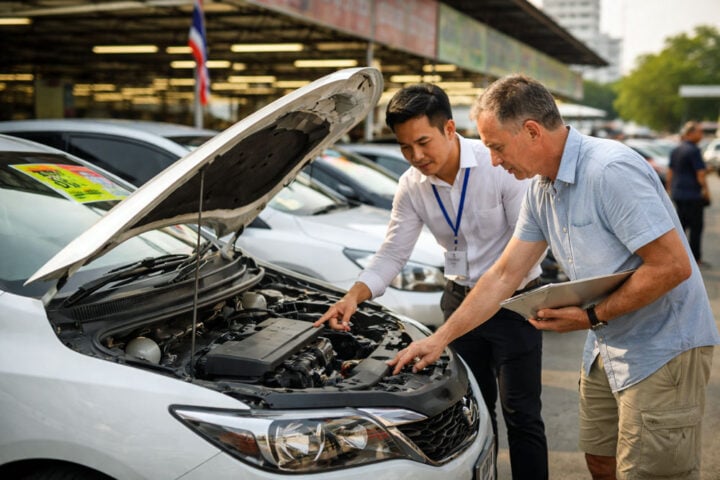
With used cars, the risks are clearly greater. Questions arise regarding damage history, mileage, outstanding financing, maintenance history, legal ownership, and hidden defects. Protection for the buyer is weaker, especially in private sales. A brand dealer with an official Certified Used program usually offers more security, as the car has been inspected and a limited warranty often applies. At a regular used car dealer, quality depends heavily on the reputation, the completeness of the paperwork, and the honesty of the seller. With a private purchase, you have to check almost everything yourself, from chassis number to tax status and from contract to transfer of ownership.
The 15 mistakes foreigners make most often
- Making a down payment too early
You often do this out of haste or because the car is attractively priced. The risk is that you will run into issues with proof of address or registration later on. Avoid this by first checking with your local DLT office which documents they accept from you. - Thinking that every province applies the same rules
Many buyers assume that a single list of documents is valid everywhere. In practice, procedures and flexibility vary by firm. Therefore, always check the local procedures before signing. - Buying from someone who cannot legally sell
A car may be registered in the name of someone other than the person offering it. This poses a risk of fraud and a failed transfer of ownership. Always request the original registration book and verify identity, name, and authorization. - Postpone the transfer
Some buyers pay and drive away, thinking the paperwork will follow later. By doing so, you are taking an unnecessary risk. Ideally, arrange payment and transfer on the same day. - Failure to check for overdue taxes or blockades
A car may be financially or administratively tied up. In that case, you won't be able to register it in your name easily. Therefore, ask in advance whether the car is freely transferable and check the status. - Overlooking outstanding financing
With used cars, this is a classic. The seller claims that everything has been paid off, but you have no proof. The result could be that you pay for a car that is not yet legally cleared. Have this confirmed in writing. - Do not physically compare chassis number and engine number
Buyers too often look only at copies or advertisements. As a result, you miss forged or incorrect papers. Always compare the numbers on the car itself with the registration book and other documents. - Blind trust in the mileage
A low mileage looks attractive but can be misleading. As a result, you pay too much and underestimate the technical risk. Check whether the mileage is consistent with age, wear, and maintenance history. - Did not have a serious technical inspection done
A neat paint job or a clean engine bay says little. Without an independent inspection, you will miss damage, rust, poor repairs, or gearbox problems. Therefore, always have the car checked by your own mechanic. - Failure to recognize flood damage or severe damage history
This often happens with cars that have been cosmetically enhanced. The consequences are significant, ranging from electrical problems to structural insecurity. Look out for paint discrepancies, weld seams, warped seams, a musty odor, and traces in the trunk or underfloor. - Thinking that Por Ror Bor is sufficient insurance
That is an expensive miscalculation. This mandatory insurance covers only limited personal injury and not ordinary property damage to another person's vehicle or to your own car. Therefore, always take out appropriate voluntary insurance. - Assuming that financing for foreigners works out automatically
Many Dutch and Belgians believe that a stable income or a long stay is sufficient. In practice, banks often require additional documents, a work permit, or even a Thai guarantor. Therefore, arrange for written pre-approval first. - Buying imported cars without checking import history
Thailand is strict regarding imported used cars. If import papers, taxes, or provenance are incorrect, you are buying into a significant legal risk. Therefore, be extra critical of grey imports and always ask for the complete documentation chain. - Trust in verbal agreements instead of a good contract
It is precisely regarding accessories, warranty, damage history, and voluntary ownership that things go wrong. Without clear written agreements, you are in a weak position. Always put the price, chassis number, mileage, known damage, charges, and accompanying documents in writing. - Only look at the purchase price
A cheap car can turn out to be expensive due to taxes, insurance, inspections, maintenance, tires, battery, and unexpected repairs. Therefore, draw up a total budget in advance for at least twelve months of ownership and use.
Practical checklist for Dutch and Belgians who want to buy a car in Thailand
Use this checklist before you pay:
- check which proof of address your local DLT office accepts;
- ensure that passport, visa and address document are valid;
- determine in advance whether you are buying with cash or need financing;
- Request written approval first for financing;
- check who is the legal owner of the car;
- check if the car is freely transferable;
- have the price, conditions, and accompanying documents recorded in writing;
- schedule payment and transfer as close together as possible;
- check what is included in the price, such as registration, insurance, and accessories;
- do not forget that Por Ror Bor is mandatory, but does not offer sufficient protection on its own;
- calculate the fixed annual costs in advance;
- Take into account differences by province, dealer, insurer, and situation.
Separate checklist for used cars
With a used car, you have to go a step further:
- always ask for the original registration book;
- compare chassis number and engine number on the car itself;
- check if there is any outstanding financing or other liabilities;
- request maintenance booklets, invoices, and service history;
- check if the mileage is logical;
- let the engine start cold and take a real test drive;
- look at paint differences, damage repair, rust and flood marks;
- have the car independently technically inspected;
- be extra careful with imported cars and conspicuously low mileage;
- Do not rely on a verbal guarantee alone;
- Only pay in full once the bank transfer and documents are demonstrably in order;
- It is better to buy from a demonstrably reliable dealer than from a private seller on a whim.
In short, the greatest danger when buying a car in Thailand lies not in the driving, but in everything leading up to it. Anyone who fails to thoroughly check the paperwork, insurance, transfer of ownership, and technical condition can lose a lot of money. Especially with used cars, caution is not a luxury, but a pure necessity.
Sources: Department of Land Transport, Office of the Consumer Protection Board, Krungsri Auto, BMW Thailand, Volvo Cars Thailand, Suzuki Thailand, Kia Thailand, Roojai, WTO Import Licensing
About this blogger

-
This article has been written and reviewed by the editorial team. The content is based on the author's personal experiences, opinions, and independent research. Where relevant, ChatGPT was used as a tool for writing and structuring text. We also sometimes generate photos using AI. Although the content is handled with care, it cannot be guaranteed that all information is complete, up-to-date, or error-free.
The reader is responsible for the use of the information on this website. The author accepts no liability for any damage or consequences resulting from the use of the information provided.
Read the latest articles here
 Car insuranceApril 14, 2026Buying a car in Thailand often goes wrong due to these 15 mistakes.
 HealthApril 14, 2026Living in Thailand and your health: more than just tropical vaccinations
 TravelApril 14, 2026Is Vietnam an alternative to Thailand in the winter?
 Expats and retireesApril 14, 2026Homesickness drives part of Western emigrants in Thailand back home