

Hurdles in the NL-TH 2025 tax treaty (reader submission)
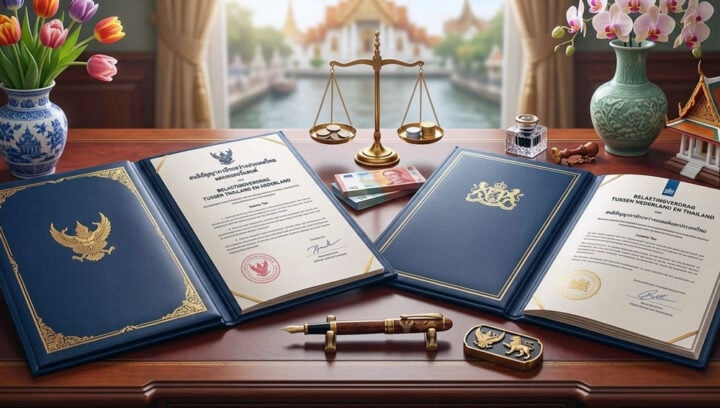
The Call to the House of Representatives Committee on Finance
Preliminary note: The Call to the Commission was deliberately brought forward. Its scheduling coincided with the parliamentary summer recess. Now that the Council of State is acting so quickly, the Commission might well decide within the short term to handle the treaty as a 'hammer piece' (without debate). Fortunately, the call was already waiting, ready and waiting. Read and shudder, and send it off. Preferably today!
1. What do the Belgians actually do, and the Germans too, for that matter?
Let's not forget the French! The answer to that question lies in the distant past: in 1995, a certain Schumacker went to the European Court of Justice. He sought to ensure that Germany, his source state (the country where the income originates), was obliged to take his personal situation into account for tax purposes. After all, in Belgium, his country of residence (the country where he is registered in the population registers), he could not demonstrate that he still possessed a sufficient taxable financial volume to claim tax credits.
That became the core of the Schumacker doctrine: the obligation of a source country to assume the duty of care of a country of residence. Although: developed on the basis of the free movement of workers within the EU.
A similar situation, in which country of residence Thailand is no longer able to fulfill its duty of care regarding tax reliefs, will also befall us once the new tax treaty becomes a reality. As the source state, the Netherlands makes it virtually impossible for us to claim “deductions and allowances” and a tax-free first tax bracket there due to the 100% levy in country of residence Thailand.
The Schumacker judgment states that the Netherlands, as the source country, assumes that obligation.
2. But the Netherlands refuses, because an EU judgment is EU law.
But is that a justified refusal? Schumacker won his plea on a number of points:
1- tax must be levied on a person's actual financial capacity;
2- if someone earns at least 90% of his income in the source country, he is in a similar situation to a resident of that country, and
3. If no income is taxed in the country of residence, the source country must assume that role to prevent discrimination.
The Netherlands has limited the scope of the Schumacker Doctrine to a “circle of countries” within that of the EU, the EEA, Switzerland, and the BES islands. This constitutes a deliberate exclusion of non-EU/EEA countries. Belgium, Germany, and France did the same, but they grant their citizens alternatives by means of a tax-free amount or bracket.
The refusal to assume duty of care is far-reaching! The EU Court did not state that EU law ceases at the borders of the EU. While the jurisdiction of the EU Court is indeed limited to the EU, the legal principles it formulates (such as the prohibition of discrimination in the case of a 100% withholding tax) are universal in nature. A high degree of legality applies within the EU, and the conduct of a government in accordance with EU standards also applies to its own nationals outside the EU/EEA. This means that the Netherlands cannot argue that 'paying capacity' ceases to exist at the border of the EU.
That principle of ability to pay, as laid down in the Explanatory Memorandum to the Income Tax Act 2001, obliges the Netherlands to act in accordance with the spirit of the EU judgment, and, in all decency, ought to assume Thailand's duty of care. As neighboring countries do.
In Part 8, a complete comparison of the Dutch system with that of neighboring countries. It will then become apparent that The Netherlands one very rigid mindset adheres to.
3- The Netherlands is becoming more fiscal.
In the Dutch tax system, a shift is taking place whereby social costs (such as the Wlz for long-term care) are no longer paid solely from premiums, but increasingly from general tax revenues. This process is called fiscalisation. As a resident of Thailand, you do not pay premiums for national insurance schemes because you are not insured for them. By renaming these premiums as income tax, our government can now claim this amount. Because we are liable for tax but not for premiums, our monthly deductions skyrocket. Due to fiscalisation, we are contributing to a Wlz package that was previously exempt, simply because the government gives it a different name. And because those premiums are becoming taxes, we cannot legally evade them.
If the financing of national insurance schemes (such as the Wlz) is transferred to general funds through fiscalization, the levy loses its character as an 'insurance premium' and becomes a general tax. It is legally indefensible to tax a citizen for the financing of these provisions while denying them access to the associated rights (such as tax credits and social security guarantees) by using outdated terminology. If the Dutch 'resident' no longer pays premiums but tax, the moral and legal distinction with the Dutch 'foreigner'—such as the Dutch pensioner in Thailand, who pays the same tax—disappears. Much more on the theme of both fiscalization and access to care facilities later. More on the implications of all this commotion later.
4. The Box 3 trap and the 90% requirement.
To be entitled to tax credits in the Netherlands (such as the elderly tax credit), you must be a Qualifying Foreign Taxpayer (KBB). The strict requirement is that at least 90% of your worldwide income must be taxable in the Netherlands.
This is where things go wrong for a significant number of Dutch pensioners in Thailand. Under Dutch tax logic, a primary residence abroad (without a mortgage) is considered a form of fictitious income (assets in Box 3). The Tax and Customs Administration adds a percentage of the value of your Thai home to your foreign income (the so-called 'benefit from savings and investments'). Although this 'income' is not taxed in the Netherlands (because Thailand has the right to tax domestic real estate), it does count towards the 90% test.
The bitter irony is that this property is not taxable in the Netherlands, yet it is used as a ground for exclusion. Based on the tax treaty, the Netherlands is not allowed to levy a single cent of tax on this real estate; nevertheless, a notional return is placed as 'foreign income' in the denominator of the fraction to torpedo the 90% requirement.
The 90% requirement acts as a 'penalty on ownership'. Someone who rents a home in Thailand and spends their money does receive the Dutch tax credits. Someone who invests in their own home and supports themselves financially is financially penalized by the tax authorities. This is referred to as Box 3 dilution of social rights. Much more on this subject in a later part.
5-The End of “Uncontrollability”
For decades, the Dutch government has excluded residents outside the EU/EEA from tax credits, arguing that personal circumstances (income, assets, family situation) in countries like Thailand could not be reliably verified. The argument of the century to geographically limit the Schumacker doctrine. Article 25 of the new treaty is full of details on how and what controls will be deployed.
With the ratification of the new 2025 Tax Treaty and the global implementation of the Common Reporting Standard (CRS), this argument has effectively and technically become obsolete. Under Article 25 of this treaty, the Netherlands and Thailand have agreed to exchange various types of tax information automatically and on a large scale and regarding a wide range of matters. Since 2022, the Tax and Customs Administration has already had precise insight into the bank balances and income streams of Dutch nationals in Thailand via OECD/CRS agreements. And these are not the only means.
Maintaining geographical exclusion limited to only EU/EEA/CH/BES has thus become a deliberate choice for injustice, purely for budgetary reasons. The Netherlands can no longer use 21st-century technology to rake in funds, while clinging to 20th-century excuses to avoid having to pay compensation.
A more detailed explanation of the impact of Article 25 and Thailand's tendency to align with OECD models will follow in one of the subsequent parts.
6-The Conclusion of Everything
All of us have no choice but urge the Finance Committee of the House of Representatives not to dismiss the new tax treaty with Thailand as a technical formality, and that the Committee forcing the Jetten cabinet and the State Secretary of Finance to modernize the 90% requirement for countries with full transparency, starting with Thailand now that new bilateral opportunities exist with the new treaty
Dutch pensioners in Thailand get completely stuck tax-wise due to:
- The annexation of the fiscal mass: The 100% withholding tax irrefutably shifts the duty of care regarding the ability-to-pay principle to the Netherlands. The Netherlands effectively becomes the country of residence, but refuses the associated rights.
- The labels paradox: Premiums are rebranded as 'taxes' in order to collect them, while the label 'premium' is misused to deny healthcare rights.
- The Box 3 blockade: The outdated 90% requirement penalizes self-reliance; home ownership in Thailand completely and unjustifiably blocks access to discounts, despite a 100% Dutch income.
- The end of 'uncontrollability': Exclusion of rights is taking place up to and including 2026 based on outdated arguments, whereas the Netherlands has already had full control since 2022 through automatic information exchange with Thailand.
In short: after having read everything and mentally absorbed it all, only one conviction remains conceivable, namely to copy and email the letter below to the Committee on Finance. With that letter, we force the Committee to put the human scale and fiscal justice on the agenda. Do not hesitate, send it in! Good luck, Ruud B.
Next week in the series:
HURDLE RUNNING IN THE NL-TH 2025 TAX TREATY
Part 1 of 12: “A comprehensive overview of the tax shifts.
Draft letter to the Standing Committee on Finance
To: the Members of the Standing Committee on Finance of the House of Representatives
From: full name
Date:
Regarding:
Ratification of new Netherlands-Thailand tax treaty; request for safeguarding legal protection and prevention of fiscal discrimination.
Dear Committee Members,
Following the recent signing of the new tax treaty between the Netherlands and Thailand (21 November 2025), we request your urgent attention to a structural inequality in the tax treatment of thousands of Dutch pensioners in Thailand.
Now that the Netherlands claims the full right to tax pension income via this treaty, a situation arises that strikes at the foundations of our tax system. We request that you take the following key points into account in your assessment:
1. The Netherlands as “Fictitious Country of Residence”: The shift in legal obligation
Through the introduction of full withholding tax, the entire taxable income is being transferred to the Netherlands. Although the so-called 'Schumacker doctrine' stems from EU law, it is based on the universal principle of ability to pay: a fundamental legal principle that the Netherlands must respect even outside the EU borders. Now that the Netherlands is claiming the entire taxable income (100%) through the new treaty and ongoing fiscalization, Thailand, as the formal country of residence, can no longer provide any personal concessions. Thailand no longer has any room to take the taxpayer's personal situation into account, because the Netherlands has fully annexed this financial leeway. In doing so, the Netherlands effectively forces itself into the role of 'fictitious country of residence'. In such a case, the legal obligation to take tax credits and the minimum subsistence level into account no longer rests with the powerless country of residence, but has irrefutably passed to the Netherlands as the dominant source state.
2. The Paradox of Fiscalization
The tax rate structure in the first bracket will shift drastically as of 2026. Due to 'fiscalization', national insurance contributions (such as the Wlz and Anw) are being converted into income tax. For residents of Thailand, this results in an effective doubling of the tax burden (from approximately 8% to approximately 18% in the first bracket), without any corresponding social or fiscal compensation. The Netherlands uses the classification 'tax' to collect it, but maintains the classification 'premium-based' to deny healthcare rights. This double standard is legally untenable.
3. No safeguard against Box 3 dilution
The current strict enforcement of the 90% requirement for Qualifying Foreign Tax Liability (KBB) creates an artificial threshold. A primary residence in Thailand (without any mortgage interest deduction in the Netherlands) counts fully as foreign income for this test, effectively penalizing citizens for their self-reliance abroad and excluding them from necessary tax credits.
4. Modernization of the concept of residence and precedent effect
The concept of physical residence from the 70s is outdated. Now that the Netherlands has full control over the income situation in Thailand through automatic information exchange (Art. 25 and CRS), the argument of “uncontrollability” falls away. Whoever has the means for 100% control also has the duty of 100% fiscal justice. We ask you: is it just to maintain this structural inequality solely as a budgetary savings measure?
I therefore request the Commission:
- To compel the State Secretary to conduct a formal review of the treaty against the universal principle of ability to pay.
- To advocate for a relaxation of the KBB criteria (90% requirement) for Thailand, now that full control is possible via Article 25.
- Not to treat the ratification of the treaty as a formality, but to complete it only when the social component (access to care) has been arranged in a coherent manner.
Yours sincerely,
Name/
Full Address Details Thailand/
Email address/Phone number
=-=-=-=-=-=-=-=
Send this letter today to: cie.fin@tweedekamer.nl
and in CC to the Finance spokespersons of the following parties:
- D66: j.vijlbrief@tweedekamer.nl
- PVV: e.mulder@tweedekamer.nl
- VVD: e.heinen@tweedekamer.nl
- CDA: h.bontenbal@tweedekamer.nl
- BBB: h.vermeer@tweedekamer.nl
- 50Plus: j.struis@tweedekamer.nl
Submitted by Ruud B.
About this blogger
Read the latest articles here
 Tax in the NetherlandsApril 14, 2026Hurdles in the NL-TH 2025 tax treaty (reader submission)
 Immigration information letterApril 12, 2026Thailand Immigration Infobrief No. 020/26: SETV in Laos (continued)
 Visa questionApril 12, 2026Thailand Immigration Question No. 056/26: Extension with hospital letter
 Reader questionApril 12, 2026Thailand reader question: does a Thai international driving licence exist?
Thank you, Ruud
I sent it immediately
Ruud B. has truly delivered an extremely thorough piece, and a solid petition to the House of Representatives (Financial Committee) in which all arguments hold absolutely water. He points out the rejection of tax credits in the new treaty, even though it is due for renewal; how fiscalization creates the risk that in a few years, instead of 8% tax, we will be teetering on the brink of 18% tax (first bracket rate minus state pension premium); and, if the treaty proves true, that we run the risk of being disadvantaged once again in Box 3. I did not expect him to come up with such a comprehensive article. Very curious about the series he is announcing. Already an asset to Thailandblog. I have sent the call by email. Bravo!
Thank you for this comprehensive article. Clear and detailed, but with a focus on tax credits to alleviate the burden and obtain equal rights like taxpayers in the Netherlands.
But now about the potential future practice.
Suppose you have an AOW benefit and a (small) supplementary company pension from the Netherlands.
Deregistered from the population register a long time ago and has no assets in the Netherlands, except for the mandatory passport to travel internationally.
Question 1: Withholding tax, does this correspond to Box 1 income tax?
Question 2: Does the same apply to income derived from dividends on shares, investment funds, and savings interest at a bank in the Netherlands?
Question 3: Same as question 2, but at a bank in Thailand or anywhere else in the world? Note: how can they even verify that?
Question 4: Your income is low, but you have substantial assets held in a bank in the Netherlands on which you live. Will this fall under Box 3 in the future, regardless of what it will look like?
Question 5: No real estate in the Netherlands, but in Thailand. Does this count towards Box 3? If so, who determines the value, not to mention art and other valuable objects?
Thank you in advance for an explanation of what the practice will look like.
Dear Ruud B.
I am trying to follow and understand it. Under the new treaty, you still have to declare the total amount you contribute. A tax credit is then applied to the amount of tax you pay in the Netherlands. The well-known deductions in Thailand remain in place, don't they?
Regards, Leo
The letter was copied and sent.
Unfortunately, the blue background came along too; I didn't see how I could remove it.
Hopefully, it will attract some extra attention.
Letter (thank you for all the work) sent, but received an error message at the email address j.struis@tweedekamer.nl so searched and found this one tweedekamerfractie50PLUS@tweedekamer.nl.
Email address is: j.struijs@tweedekamer.nl
Hi Ruud. Very good letter, which I fully support.
Thanks for the draft letter. I have just sent it to the mentioned committee and its members. Great!
Thank you, Ruud B., for the clear explanation. I will definitely send the letter by email this week.
I would, however, like to make a small addition to the last section regarding the Finance Committee and the persons you mentioned.
You can find information about the finance committee at this link: https://www.tweedekamer.nl/kamerleden_en_commissies/commissies/fin
In addition, Messrs. Vijlbrief and Heinen are currently ministers and, as such, are not members of the Finance Committee. Bontenbal of the CDA is no longer a member either. The current members are listed in the link above. I suggest writing to members of the parties mentioned by Ruud B in his article. I would also include André Flach of the SGP and Pieter Grinwis of the CU in the email. They aren't really my clubs, but they do know their stuff.
Eelco Eerenberg – D66 (State Secretary for Finance) is now responsible for tax matters. I cannot quickly find his email address.
Vijlbrief is now Minister of Social Affairs. I don't see an email address for him either.
It might also be useful to include the Speaker of the House of Representatives in the email.
Those are my thoughts so far. I look forward to hearing your opinions.
If I am not mistaken, the Netherlands always withholds tax on the AOW, and Thailand is permitted to withhold tax pursuant to the current treaty as well as the new treaty. The change in the new treaty relates to private pensions, on which the Netherlands can now levy tax. Consequently, Thailand may also levy tax on public income under the new treaty, which is not permitted under the current treaty.
I had already posted a comment, which I cannot find here. Ruud B. Thanks again.
Attached is the link to the Finance Committee in the House of Representatives.
https://www.tweedekamer.nl/kamerleden_en_commissies/commissies/fin/samenstelling
Commission: cie.fin@tweedekamer.nl;
PVV: c.jansen@tweedekamer.nl - chair
PVV: edgar.mulder@tweedekamer.nl;
CU: p.grinwis@tweedekamer.nl;
VVD: c.martens-america@tweedekamer.nl;
CDA: i.vdijk@tweedekamer.nl;
SGP: a.flach@tweedekamer.nl;
BBB: h.vermeer@tweedekamer.nl;
D66: h.oosterhuis@tweedekamer.nl;
Ja21: m.hoogeveen@tweedekamer.nl;
50 Plus: j.struijs@tweedekamer.nl
I wrote to all these members this morning.
The responsible State Secretary is: Eelco Eerenberg of D66.
Good luck everyone, and let me know if you have received a response. I am personally going to give a printout of the email to the ambassador during his visit to Udon Thani next week, with the request to also pass this on to the relevant government ministers and members of parliament.
I don't know anything about this, but could it be that they prefer to sweep these kinds of matters under the rug?
Could it be that they are not publicizing it because they might receive claims from “Dutch people” who have obtained Dutch nationality and are now living in their home country again?
Would it be possible that half of Morocco or Turkey will soon start making claims and potentially also want to be entitled to Dutch health insurance while living somewhere else?
Is there anyone who has an answer to that?
Email address j.struis is incorrect, it should be j.struijs@tweedekamer.nl
With kind regards,
Hendrik
On my behalf as well, many thanks to Ruud B. I too have just sent the letter to all members (under my real name etc.), with a separate email to those new names and BCC to Thailandkoorts.nl.
I received an answer from Henk Vermeer right away… He is being flooded with emails.
Ruud, first of all, thank you very much for your dedication and leading role!
I have just made my contribution to this headache file as well by informing the aforementioned committee members of our points of concern and objections.
Hopefully, there is still understanding, humanity, and compassion in the Netherlands for those born and raised in the Netherlands. Those who have made an active contribution to Dutch society throughout their entire working lives and who may now be cast aside simply because they no longer live in the Netherlands.