

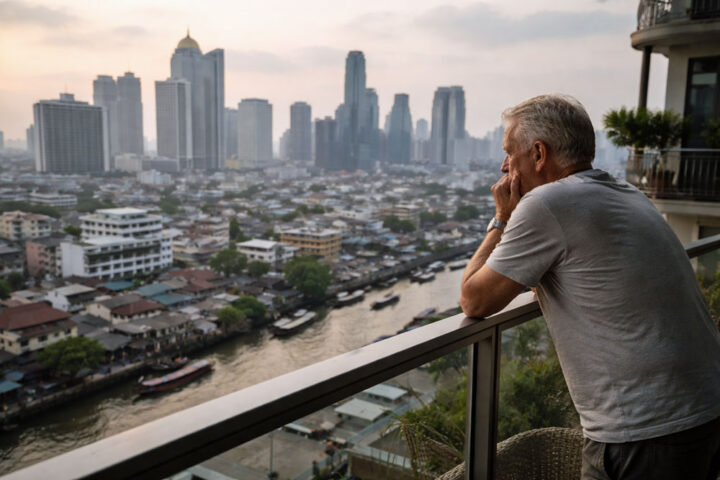
For many Dutch, Belgian, and other Westerners, Thailand seems like a logical place to start over. Warm weather, lower living costs, and a quieter life have been attracting retirees and other emigrants for years. But behind that attractive image lies a reality in which distance, dependence, and adjustment can prove more difficult than expected.
Precise figures on return due to homesickness do not exist, not even for Thailand. Nevertheless, migration data, studies, and practical experience point in the same direction. Homesickness rarely proves to be an isolated feeling, but often grows out of a combination of loneliness, missing family, health concerns, relationship problems, bureaucratic stress, and often disappointing integration into daily life.
Large community, but no exact count of homesickness
Anyone wishing to know how many Western emigrants leave Thailand due to homesickness immediately encounters a lack of direct figures. Official records usually count visas, residents, or registered compatriots, but not the personal reason why someone leaves later. As a result, homesickness disappears into broader categories such as remigration, return, or departure from Thailand. This makes it difficult to measure the problem precisely, even for the Dutch and Belgians.
However, the group we are discussing is certainly not small. Academic research reported nearly 73.000 foreign pensioners in Thailand for 2018. Additionally, the number of retirement visas grew from over 10.700 in 2005 to more than 52.000 in 2021. For Belgium, it is known that 3743 Belgians were officially registered in Thailand in June 2025, although the government itself indicates that this is likely an underestimate as registration is not mandatory. For the Dutch, an equally precise, up-to-date total figure is lacking, but sub-studies do show that Thailand remains an important destination for Dutch pension migrants.
Dutch people demonstrably return relatively often.
The clearest hard figures come from the Netherlands. Older CBS data show that 28,7 percent of Dutch people who emigrated to Thailand returned to the Netherlands within two years. That was clearly above the average of 20,5 percent for all destination countries in the same analysis. These figures do not suggest that all these people left due to homesickness, but they do show that emigration to Thailand failed relatively often more quickly than many other emigrations.
Newer data on pension migrants confirm that picture in a different way. In early 2021, a Dutch dataset counted 1028 Dutch pension migrants in Thailand aged between 66 and 90. Other research showed that only 5 percent of international pension migrants expected to return within three years, while in reality nearly 9 percent did. If that trend continues, about a third would return before the age of eighty. For Belgians, comparable public return figures are almost entirely lacking. As a result, for Belgians, mainly the direction is visible, but not the exact extent.
Homesickness is usually not an isolated problem but an accumulation.
In practice, homesickness rarely comes alone. It often grows out of a combination of social and practical factors. The absence of children, grandchildren, brothers, sisters, and old friends becomes more palpable from a distance, especially when illness, loss, or family problems are involved. This is especially true for older emigrants. For them, a quiet environment may initially seem attractive, but later it can turn into a feeling of emptiness or social isolation.
Language and culture come into play here. You can often get by perfectly well in Thailand without speaking fluent Thai, but that doesn't mean you truly feel at home. Among foreigners in Bangkok, it regularly becomes apparent that language and bureaucracy remain persistent barriers. Forms, visas, banking, medical consultations, and official regulations demand sustained effort. Those without a strong local network are more likely to get stuck in a small expat world or entirely within their partner's circle. It is precisely then that homesickness finds more room, because while daily life keeps going, it fails to take root sufficiently.
Health, dependency, and relationship problems make it harder.
Research into retirement migrants shows that poor health increases the likelihood of return. That is logical. As long as you are vital, Thailand often feels manageable and attractive. But when your health deteriorates, many things change at once. Healthcare needs become more urgent, insurance becomes more important, administrative matters more complicated, and the need for familiar social contact grows. Then the distance to the Netherlands or Belgium suddenly ceases to be abstract and becomes very practical.
Studies show that older Western men in Thailand, in particular, often appear to be heavily dependent on their Thai partners for daily support, language, care, and organization. This need not be a problem as long as everything remains stable, but it makes the situation vulnerable. If a relationship deteriorates, a partner drops out, or care needs increase, an emigrant may suddenly feel isolated and powerless. Homesickness then becomes not only emotional but also functional. The question is no longer just where you want to live, but also where you can still live safely, receive care, and live independently.
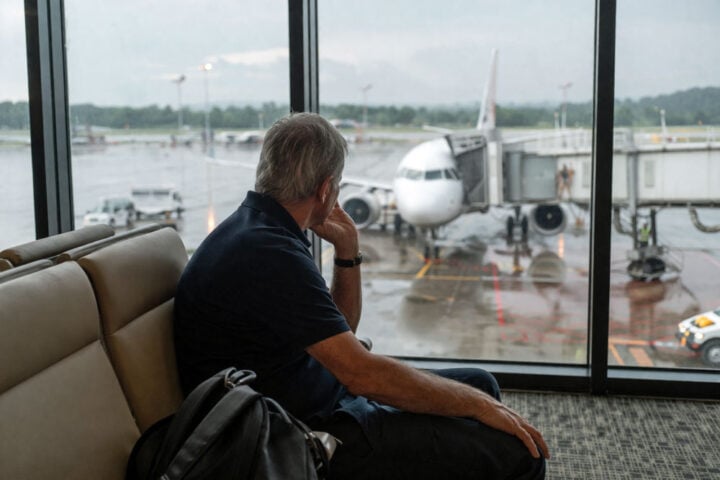
Homesickness also affects mental well-being and daily functioning.
Homesickness in Thailand usually does not manifest as a simple longing for home, but as an accumulation of complaints and behaviors. People become more somber, withdraw, lose rhythm and initiative, or become irritated more easily. Building new contacts becomes more difficult, while old contacts at home start to feel more important. This creates an unbalanced life: physically you are in Thailand, but emotionally you are increasingly living with your head in the Netherlands or Belgium.
This tension also spills over into relationships. One partner then becomes not only a lover, but simultaneously an interpreter, organizer, social anchor, and sometimes a caregiver. This puts pressure on the relationship. The difference between a holiday experience and permanent residence also plays a role. What feels like freedom during a trip can, in the long run, turn into boredom, a loss of routine, or the realization that you are not truly part of anything. Homesickness is therefore sometimes a temporary adjustment phase, but it can also develop into a structural problem that significantly increases the risk of failed emigration.
What you can do to reduce homesickness
The best protection begins before departure. Many emigrants prepare their finances well but underestimate the social and psychological aspects. That is precisely where the real risk often lies. A long trial period outside of holiday mode is wiser than a quick, definitive step. That way, you get a better sense of what it feels like to live in Thailand for months with ordinary days, fixed bills, fewer visitors, and a smaller social safety net.
In practice, this approach in particular seems the most promising:
- consciously build a local network, also outside the expat circle;
- maintain stable and realistic contact with family and friends back home;
- Ensure daily structure, activities, and a rhythm that suits you;
- learn at least functional Thai for everyday situations;
- choose a place of residence that suits your age, health, and mobility;
- Arrange healthcare, insurance, emergency contacts, and a financial buffer in advance.
- take persistent gloominess, isolation, or relationship problems seriously early on;
- • Consciously schedule return visits, without constantly remaining stuck between two lives.
Those who become rooted locally while remaining connected to home clearly have a greater chance of experiencing Thailand as home in the long term.
Homesickness among Western emigrants in Thailand is difficult to measure exactly, but it is certainly not a minor issue. Older Dutch and Belgians with a small network, strong family ties back home, health problems, or a high degree of dependence on a partner are particularly at risk. Those who leave with a realistic perspective, actively integrate, and build a solid safety net reduce the chance that their emigration dream will ultimately end in return.
Sources: CBS, NIDI, Population Europe, Belgian Diplomacy, Ageing & Society, InterNations, Austrian Academy of Sciences
About this blogger

-
This article has been written and reviewed by the editorial team. The content is based on the author's personal experiences, opinions, and independent research. Where relevant, ChatGPT was used as a tool for writing and structuring text. We also sometimes generate photos using AI. Although the content is handled with care, it cannot be guaranteed that all information is complete, up-to-date, or error-free.
The reader is responsible for the use of the information on this website. The author accepts no liability for any damage or consequences resulting from the use of the information provided.
Read the latest articles here
 Car insuranceApril 14, 2026Buying a car in Thailand often goes wrong due to these 15 mistakes.
 HealthApril 14, 2026Living in Thailand and your health: more than just tropical vaccinations
 TravelApril 14, 2026Is Vietnam an alternative to Thailand in the winter?
 Expats and retireesApril 14, 2026Homesickness drives part of Western emigrants in Thailand back home