

Tobacco cultivation in Thailand
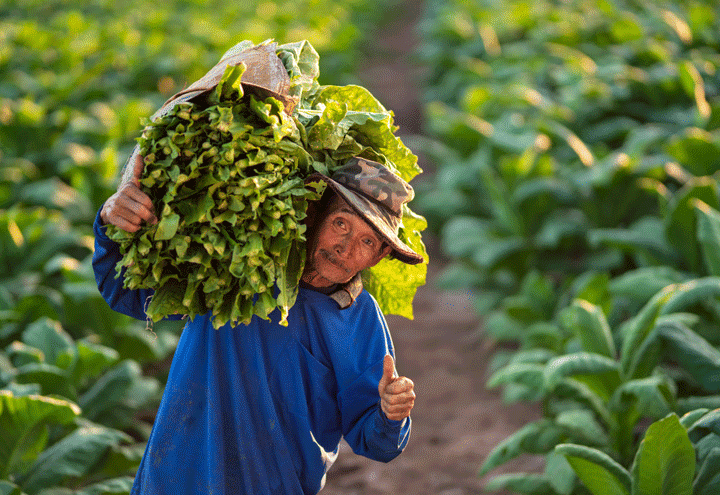
For the production of cigarettes, cigars, etc., the leaves of the tobacco plant (Nicotiana tabacumbour) are used, an annual plant grown on plantations in many countries.
Tobacco cultivation also took place in the Netherlands and Belgium, but was considered unprofitable, especially after the Second World War, due to the rise of large producers such as China, Brazil, the United States and numerous developing countries in Africa and Asia. Thailand also has a considerable area of agricultural land where the tobacco plant is grown.
History of the tobacco plant
On his first voyage to the New World, Christopher Columbus and his retinue were told of a plant, the smoke of which, when burned, was called "tobacco" by the natives of Hispaniola.
In 1560, Jean Nicot de Villemain brought tobacco seeds and leaves to the French court and called it a panacea. In 1586, the botanist Jacques Deschamps gave the plant the name of Herba Nicotiana, it was initially considered a decorative plant before the leaves were used for snuff and tobacco.
Tobacco also made its way to Africa in the early 17th century, where extract of the leaves became a popular pest control agent.
In 1851, the Belgian chemist Jean Stas demonstrated that the tobacco extract was used as a poisonous murder weapon. The Belgian count Hippolyte Visart de Bocarmé had poisoned his brother-in-law in this way, because he was after that brother-in-law's money.
World production
If you think that due to the ever-expanding anti-smoking campaigns, the production of tobacco will have decreased, then I have to disappoint you. That production is still increasing. According to figures from the United Nations, 1971 million tons of tobacco leaves were harvested in 4,2 and is currently over 7 million tons per year. The largest producer is China with almost 40%, followed by India with 8%, Brazil with 7% and the United States with almost 5%. The remaining 40% comes from numerous (developing) countries, including Thailand.
Production in Thailand
In Thailand, a harvest of more than 2014 million kilos was achieved in the period 2015/50. Cultivation is practiced throughout the country, but the emphasis is on the northeast of Thailand, with Nakhon Phanom as the center. Nationally, more than 45.000 households depend on tobacco cultivation. The value of the tobacco purchased from Thai farmers in the period 2010-2014 was more than 4.33 billion Baht, for 2015 the yield is estimated at almost 800 million Baht.
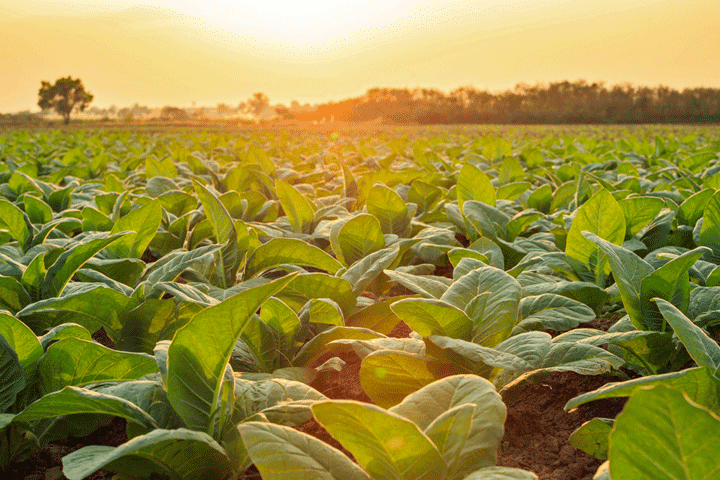
Tobacco field in Sukhothai
Working conditions
The working conditions on the tobacco plantations are not too good. Tobacco cultivation may yield more than, for example, rice, but a lot of insecticide and artificial fertilizer are used. Tobacco production is also poorly known for the high level of child labour. But there is a change in that situation. Although Philip Morris (Thailand) Ltd (PMTL), an importer and exporter of Thai tobacco and cigarettes, has been operating for more than 40 years, a scheme has only recently been put in place to improve working conditions. In cooperation with Adams International, a tobacco leaf buyer and exporter also present in Thailand, a regulation has been drawn up since 2012, which is called General Agricultural Practices.
General Farming Practices
This regulation includes measures to protect farmers from the chemicals and other pesticides used. Meetings are organized where farmers are informed about the hazardous substances and how to properly dispose of them after use. It is also strictly forbidden for farmers under contract with Philip Morris to let children under the age of 13 work on the plantations, even if those children belong to the family. In a recent praise article in The Nation, spokespersons for both companies praise the ALP, which should offer farmers a nice working environment.
Earnings in tobacco cultivation
I have not been able to find out whether the Thai tobacco growers also receive a fair price for their product. A woman from the Nakhon Phanom region says in that article that she plans to expand her tobacco production. It yields more than rice. She says that last year she "earned 60.000 Baht". The explanation of "earned" can be interpreted in several ways, but I want to assume that it is about pure profit, so selling price minus all costs such as seeds, pesticides, fertilizer and a reasonable compensation as wages for plantation owner and workers.
A very optimistic thought, I think!
Source: The Nation/Wikipedia
About this blogger

-
Bert Gringhuis (1945), born and raised in Almelo in the beautiful Twente. Later lived for many years in Amsterdam and Alkmaar, working in export for various companies. I first came to Thailand in 1980 and immediately fell in love with the country. Been back many times since then and moved to Thailand after my (early) retirement as a widower. I have been living there for 22 years now with my somewhat younger Thai lady Poopae.
My first experiences in Thailand as a kind of newsletter sent to family, friends and acquaintances, which later appeared under the name Gringo on Thailandblog. Many, many articles followed those first stories and that has grown into an almost daily hobby.
In the Netherlands still an avid footballer and football referee, but the years are starting to tell and in Thailand still avid, but the pool billiards is really of inferior quality, ha ha!
Read the latest articles here
 Background6 Januari 2026Pineapple in Thailand
 Korat29 December 2025Nakhon Ratchasima: Gateway of Isan
 Background13 December 2025The history of Thai cuisine
 ActivitiesOctober 28, 2025High altitude mountain hiking in Thailand
Hey Gringo,
What is the growing period of tobacco in Thailand?
How long does it stand before harvesting?
In short, you can say something about its cultivation.
Gr. Ruudje
Sorry Ruudje, I can't answer that.
Google "Tobacco growing in Thailand" and there will be a lot of info
to you
Good story Gringo.
You may have come across the answer to this question in your research.
Tobacco is supplied with 3.500+ chemicals by the manufacturers as far as I read.
Has that also happened with the tobacco that is sometimes for sale in markets per desired quantity, 250 gr. or 1 kilo?
Maybe someone else knows this?
Don't often see that way of loose sales anymore, is there a law against that?
Thank you very much for an answer.
Nico B
@NicoB; the approach of my story was actually only the General Agricultural Practices that have been in force since 2012, which must educate and protect farmers against the toxic pesticides used and, moreover, must prevent child labor.
I did wonder whether the farmers get a reasonable price for their product, but I couldn't find anything about that. I did find an overview of how tobacco cultivation is organized in Thailand:
“Tobacco growing Tobacco growing in Thailand is mostly in the northern and northeastern regions, and in some small areas in central and southern provinces.
There are three categories of tobacco cultivation:
1) Cultivation under quota of the Governmental Tobacco Monopoly (TTM) for sale to TTM's offices,
2) Self-cultivation plantation for sale to local shredded tobacco factories,
3) Cultivation under quota of private companies, for export to other countries.
There are several organizations involved in tobacco growing:
1) The Excise Department, Ministry of Finance.
Anyone who wants to cultivate tobacco plants must possess a license issued by the Excise Department. The Excise Department also determines the area in which tobacco can be produced, as well as determines the species of tobacco to be produced in each area.
2) The Governmental Tobacco Monopoly, Ministry of Finance.
This organization determines quotas for tobacco growing, and gives advice and support to tobacco farmers to produce good quality tobacco leaves. There are 12 regional TTM offices located in the plantation areas to work closely with these farmers.
3) Private companies.
These companies also determine quotas and take care of the quality of tobacco leaves, as TTM does. However, all of these products will be exported to other countries.”
Perhaps there are blog readers who - living in the region of tobacco cultivation - can tell more about the benefits for the farmers.
@Gringo, as soon as I see a tobacco plant I will talk to the tobacco farmer and see if I can get an answer to the question regarding the merit tov. the earnings with rice.
I immediately inquire about whether or not chemicals are used in the tobacco that is for sale in loose sales.
Greeting.
Nico B
Dear NicoB
I also buy my tobacco at the local market, here in Cha am there is only one I know of that sells it.
And he is only there on Saturday morning, but he has quite a lot of tobacco, I estimate about 15 to 20 kilos. Costs 60 baht per 100 grams. I buy half a kilo once every 5 weeks.
In Khanom (Nakhon si thammarat) there were several who sold tobacco in different markets but they only had limited quantities. The problem is more to get the right rolling papers, namely the papers with adhesive edge. The seller in Cha am sells all kinds from paper to bamboo, but not those with adhesive edges.
I have found a solution for this. I once found the rolling papers of the Catbrand (yellow and red packets with a black cat on them) which also have a telephone number and through that number my girlfriend was able to order a few boxes. Was not delivered at home but via an appointment with one of their carriers if they are nearby to deliver orders. I had them in a few days.
For those interested Hun Tel: 0-2812-5355 Piangchai Industry.
Regards George
Hello everyone! I once saw a tobacco field in Northern Thailand, but I don't know its quality.
In 1968, '69 and '70 I went to pick tobacco on a tobacco farm in Canada and I can tell you something about this.
The plants are grown in a greenhouse and planted in the field in May. The ideal soil for tobacco is light, sandy and is preferably provided with an irrigation system to drain excess water. The plant grows with many shallow roots in sandy soil and is therefore vulnerable to heavy rain, wind and night frost. Normally, a fully grown plant has 21 leaves and is (in Canada that is) about 1m80 tall, depending on the species. At the beginning of August we started picking, starting from the bottom and per 3 leaves. So all fields were driven 7 times until the end of the third week of September. After picking, the leaves are dried in a drying cabinet (in Canada with propylene burners) for about 7 days. Afterwards it was piled up in the barn until October when they started sorting by color. And from November the bales of tobacco were sold in an auction hall.
In Canada, planting was already restricted in 1970 by the Ministry of Agriculture to prevent overproduction. Must say right away that the tobacco in Thailand is different in color size.
Regards. Bart.
Comparing the tobacco cultivation of 1971 with that of today is, of course, a bit simplistic.
in 1971 4,2 million tons.
Now 7 million tons.
But perhaps there was a peak of 2000 million tons in the year 10, and it has been declining since then.
I'm not saying this is the case, because I don't know the figures, but comparing 1971 with 46 years later and concluding that cultivation is still increasing, doesn't seem right to me.
Tobacco is grown in the flood plains of the Mekong, which will never overflow due to the construction of dams. I have often driven past Nongkhai region. After the harvest, the tobacco is laid out to dry on wooden tables in the field, and also on green horticultural mats just along the road in the villages. They also have cabbage there.
I have the impression that the harvest is so small that the tobacco is offered on the local markets without processing and without knowledge of the Tobacco Monopoly Office and of course in the villages. Tried to smoke that tobacco in my pipe once, it's very cheap, but the smoke was way too sharp and I just stopped...
Last year, visiting my uncle in Nong Khai. Next to his house there is a large tobacco field. It was just harvest time and yes, the leaves were drying, on wooden pickets, in the sun. Every day, very early in the morning, at the first light of day, they were already at work. During the day, the leaves, which had been dried for days in the sun, were ground with a special mill that made a hell of a noise. And there was cheerful singing .... beautiful to see and hear ...
I tried smoking that tobacco in a self-rolled cigarette: just impossible… way too strong. I think it is mixed afterwards with other, less strong varieties because I don't see who can smoke something like that in its pure form. My uncle suggested to buy a few kilos, costs almost nothing there. But I thanked for it…. for me it was totally smokeless.
A lot of tobacco is grown in the villages around ThaBo in the NongKhai province. Certainly not only along the Mekong, but also far inland. Harvest time is February-March. During the day it is dried and you can smell it everywhere. It is mainly processed in the evening and at night. You can see lights burning at almost all the houses and people at work.
It is certainly not small-scale and only for the local market.
Closer to the Mekong, a lot of cillie is cultivated.
Tobacco is also grown in ampheu Kaset Sombun, Chaiyaphum. Tobacco leaves were harvested there at the beginning of this month.
In films I have seen that in the US the leaves were hung on the stem to dry after harvesting, but in this ampheu they do it differently. Immediately after harvesting, the stems and most of the midribs were first removed at a cost of ฿6 per 100 leaves. After 4 days, the leaves (in rolls of 10 pieces) were ground and placed on (low) bamboo wicker tables to dry in the sun for 3 days. Sail over it when it started to rain. The harvest of 8000 tobacco plants yielded 169 10kg bags which were sold to a wholesaler for ฿110 per kg. So total 169 x 10 x ฿110 = ฿185.900.
I can't say anything about the quality, I don't smoke anymore.